Overview
This study, co-authored by Jungmok Seo (then at the School of Electrical and Electronic Engineering, Yonsei University), who now leads the BLISS Lab at Yonsei University, made superamphiphobic Pd-decorated Ag dendrite (Pd/Ag dendrite) surfaces whose liquid adhesion is switched by the surrounding gas. Exposure to 8% hydrogen (H2) pinned droplets that rolled off in air, and a 7 μL n-hexadecane (HD) droplet stayed on the inverted surface with an adhesion force of 31.8 μN.
Background
Droplet-based open channel microfluidics requires liquid-repellent surfaces whose adhesion can be switched so that droplets can be moved or stopped on demand. Earlier switchable surfaces, including the group's Pd-sputtered superhydrophobic surfaces, worked for water but could not be applied to oil and organic solvents. Superamphiphobic surfaces with tunable oil adhesion had been switched by ultraviolet light, annealing or plasma treatment, which also expose the droplets to these stimuli and require annealing or fluorine recoating to recover the low-adhesive state.
Design and approach
Ag dendrites were grown on Cu foil by electroless galvanic replacement in AgNO3, and Pd particles were then deposited on the dendrites by the same reaction from PdCl2 in HCl, followed by a 1H,1H,2H,2H-perfluorodecanethiol (PFDT) coating. Leaf-textured Ag dendrites form a microscale overhang structure with voids beneath the leaves, and the Pd particles add nanoscale cavities, so that liquids rest on trapped air in a Cassie-Baxter state. When the surface is exposed to H2, Pd forms palladium hydride (PdHx) and expands; the enlarged leaves increase the contact area with the droplet and raise adhesion, and hydrogen desorbs again in air.
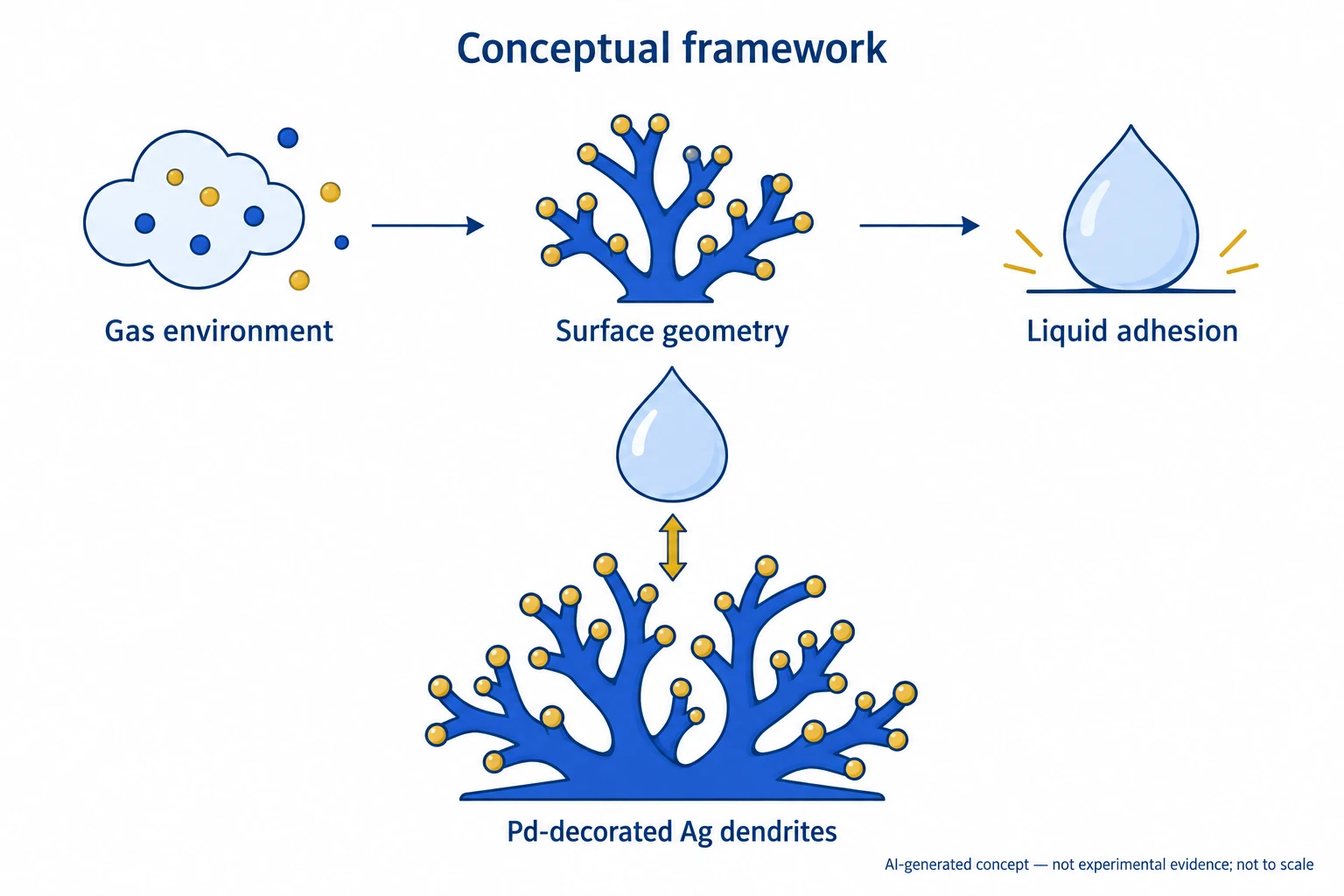
This AI-generated, not-to-scale concept diagram connects gas environment, surface shape and liquid adhesion on palladium-decorated silver dendrites. The studied PFDT treatment and actual coating and particle distribution are omitted. Arrows show the switching concept, not measured results or perfect reversibility.
Generated for this library to illustrate the design; it is not a figure from the paper and does not show measured data.
How it was evaluated
The authors examined dendrite coverage by scanning electron microscopy as a function of Ag deposition time (tAg), contact angles (CAs) and sliding angles of about 7 μL droplets of water, ethylene glycol (EG), olive oil and HD, and droplet motion on tilted surfaces under air and 8% H2. Pd expansion was checked indirectly by electrical resistance and by in situ atomic force microscopy (AFM) under alternating gases. The change in adhesion force (ΔFadh) was derived from critical sliding angles for different Pd deposition times (tPd), and flat Pd and Ag dendrites without Pd served as controls.
Key results
Leaf-textured Ag dendrites were absent at tAg = 5 min and covered more than 73% of the surface after 100 min. The CA of water exceeded 150° already at 5 min and rose to above 160°, while the lower-surface-tension liquids had CAs well below 150° at 5 min and above 150° at tAg of 100 min or more. On surfaces prepared with tAg = 100 min and tPd = 100 min, the sliding angle was below 10° for all four liquids.
On a surface tilted by 1.8°, an EG droplet rolled off in air but was pinned after 30 s of exposure to 8% H2; an HD droplet was pinned under H2 even at 12.47°, and roll-off recovered within 1 min after re-exposure to air. The resistance of the Pd/Ag dendrites was higher under H2 than in air, and in situ AFM showed the leaves shifting under H2 and returning in air. Neither flat Pd nor Ag dendrites without Pd showed this adhesion change.
ΔFadh increased with tPd for all liquids and was larger for liquids of lower surface tension, in the order water, EG, oil and HD; the authors attribute this to the larger increase in contact area for low-surface-tension liquids. HD (27.5 mN/m) showed a larger ΔFadh than water (72.8 mN/m), and with tPd = 100 min the adhesion force of the HD droplet under H2 was 31.8 μN. HD adhesion was switched for 10 cycles between air and 8% H2 with CAs remaining above 150°, and under H2 the surface selectively picked up an HD droplet while leaving water behind.
Open questions
The switching works only within a range of Pd deposition times. With tPd below 40 min, droplets rolled off both before and after H2 exposure, and with tPd above 100 min the surfaces lost reversible switching because oil and HD wetted the agglomerated Pd layer.
Related research
Bioinspired self-repairing slippery surfaces with pressure-stable omniphobicity
Slippery liquid-infused porous surfaces (SLIPS) repel liquids through an infused lubricant layer, whereas the Pd/Ag dendrite surface keeps liquids on trapped air and changes their adhesion actively through hydrogen-induced expansion of Pd.
Abstract-based introductionRESEARCH NEWS
Research in the news
Unverified candidates and access limits (1)
Sources used in this summary
This summary is based on the publisher PDF of the article, including the Experimental Section and figure legends; the Supporting Information and videos were not reviewed, and the text and legends number the Figure 2 and Figure 6 panels differently.