Overview
This review, co-authored by Jungmok Seo of the BLISS Lab at Yonsei University, surveys piezocatalytic antibacterial platforms that convert ultrasound, environmental motion or physiological movement into local electric fields and reactive oxygen species (ROS), and examines how machine learning and closed-loop control are being added to them. It organizes the field by energy input, material design strategy and infection site, and concludes that the absence of standardized ultrasound reporting, ROS detection and piezoelectric characterization limits comparison across studies.
Background
Antimicrobial resistance and biofilm-associated infections reduce the effect of antibiotics, and passive antibacterial materials are limited by short activity, local toxicity and lack of responsiveness. Piezocatalysis offers an antibiotic-independent route, but the authors note that first-generation systems rely on a single energy input, material design is largely empirical, and earlier reviews lacked a framework for moving from responsive materials to adaptive, intelligent systems.
How the review is organized
The review first explains three theoretical frameworks for piezocatalysis (energy band theory, electrocatalysis-like theory and the screened charge effect) and the antibacterial actions that follow: ROS-induced oxidative stress, physical disruption and electric-field effects on membrane potential, electron transport and ATP synthesis. It defines self-powered, adaptive, smart and intelligent systems as increasing levels of complexity, with intelligent systems incorporating machine learning and closed-loop control. The design framework is then divided into mechanical energy input, rational material design and system-level integration.
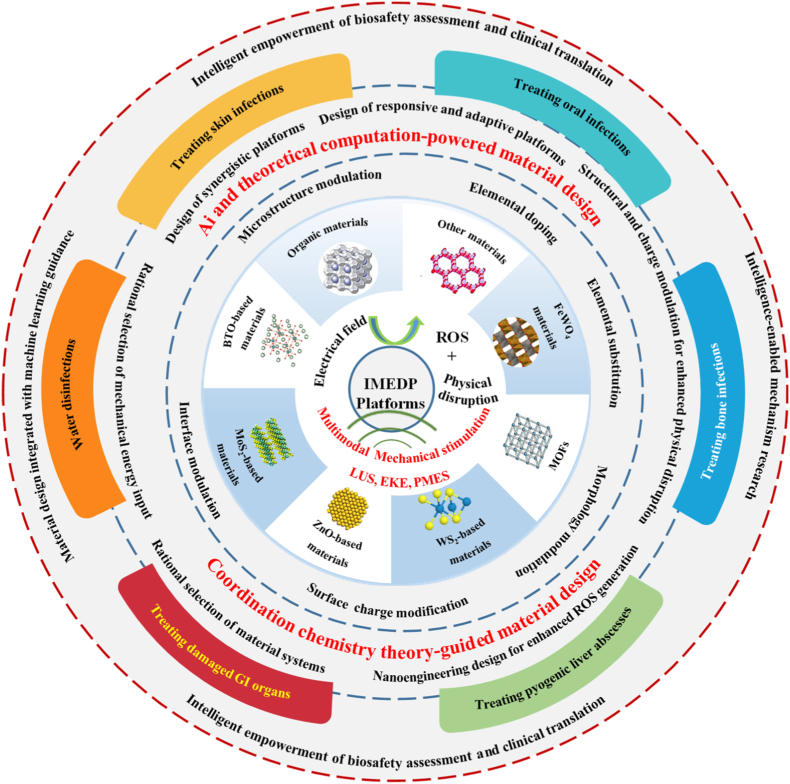
Review overview linking materials, operating principles and applications of multimodal-energy-driven piezoelectric antibacterial platforms.
Jiaqi Liu, Jun Li, Huiyan Sun et al. “Intelligent multimodal-energy-driven piezoelectric antibacterial platforms: From structural control to system-level diagnosis”. Scheme 1. DOI: 10.1016/j.mtbio.2026.103299. CC BY 4.0. Figure content is unchanged.
Source figure and caption ↗ · DOI: 10.1016/j.mtbio.2026.103299 ↗ · CC BY 4.0 ↗
Scope of the review
Energy inputs are classified as external mechanical energy (mainly low-intensity ultrasound), environmental kinetic energy and endogenous physiological mechanical energy, which is characterized by ultra-low frequency (<10 Hz). Materials are grouped as inorganic, organic and organic-inorganic hybrid piezoelectrics, and Table 3 compiles optimization method, d33 or related metric, stimulation conditions, ROS species and reported antibacterial efficacy for each example. Design strategies covered include bandgap engineering, doping, heterojunctions, oxygen vacancies, morphology and surface charge, together with pH-, hypoxia- and ROS-responsive systems and combinations of sonodynamic therapy with drugs, gases, photothermal or photodynamic therapy, cascade enzymes, macrophages and targeting. Applications are reviewed for skin, bone, oral, pyogenic liver abscess and gastrointestinal perforation infections (Table 5).
Main points of the review
On material discovery, the review summarizes data-driven studies combining density functional theory and machine learning. Examples include prediction of piezoelectric coefficients for 12,680 materials with identification of 20 high-performance candidates, identification of over 140 MXenes with e31 > 3 × 10^-10 C/m (support vector regression R2 = 0.89), and synthesis of a BaTiO3-based ceramic of about 430 pC/N within two iterative cycles from nearly nine million candidate compositions. Table 4 compiles d33 gains from defect and interface engineering, such as 35.9 to 129.22 pm/V for a BiOI/Ti3C2 heterointerface and 5.6 to 35.1 pC/N for MoS2 with sulfur vacancies and boron doping, with the caveat that measurement conditions differ between studies.
On system integration, the review presents examples that sense the infection microenvironment and trigger treatment. In one cited closed-loop patch, hyaluronidase secreted by colonizing bacteria degraded a hydrogel, and when electrode capacitance fell to 20% of its initial value the patch released sonosensitizing nanodots for ultrasound treatment, giving about 90% wound closure within 12 days in a murine model. The authors also note that, despite the use of DFT and machine learning in materials science, systematic application of machine learning to antibacterial piezoelectric materials has not yet been reported.
As translational requirements, the review lists hemolysis below 5%, assessment of IL-6 and TNF-α, 6- to 12-month repeated-dose toxicity studies in rodent and non-rodent models, and attention to biodistribution and clearance of non-degradable materials such as barium titanate. It proposes a minimum reporting standard for ultrasound therapy (frequency, intensity, duty cycle, treatment duration and waveform) and a standard operating procedure for ex vivo ROS quantification in infected tissue.
Open questions
The authors identify an unclear understanding of in vivo bio-effects of piezocatalysis, a lack of standardized ROS detection and piezoelectric characterization, variable ultrasound parameters, animal models (acute subcutaneous or superficial wound infection) that differ from chronic biofilm and implant-related infections, unknown long-term in vivo fate beyond 6 months, poor batch-to-batch consistency and the absence of GMP-compliant production as remaining obstacles.
Related research
Heterostructured piezocatalytic nanoparticles with enhanced ultrasound response for efficient repair of infectious bone defects
DOI: 10.1016/j.actbio.2023.10.006 ↗
Ultrasound-responsive Se@BTO offers an experimental example connecting charge separation with repair of infected bone.
Abstract-based introductionSources used in this summary
This summary is based on the full text of the open-access review (PMC13253188), including its tables and figure legends; quantitative examples are reported as the review summarizes them, and the cited primary studies were not checked.