Why this research matters
This gas-separation study physically confines and seals ZIF-8 membranes to control nonselective transport pathways. It examines how confinement, liquid sealing and surface fluorination separately affect hydrogen selectivity.
What the study did
The study combines GNR confinement and PFPE sealing to control nonselective paths through a ZIF-8 gas-separation membrane.
Confinement, sealing and surface fluorination play different roles in adjusting selectivity for different gas pairs.
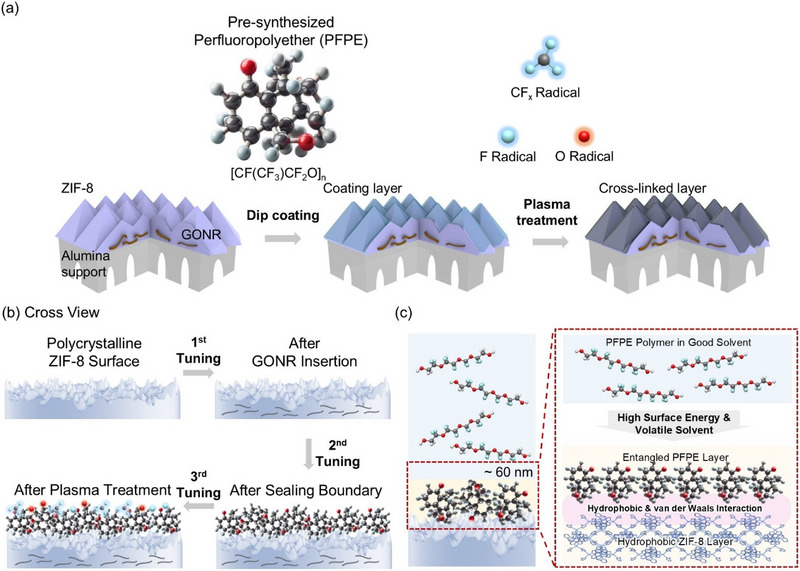
Overview of ZIF gas-separation membrane design using GONR layers, PFPE sealing and plasma treatment; not evidence of biological performance.
Eunji Choi, Seungho Yu, Taehwan Kim et al. “Gas‐Specific and Tunable Hydrogen‐Selective ZIF Membrane through Combined Physical Confinement and Sealing Techniques”. Figure 1. DOI: 10.1002/smll.202501590. CC BY-NC-ND 4.0. Figure content is unchanged.
Source figure and caption ↗ · DOI: 10.1002/smll.202501590 ↗ · CC BY-NC-ND 4.0 ↗
Noncommercial academic use with attribution and the license link; keep the original figure unchanged. Cropping, translation overlays and annotations are not included.
What remains to be answered
Selected gas mixtures were tested at 25 °C and 1 bar. An open question is whether the balance between selectivity and permeance persists under humidity, changing pressure and prolonged operation.
What to compare
Separate pure-gas and mixed-gas results, and match the gas pair, pressure, temperature, membrane thickness and support.
Related research
A MOF Glass Membrane for Gas Separation
The external abstract reports eliminating intercrystalline-defect formation by vitrifying ZIF-62. This study instead confines and seals a crystalline membrane.
Framework, phase, support and gas pairs differ, so separation factors alone cannot establish which approach is better.
Abstract-based introductionRESEARCH NEWS
Research in the news
Sources used in this summary
The scientific text of the archived official article XML and Figure 1 were reviewed. Original Figures 2–5 and the contents of the supporting information remain unreviewed. This is gas-separation research and does not establish biological or bioelectronic performance.