Research context and placement
Foundational liquid-repellency review; superamphiphobicity alone does not prove antifouling or immune-response benefits.
Boundary case: assigned to the closest interface for navigation. Read the rationale and cross-links together; the primary theme does not delimit the study. Placement of foundational work does not establish direct bioelectronic application.
Balancing transparency and repellency
A transparent repellent coating cannot be designed by adding roughness alone. Texture can help retain air beneath liquid, but it also affects light scattering. Bending or stretching adds another requirement: the wetting state must survive deformation. This 2018 review examines the resulting constraints on combining repellency, transparency and flexibility.
Three fabrication routes
The three routes address different design choices. Pattern transfer controls texture through molding or replication. Nanoparticle assembly builds rough coatings across different substrates. Thiol–ene functionalization changes surface chemistry and can define regions with different wetting behavior. The useful comparison therefore depends on whether geometry, substrate coverage or chemical patterning is the priority.
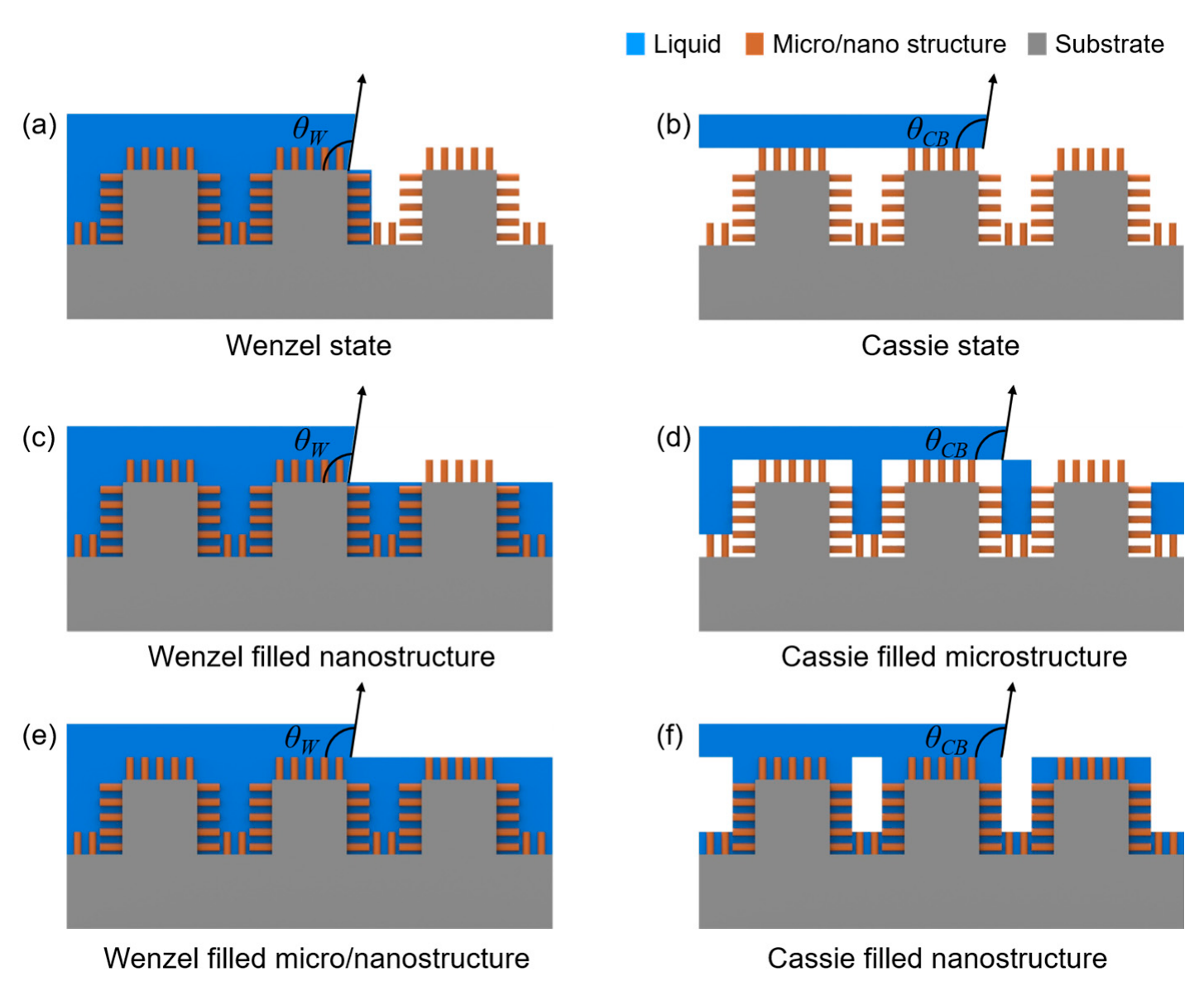
Review schematic comparing six wetting states on hierarchical micro- and nanostructures.
Bichitra Sahoo, Kukro Yoon, Jungmok Seo and Taeyoon Lee (2018). “Chemical and Physical Pathways for Fabricating Flexible Superamphiphobic Surfaces with High Transparency”. Figure 2. DOI: 10.3390/coatings8020047. CC BY 4.0. Rasterized from the PDF at 300 dpi and cropped to the complete figure; figure content is unchanged.
Source figure and caption ↗ · DOI: 10.3390/coatings8020047 ↗ · CC BY 4.0 ↗
Wetting, optics and durability
A high static contact angle does not by itself show that liquid moves readily. Hysteresis and sliding angle help assess retention. Transmission needs its wavelength and substrate context, while durability depends on load, cycle count and abrasion method. Reading these measures together makes tradeoffs visible rather than allowing one favorable metric to stand for overall performance.
Geometry control and substrate coverage
The authors distinguish geometry control in pattern transfer from the substrate versatility of nanoparticle assembly. They also identify gaps in joint optical and mechanical characterization. These are conclusions drawn across reported studies, not results from testing every route in one standardized experiment or identifying a universal optimum.
Standardization and material choices
A central concern in the 2018 review is inconsistent durability evaluation and reporting. Adhesion, bending, abrasion and washing become relevant under different intended uses. Fluorinated-material cost and environmental burden add material-selection constraints. These historical observations are not a current regulatory assessment or a basis for ranking original studies with unmatched test conditions.
Related external research
Designing superoleophobic surfaces
DOI: 10.1126/science.1148326 ↗
Re-entrant curvature, chemistry and roughness provide a specific foundation for low-surface-tension liquid repellency.
PubMed abstract read. It does not establish simultaneous transparency, flexibility and abrasion durability.
Abstract checkedCorresponding-author verification
Jungmok Seo: corresponding authorThis record concerns Jungmok Seo’s correspondence designation. Author order or an asterisk alone is not treated as confirmation; this check is separate from verification of the research content.
- Correspondence evidence source ↗
Correspondence: [omitted] (J.S.); [omitted] (T.L.)
PDF p.1; author/correspondence information · publisher_PDF_publicly_hosted_by_author_institution
- Main-text review scope
- Institution-hosted publisher PDF p.1–26 read: Introduction, wetting models/transitions, all three fabrication-route sections, Applications, Recommendations, Conclusions and figure captions. Table 1 was read. Individual references p.26–32 and original-study data were not independently validated.
- Supplementary review scope
- No separate SI was identified in the reviewed main document; no SI is claimed as read. This does not establish that no separate SI exists.
- Pending verification
- Individual references and original-study data were not independently validated. No separate SI was identified in the reviewed main document; neither an SI read nor its absence is established. The review does not establish performance rankings, current regulation or present commercial readiness.
COVERAGE & OUTREACH
Coverage and outreach
Links are checked for their relationship to this paper. Media publication does not establish independent reporting or additional experimental validation.
No related outreach link was verified against its body within these searches. This does not establish that none exists.
Channel coverage and search log for all 101 records →Sources and verification scope
Institution-hosted publisher PDF p.1–26 read: Introduction, wetting models/transitions, all three fabrication-route sections, Applications, Recommendations, Conclusions and figure captions. Table 1 was read. Individual references p.26–32 and original-study data were not independently validated.
The additional commentary is editorially approved within the stated evidence scope. This does not imply complete verification of all main-text and supplementary material.
- Additional main-text review scope
- Institution-hosted publisher PDF p.1–26 read: Introduction, wetting models/transitions, all three fabrication-route sections, Applications, Recommendations, Conclusions and figure captions. Table 1 was read. Individual references p.26–32 and original-study data were not independently validated.
- Additional supplementary review scope
- No separate SI was identified in the reviewed main document; no SI is claimed as read. This does not establish that no separate SI exists.
- Public publication baseline ↗ · #42 · 2026-10-03
- Crossref metadata ↗: Only public bibliographic metadata registered with Crossref was checked. This does not mean that the publisher page, abstract, or full text was read; full-text verification in the school Chrome session remains pending. The titles differ after normalization and require manual review. The original title was not changed. The original adds and its recent developments and uses for the fabrication of rather than for Fabricating. The altered title requires review. license_urls lists registered links and does not establish permission to redistribute text or figures. It may include TDM or posting-policy links.
- Crossref record supplied by publisher ↗
publisher_registered_abstract_via_Crossref · message.abstract; read 2026-10-03; not direct publisher full text - Public access attempt ↗
access_attempt_failed · HTTP 429 Too Many Requests; checked 2026-10-03; no paper content inferred - Chemical and Physical Pathways for Fabricating Flexible Superamphiphobic Surfaces with High Transparency ↗
main_text · Introduction end; roughness/transparency challenge - Chemical and Physical Pathways for Fabricating Flexible Superamphiphobic Surfaces with High Transparency ↗
main_text · Section 2 opening, fabrication design tradeoff - Chemical and Physical Pathways for Fabricating Flexible Superamphiphobic Surfaces with High Transparency ↗
main_text · Section 2 route overview p.6; pattern-transfer examples p.6–17; nanoparticle assembly p.17–20; thiol–ene functionalization and wetting patterning p.21–23 - Chemical and Physical Pathways for Fabricating Flexible Superamphiphobic Surfaces with High Transparency ↗
review body; explanation of why static angle alone is insufficient is grounded in sections 1.1–1.2 · Section 1.1, contact-angle hysteresis - Chemical and Physical Pathways for Fabricating Flexible Superamphiphobic Surfaces with High Transparency ↗
main_text · Table 1: CA/CAH and transmission columns - Chemical and Physical Pathways for Fabricating Flexible Superamphiphobic Surfaces with High Transparency ↗
main_text · Wavelength-dependent transmission and wetting comparisons in section 2.1.4 - Chemical and Physical Pathways for Fabricating Flexible Superamphiphobic Surfaces with High Transparency ↗
review recommendations; comparison framing is editorial · Section 4: application-dependent durability tests - Chemical and Physical Pathways for Fabricating Flexible Superamphiphobic Surfaces with High Transparency ↗
main_text · Section 4 p.24–25: geometry control and substrate applicability; Section 5 p.25–26: gaps in flexibility/wear characterization - Chemical and Physical Pathways for Fabricating Flexible Superamphiphobic Surfaces with High Transparency ↗
review synthesis, not new experimental validation · Section 5 synthesis of the three fabrication routes - Chemical and Physical Pathways for Fabricating Flexible Superamphiphobic Surfaces with High Transparency ↗
main_text · Section 4: lack of unified reporting and durability procedures - Chemical and Physical Pathways for Fabricating Flexible Superamphiphobic Surfaces with High Transparency ↗
2018 review position; not a current regulatory determination · Section 4: fluorocarbon cost/environment discussion - Chemical and Physical Pathways for Fabricating Flexible Superamphiphobic Surfaces with High Transparency ↗
independent_reviewer_selected_main_text · PDF pp.3,5–6,13,22–26: wetting, fabrication, thiol–ene patterning, recommendations and conclusions. Underlying primary experiments not audited. - Additional commentary source ↗
Research background · Introduction end; roughness/transparency challenge · main_text - Additional commentary source ↗
Research background · Section 2 opening, fabrication design tradeoff · main_text - Additional commentary source ↗
Approach and advances · Section 2 route overview p.6; pattern-transfer examples p.6–17; nanoparticle assembly p.17–20; thiol–ene functionalization and wetting patterning p.21–23 · main_text - Additional commentary source ↗
Evaluation and conditions · Section 1.1, contact-angle hysteresis · review body; explanation of why static angle alone is insufficient is grounded in sections 1.1–1.2 - Additional commentary source ↗
Evaluation and conditions · Table 1: CA/CAH and transmission columns · main_text - Additional commentary source ↗
Evaluation and conditions · Wavelength-dependent transmission and wetting comparisons in section 2.1.4 · main_text - Additional commentary source ↗
Evaluation and conditions · Section 4: application-dependent durability tests · review recommendations; comparison framing is editorial - Additional commentary source ↗
Key findings · Section 4 p.24–25: geometry control and substrate applicability; Section 5 p.25–26: gaps in flexibility/wear characterization · main_text - Additional commentary source ↗
Key findings · Section 5 synthesis of the three fabrication routes · review synthesis, not new experimental validation - Additional commentary source ↗
Limits and open questions · Section 4: lack of unified reporting and durability procedures · main_text - Additional commentary source ↗
Limits and open questions · Section 4: fluorocarbon cost/environment discussion · 2018 review position; not a current regulatory determination - Additional commentary source ↗
Connections to related work · Existing verified PubMed abstract for Designing superoleophobic surfaces · abstract_only; no original full-text benchmark - Additional commentary source ↗
Connections to related work · Re-entrant geometry and discussion of different fabrication-route capabilities · main_text