Research context and placement
A lubricated interface on orthopedic fixation hardware is evaluated for bacterial attachment, infection-related inflammation and bone healing. Device-surface biological responses place it within host interaction.
Fouling and surface damage on orthopedic fixation devices
Orthopedic fixation devices experience handling damage. LOIS evaluates antifouling under these mechanical conditions. Initial repellency may change when fixation hardware is handled or deformed. The study therefore carries the surface question into mechanical handling and a contaminated implantation model.
Approach and advances
Micro/nanostructures retain lubricant. Comparison with air-supported superhydrophobic surfaces examines interface maintenance after damage. Low attachment at the liquid interface works together with the supporting structure. Unlike a bactericidal drug, the design targets establishment of material on the surface; infection-related claims must be read through that mechanism and the tested model.
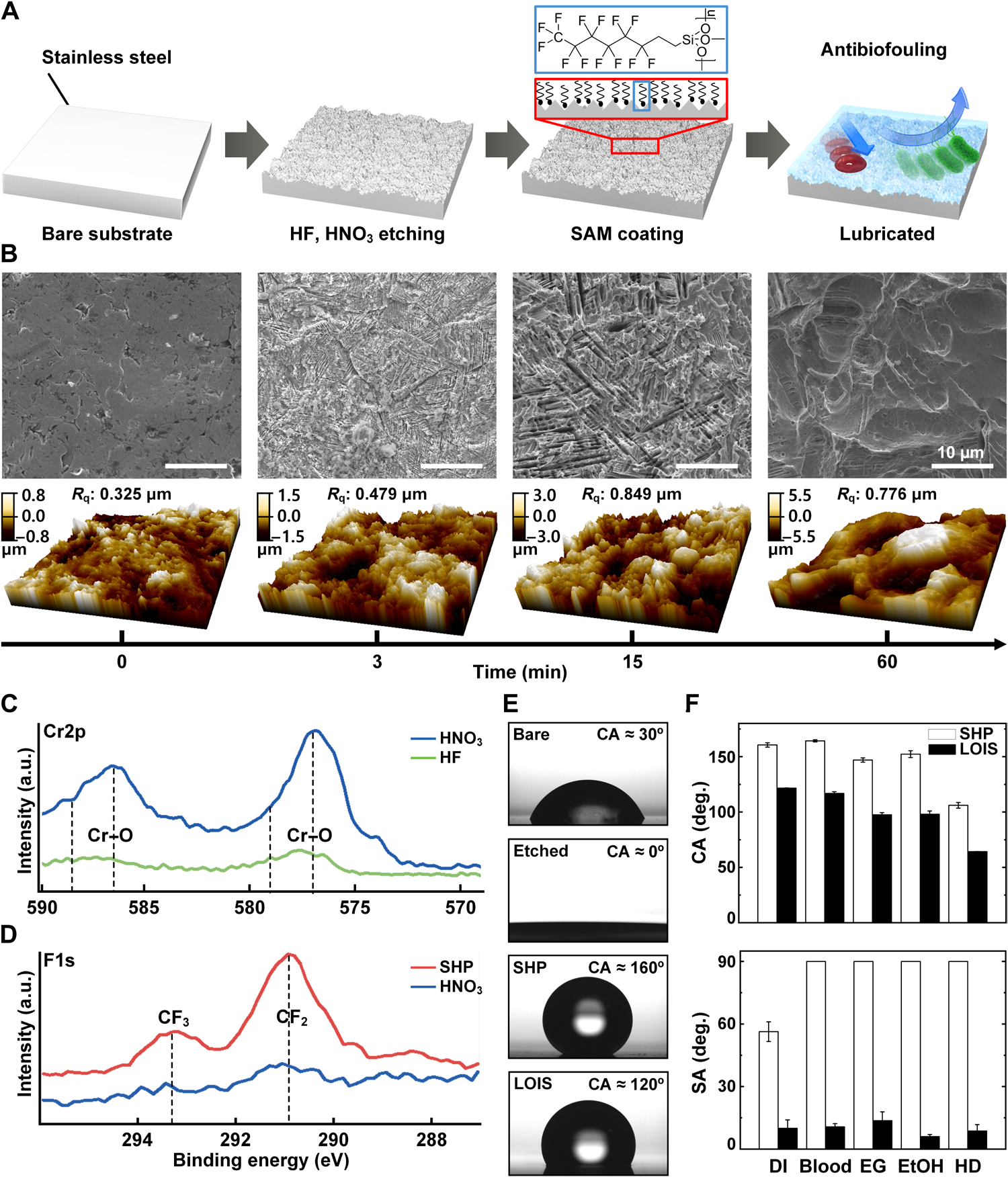
Original paper figure showing LOIS surface-treatment stages, microstructure, surface chemistry and wetting characterization. A presents fabrication, B SEM/AFM observations, C–D XPS analyses, and E–F droplet observations and contact/sliding-angle comparisons.
Kyomin Chae, Woo Young Jang, Kijun Park et al. “Antibacterial infection and immune-evasive coating for orthopedic implants”. Figure 2. DOI: 10.1126/sciadv.abb0025. © 2020 The Authors. CC BY-NC 4.0. Source: NLM/PMC Article Datasets. The PDF image object was extracted to PNG without changing dimensions, panels or labels.
Source figure and caption ↗ · DOI: 10.1126/sciadv.abb0025 ↗ · CC BY-NC 4.0 ↗
Noncommercial academic use requires author/source attribution, the license link and disclosure of changes.
Evaluation and conditions
Precontaminated fixation implants were compared with contaminated bare/superhydrophobic surfaces in rabbit fractures. Sterile bare implants provide a separate noninfected-healing reference. Histology examines infection-associated damage, while imaging/callus analysis examines fracture repair. A noninfected reference is needed alongside contaminated controls to address whether the coating interferes with healing.
Key findings
Contaminated bare implants showed abscess/necrosis and limited callus, whereas LOIS showed less infection-related pathology and callus formation. This links antifouling with model-specific healing, not direct bacterial killing. Bone observations test whether the surface strategy remains relevant on implanted fixation hardware. More callus or reduced inflammation in this setting should not be converted into universal superiority in osseointegration.
Limits and open questions
Preimplant contamination does not represent every infection route. Postimplant infection and selective osteogenic-cell attachment remain future questions. Preimplant surface contamination differs from infection arriving by another route after surgery. The balance between broadly suppressing attachment and permitting desirable bone-cell contact also requires separate validation.
Related external research
Bioinspired self-repairing slippery surfaces with pressure-stable omniphobicity
Distinguish SLIPS repellency from LOIS implant-infection and host-response endpoints.
Liquid-repellency tests cannot substitute for implant infection or bone-integration evidence. External full text was not read; no clinical ranking is claimed.
Abstract checkedCorresponding-author verification
Jungmok Seo: corresponding authorThis record concerns Jungmok Seo’s correspondence designation. Author order or an asterisk alone is not treated as confirmation; this check is separate from verification of the research content.
- Correspondence evidence source ↗
Corresponding author. Email: [email] (J.S.); [email] (S.H.L.)
contrib/xref[@ref-type="corresp"] → cor1; author-notes · public_repository_xml_author_and_correspondence_read
- Main-text review scope
- Public PMC body: Results, Figures 3–6; Discussion including future infection model/osteogenic-cell work; Materials and Methods. Additional targeted main-text reading in this pass: Results, paragraphs accompanying Figs. 5C–G and 6B–F; preincubation model and bare-negative/positive controls. Bone observations are summarized qualitatively; inconsistent bare-positive/negative wording in late source sentences is not adopted. This additional reading refers to main text, not supplementary information.
- Supplementary review scope
- Supplementary information was not read. No supplementary material is listed as reviewed, and a complete SI audit is not claimed.
- Pending verification
- SI was not read, and direct comparison with the current publisher version remains pending. Lubricant-retention quantities, animal-allocation details and postimplant-infection outcomes require further verification.
COVERAGE & OUTREACH
Coverage and outreach
Links are checked for their relationship to this paper. Media publication does not establish independent reporting or additional experimental validation.
임플란트 세균 감염 줄이는 코팅 기술 개발 ↗
The Seo/Jang team, lubricant coating, rabbit implantation and Science Advances identify #57's orthopedic-implant study.
Body read Read the public HTML body and October 29, 03:00 publication information. This is announcement-based coverage; its general dental framing is not clinical validation of the orthopedic study.
BLISS 채교민 & 박기준 학생 삽입형 소재의 수술 후 감염 억제를 위한 고기능성 표면 개질 기술 연구 Science Advances 게재 승인 ↗
The public announcement names Chae/Park, Science Advances and implant-surface modification against postoperative infection, matching #57.
Partial body read Read the public JSON entry's title and date (entry: lois-2). The additional image was not read. This is a lab announcement, distinct from publisher confirmation.
Device–tissue interfaces: prior studies, ELFS biliary stents and FLUID ureteral stents ↗
The post describes prior work on infection and immune responses around orthopedic implants. DOI 10.1126/sciadv.abb0025, documented as the destination of the in-body shortened link, matches the title and DOI of #57 in the public 101-paper catalogue.
Body read Based on a verification record documenting the post body, “Worldwide” visibility and DOI destinations of six shortened links in a logged-in session. The publication date was determined from the “4 hours” display observed at 22:37 KST on 2026-10-03; the exact publication time remains unverified. DOI destinations were checked on LinkedIn’s external-link notice screens; this does not represent a new review of publisher full text. This is researcher-authored promotion, not independent reporting or additional experimental validation.
Sources and verification scope
Public PMC body: Results, Figures 3–6; Discussion including future infection model/osteogenic-cell work; Materials and Methods. Additional targeted main-text reading in this pass: Results, paragraphs accompanying Figs. 5C–G and 6B–F; preincubation model and bare-negative/positive controls. Bone observations are summarized qualitatively; inconsistent bare-positive/negative wording in late source sentences is not adopted. This additional reading refers to main text, not supplementary information.
The additional commentary is editorially approved within the stated evidence scope. This does not imply complete verification of all main-text and supplementary material.
- Additional main-text review scope
- Public PMC body: Results, Figures 3–6; Discussion including future infection model/osteogenic-cell work; Materials and Methods. Additional targeted main-text reading in this pass: Results, paragraphs accompanying Figs. 5C–G and 6B–F; preincubation model and bare-negative/positive controls. Bone observations are summarized qualitatively; inconsistent bare-positive/negative wording in late source sentences is not adopted. This additional reading refers to main text, not supplementary information.
- Additional supplementary review scope
- Supplementary information was not read. No supplementary material is listed as reviewed, and a complete SI audit is not claimed.
- Public publication baseline ↗ · #57 · 2026-10-03
- Crossref metadata ↗: Only public bibliographic metadata registered with Crossref was checked. This does not mean that the publisher page, abstract, or full text was read; full-text verification in the school Chrome session remains pending. license_urls lists registered links and does not establish permission to redistribute text or figures. It may include TDM or posting-policy links.
- Antibacterial infection and immune-evasive coating for orthopedic implants ↗
public_web_full_text · Results and Figs. 3-6: biofouling, mechanical robustness and rabbit bone healing; Discussion, especially final paragraph on future infection model and osteoinduction; Materials and Methods. DOI 10.1126/sciadv.abb0025. Checked 2026-10-03. - Antibacterial infection and immune-evasive coating for orthopedic implants ↗
public_repository_full_text · Results, paragraphs accompanying Figs. 5C–G and 6B–F; preincubation model and bare-negative/positive controls. Bone observations are summarized qualitatively; inconsistent bare-positive/negative wording in late source sentences is not adopted. - Antibacterial infection and immune-evasive coating for orthopedic implants ↗
independent_reviewer_selected_main_text · Results selected preincubation, Fig.5 infection and Fig.6 callus paragraphs; Discussion future models. - Additional commentary source ↗
Research background · Results and Figs. 3-6: biofouling, mechanical robustness and rabbit bone healing; Discussion, especially final paragraph on future infection model and osteoinduction; Materials and Methods. DOI 10.1126/sciadv.abb0025. Checked 2026-10-03. · public_web_full_text - Additional commentary source ↗
Approach and advances · Results and Figs. 3-6: biofouling, mechanical robustness and rabbit bone healing; Discussion, especially final paragraph on future infection model and osteoinduction; Materials and Methods. DOI 10.1126/sciadv.abb0025. Checked 2026-10-03. · public_web_full_text - Additional commentary source ↗
Limits and open questions · Results and Figs. 3-6: biofouling, mechanical robustness and rabbit bone healing; Discussion, especially final paragraph on future infection model and osteoinduction; Materials and Methods. DOI 10.1126/sciadv.abb0025. Checked 2026-10-03. · public_web_full_text - Additional commentary source ↗
Connections to related work · Bioinspired self-repairing slippery surfaces with pressure-stable omniphobicity; DOI 10.1038/nature10447; previously verified abstract · abstract - Additional commentary source ↗
Evaluation and conditions · Results, paragraphs accompanying Figs. 5C–G and 6B–F; preincubation model and bare-negative/positive controls. Bone observations are summarized qualitatively; inconsistent bare-positive/negative wording in late source sentences is not adopted. · public_repository_full_text - Additional commentary source ↗
Key findings · Results, paragraphs accompanying Figs. 5C–G and 6B–F; preincubation model and bare-negative/positive controls. Bone observations are summarized qualitatively; inconsistent bare-positive/negative wording in late source sentences is not adopted. · public_repository_full_text