Research context and placement
The medical interface centers on reduced biological fouling and friction. Industrial demolding is also included and is not itself evidence of host response.
Research background
Lubricated surfaces can be disrupted by abrasion and bending. This work separates an adsorbed base from a mobile lubricant layer. Retaining the coating and redistributing liquid after disturbance are connected but different functions.
Approach and advances
Lower-molecular-weight PFPE adsorbs after solvent evaporation, forming the base surface. Higher-molecular-weight PFPE supplies a compatible mobile liquid layer. Recovery therefore involves interfacial redistribution rather than rebuilding a cured solid network.
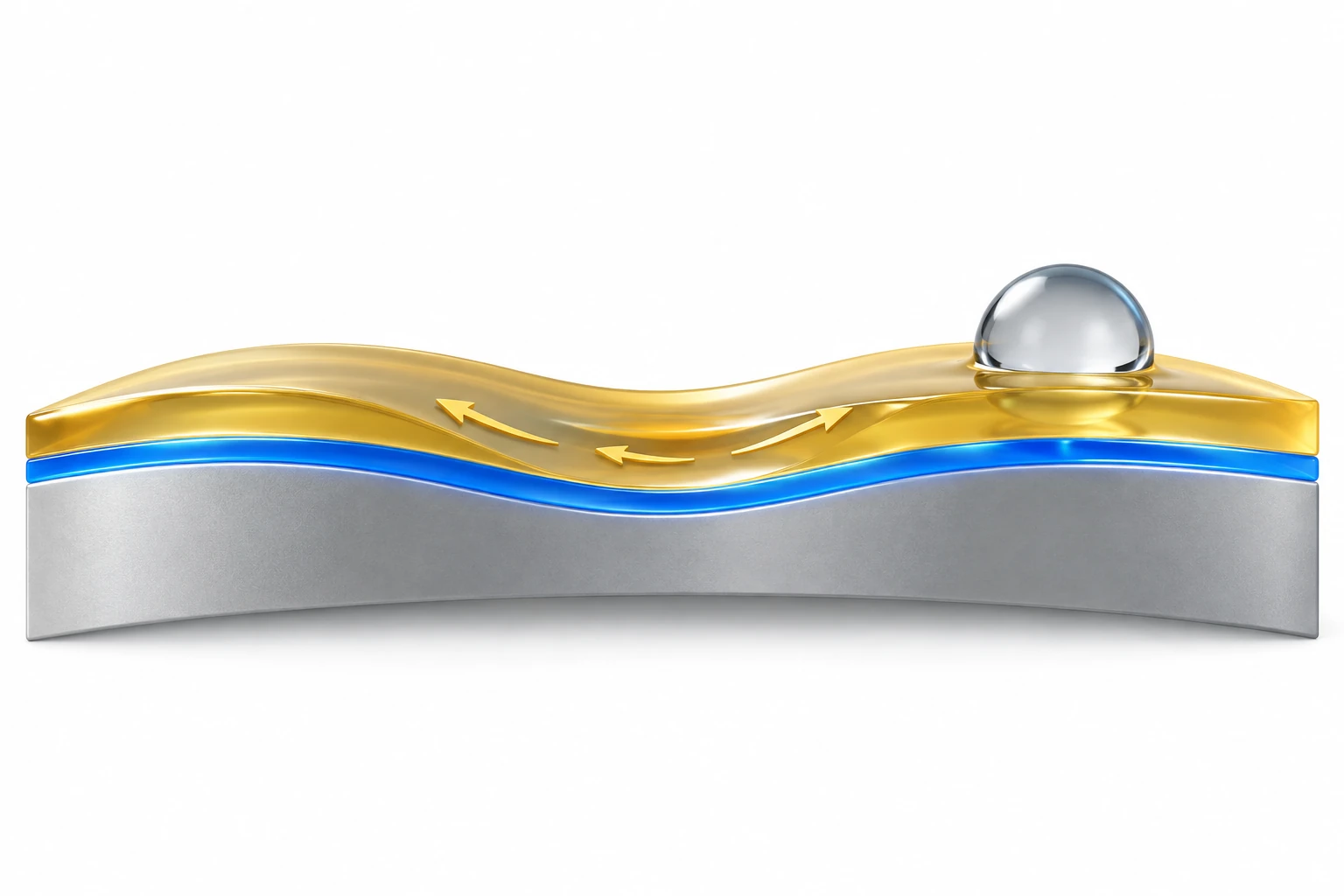
AI-generated concept separating SLIME’s lower-molecular-weight adsorbed PFPE base and higher-molecular-weight mobile lubricant. Arrows indicate possible motion of remaining liquid, not solid-crack healing or a measured recovery-flow field.
Gold distinguishes liquid, not a metal film. Thickness, molecular arrangement, arrow direction/speed and droplet contact angle are not reproduced. The image does not imply regeneration after lubricant loss or maintenance-free lifetime.
This is not a reproduced paper figure and does not establish permission to reuse the original figure.
Generated in ChatGPT on the web from concepts in a public paper and checked for conceptual consistency within the selected main-text reading and stated independent-review scope. This does not claim a complete main-text or supplement audit. Display processing is limited to WebP encoding, without cropping or content editing.
Evaluation and conditions
Chemistry, thickness, roughness and transparency characterize the initial coating. Abrasion and deformation tests examine subsequent interface function. Fouling assays are then needed to connect surface formation with the intended biological outcome.
Key findings
After swab abrasion, droplets continued rolling without pinning on SLIME, whereas the main text reports pinning on the SAM comparator. This connects retained function to redistribution of mobile PFPE. The main-text description was checked, not a complete SI audit; it does not imply unlimited regeneration after lubricant loss.
Limits and open questions
Follow-up comparisons need matched damage severity and recovery time, alongside lubricant retention under flow. Substrate and geometry may also matter. The inspected biocompatibility tests do not establish long-term implantation safety.
Related external research
Bioinspired self-repairing slippery surfaces with pressure-stable omniphobicity
Compare lubricant-retaining SLIPS with SLIME adsorption.
The external paper was read at abstract level. Pressure stability and SLIME abrasion durability are different endpoints.
Abstract checkedCorresponding-author verification
Jungmok Seo: corresponding authorThis record concerns Jungmok Seo’s correspondence designation. Author order or an asterisk alone is not treated as confirmation; this check is separate from verification of the research content.
- Correspondence evidence source ↗
Corresponding Author — Jungmok Seo
Author information: Jungmok Seo block · public_publisher_author_information_read
- Main-text review scope
- Read the public Wiley text on fabrication, surface performance, damage tests and biocompatibility. Supplementary files and long-term implantation require separate review.
- Supplementary review scope
- Supporting information was not comprehensively read. A main-text citation to supplementary results does not count as direct inspection of those results.
- Pending verification
- Check supplementary cleaning, lubricant-loss conditions and prolonged-exposure evidence during school Chrome DOI verification.
COVERAGE & OUTREACH
Coverage and outreach
Links are checked for their relationship to this paper. Media publication does not establish independent reporting or additional experimental validation.
No related outreach link was verified against its body within these searches. This does not establish that none exists.
Channel coverage and search log for all 101 records →Sources and verification scope
Read the public Wiley text on fabrication, surface performance, damage tests and biocompatibility. Supplementary files and long-term implantation require separate review.
The additional commentary is editorially approved within the stated evidence scope. This does not imply complete verification of all main-text and supplementary material.
- Additional main-text review scope
- Read the public Wiley text on fabrication, surface performance, damage tests and biocompatibility. Supplementary files and long-term implantation require separate review.
- Additional supplementary review scope
- Supporting information was not comprehensively read. A main-text citation to supplementary results does not count as direct inspection of those results.
- Public publication baseline ↗ · #83 · 2026-10-03
- Crossref metadata ↗: Only public bibliographic metadata registered with Crossref was checked. This does not mean that the publisher page, abstract, or full text was read; full-text verification in the school Chrome session remains pending. license_urls lists registered links and does not establish permission to redistribute text or figures. It may include TDM or posting-policy links.
- Rapid and Scalable Lubrication Coating for Industrial and Medical Applications via Sequential Dip-Coating ↗
public_web_full_text · Sections 2.1–2.3, 2.5 and Conclusion - Rapid and Scalable Lubrication Coating for Industrial and Medical Applications via Sequential Dip‐Coating ↗
public_publisher_selected_full_text_read · §2.1 Fabrication/design; Conclusion - Rapid and Scalable Lubrication Coating for Industrial and Medical Applications via Sequential Dip‐Coating ↗
public_publisher_selected_full_text_read · §2.1: low-molecular-weight PFPE adsorption and high-molecular-weight mobile lubricant - Rapid and Scalable Lubrication Coating for Industrial and Medical Applications via Sequential Dip‐Coating ↗
public_publisher_selected_full_text_read · §2.1–2.3: surface characterization and damage tests; §2.5 biocompatibility - Rapid and Scalable Lubrication Coating for Industrial and Medical Applications via Sequential Dip‐Coating ↗
public_publisher_selected_full_text_read · §2.3 first three paragraphs; Fig. 3A and main-text description of SAM comparison referencing Fig. S3; supplementary figure itself not independently audited - Rapid and Scalable Lubrication Coating for Industrial and Medical Applications via Sequential Dip‐Coating ↗
public_publisher_selected_full_text_read · §2.3; §2.5; Conclusion; editorial durability and implant-safety questions - Rapid and Scalable Lubrication Coating for Industrial and Medical Applications via Sequential Dip‐Coating ↗
independent_reviewer_selected_main_text · Public Wiley §2.1 adsorption/mobile-PFPE roles, §2.2 fouling, §2.3 abrasion/rolling passages; main-text account of SI only - Additional commentary source ↗
Research background · §2.1 Fabrication/design; Conclusion · public_publisher_selected_full_text_read - Additional commentary source ↗
Approach and advances · §2.1: low-molecular-weight PFPE adsorption and high-molecular-weight mobile lubricant · public_publisher_selected_full_text_read - Additional commentary source ↗
Evaluation and conditions · §2.1–2.3: surface characterization and damage tests; §2.5 biocompatibility · public_publisher_selected_full_text_read - Additional commentary source ↗
Key findings · §2.3 first three paragraphs; Fig. 3A and main-text description of SAM comparison referencing Fig. S3; supplementary figure itself not independently audited · public_publisher_selected_full_text_read - Additional commentary source ↗
Limits and open questions · §2.3; §2.5; Conclusion; editorial durability and implant-safety questions · public_publisher_selected_full_text_read - Additional commentary source ↗
Connections to related work · §2.1 coating-retention mechanism; external abstract · public_publisher_selected_full_text_read - Additional commentary source ↗
Connections to related work · Bioinspired self-repairing slippery surfaces with pressure-stable omniphobicity; DOI 10.1038/nature10447; previously verified Abstract · public_external_abstract_read