Overview
This study converts a commercial multifilament polyurethane-based fiber into a strain sensor by growing Ag nanoparticles inside it, and was carried out by researchers at the School of Electrical and Electronic Engineering, Yonsei University, and co-authored by Jungmok Seo (then at the Korea Institute of Science and Technology, KIST), who now leads the BLISS Lab at Yonsei University. The fiber reached gauge factors of about 9.3 × 10^5 and 659 with sensing ranges of 450% and 200% in the first and subsequent stretching, respectively, and was used in a glove that controlled a hand robot and on a pig bladder in an artificial bladder system.
Background
Fiber strain sensors can be sewn into textiles or wrapped onto curved objects, but most earlier designs had to trade sensitivity against sensing range. The authors point to a carbon nanotube sheet fiber that worked up to 600% strain with a gauge factor (GF) of only 0.5 within 200%, and an Ag nanowire fiber with a GF of about 15 up to about 100% strain that relied on costly high-aspect-ratio fillers.
Design and approach
A commercial polyurethane-based stretchable fiber made of coalesced microfilaments is soaked in a 40 wt % solution of silver trifluoroacetate (AgCF3COO) in ethanol for 30 min, and the absorbed precursor is reduced to Ag nanoparticles with hydrazine hydrate. Because the precursor diffuses inward, the nanoparticles are densest near the surface and form an Ag-rich shell that X-ray photoelectron spectroscopy identified as an Ag nanoparticle and elastomer composite. Under strain this shell cracks, and the authors propose that shell segments that keep gripping the inner composite, together with contacts between shells of neighboring filaments, preserve conduction paths; a two-filament resistance model and a modified percolation model describe this behavior.
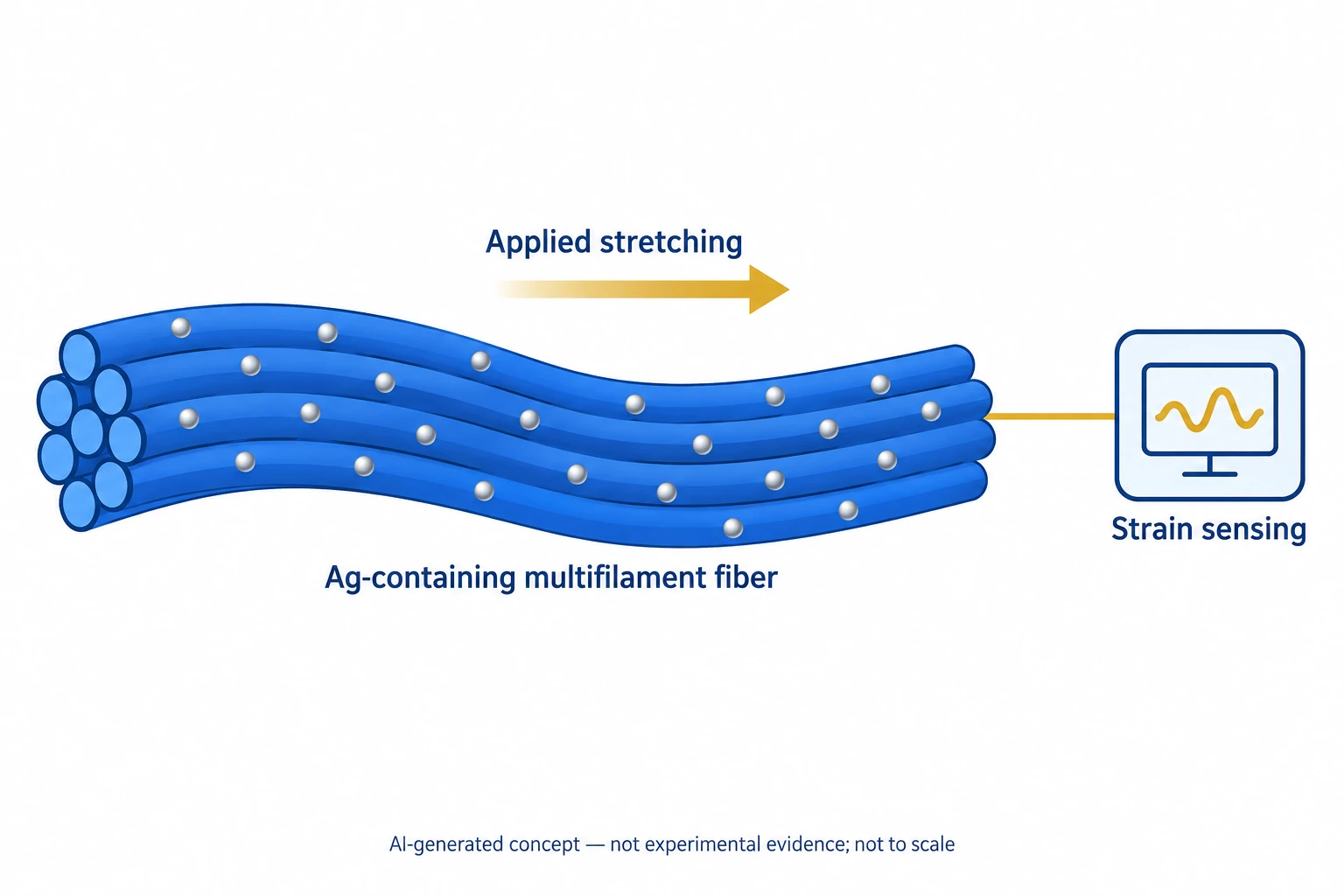
AI-generated, not-to-scale concept showing the relationship between stretching an Ag-containing multifilament fiber and strain sensing.
Generated for this library to illustrate the design; it is not a figure from the paper and does not show measured data.
How it was evaluated
Fibers of about 206 μm in diameter were characterized by electron microscopy, energy-dispersive X-ray mapping and thermogravimetry, and their resistance was measured during first and repeated stretching, cyclic loading and comparisons of mono- and multifilament fibers and of different numbers of absorption and reduction cycles. Applications were tested in a sewn glove read by a microcontroller and in an artificial bladder system in which the sensor was mounted around a rubber balloon or a pig bladder and controlled a solenoid valve.
Key results
Repeating the absorption and reduction steps raised the initial conductivity to 20 964 S cm−1 but gradually lowered the rupture strain. The fiber made with five reduction processes, identified as the optimum, had an initial resistance of about 0.16 ohms cm−1. During the first stretch to 450%, the GF was about 182 and 1032 within 100% strain, about 1.0 × 10^4 and 3.1 × 10^4 at 150-250%, and about 9.3 × 10^5 at 300-450%. The first stretch showed electrical and mechanical hysteresis; after this prestrain the hysteresis was negligible and the GF was about 35 within 100% and about 659 at 150-200%, the decrease being attributed to the higher base resistance and length after the first stretch.
The Ag-rich shells cracked mainly below about 150% strain, while stretching of the inner composite dominated above 150%. The sensing range increased with the number of filaments, and the multifilament data agreed with a modified percolation model (α = 0.0036). A monofilament sensor reached GFs of about 406 and 7.0 × 10^5 but only within 70% strain, and more than five reduction cycles lowered the electrical stretchability.
After a 450% prestrain, the sensor responded repeatably to 20, 40, 60 and 100% strain. The signal was maintained without considerable degradation over 10,000 cycles at 10% strain, and responses also saturated stably over 10,000 cycles at 50, 70 and 100% strain.
Sensors sewn onto the five finger joints of a glove, each driven at 5 V, distinguished finger bending without considerable crosstalk and controlled the matching fingers of a hand robot. In the artificial bladder system, a sensor on a pig bladder tracked filling to 200 mL, after which the solenoid valve opened and the liquid was drained until the bladder returned to its initial volume.
Open questions
The authors note that the Ag nanoparticles have limited biocompatibility for in vivo use and propose protective PDMS or Ecoflex layers, and that waterproofing is expected with such coatings or low-surface-energy materials. The GF and range in subsequent stretching are lower than in the first stretch, and the first stretch shows hysteresis.
Related research
A stretchable carbon nanotube strain sensor for human-motion detection
The authors cite this carbon nanotube film strain sensor, which detected human motion, in their opening group of references on stretchable devices for wearable electronics, electronic skins, soft robotics and biomedical electronics. The present sensor is a single fiber whose response comes from cracking Ag-rich shells and shell-to-shell contacts between neighboring filaments.
Abstract-based introductionSources used in this summary
This summary is based on the publisher PDF of the article, including the figure legends and Methods; the Supporting Information and movies were not reviewed.