Overview
This review, by researchers at the Nanobio Device Laboratory (Taeyoon Lee) and the BLISS Lab (Jungmok Seo) at Yonsei University, examines electronic drugs (e-drugs), electronic devices that monitor body signals and deliver treatment to a targeted tissue or organ, through the spatial and temporal requirements of therapy. It groups e-drugs into noninvasive ingestible and patch-type devices, short-term bioresorbable implants and long-term implants, and treats patient compliance, the mechanical mismatch between tissue (typically below 100 kPa) and conventional electronics (above 80 GPa), and biocompatibility as the main design problems.
Background
Oral administration and injection cannot readily meet the spatial and temporal demands of treatment, because of limits such as a narrow therapeutic window and the need for long-term implantation. Adherence is also a problem: the review cites a study in which only 29.7–38.5% of patients with type-2 diabetes in Asia, Eastern Europe and Latin America self-monitored their glucose. Electronic devices can sense analytes, physical stimuli and electrophysiological signals and deliver therapy on wireless command, but the stiff, dry and static nature of conventional electronics causes micromotion-induced inflammation, scar tissue and fibrotic encapsulation that shorten device performance and lifetime.
How the review is organized
The review is organized by site and duration of action. Section 2 covers noninvasive ingestible devices for the gastrointestinal (GI) tract, with Table 1 summarizing pH, oxygen partial pressure, microbial load and diseases of each GI organ, and patch-type devices for wound monitoring, electrical stimulation and thermally triggered drug release. Section 3 covers bioresorbable materials (Tables 2 and 3 list organic and inorganic materials with their dissolution products), functional bioresorbable implants and bioresorbable sensors. Section 4 covers the foreign body response (FBR) to long-term implants, three strategies to suppress it (antifouling surfaces, tissue-matched mechanical properties and nanoporous membranes) and implantable devices for the brain, adrenal gland, heart and spinal cord.
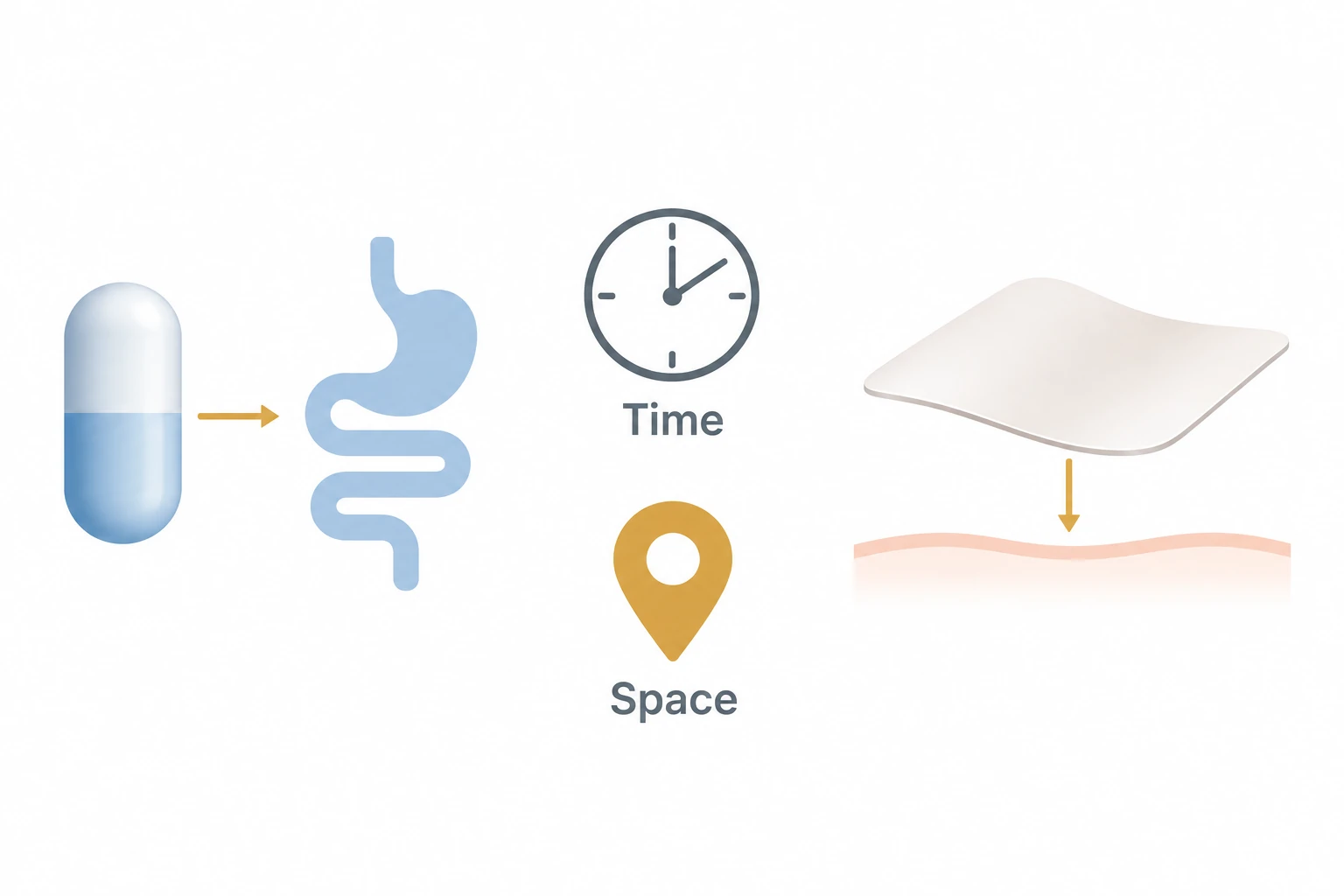
AI-generated concept showing spatial and temporal themes and ingestible and patch-device examples from the electronic-medicine review abstract.
Generated for this library to illustrate the design; it is not a figure from the paper and does not show measured data.
Scope of the review
For each device class the review describes representative studies, their design and the reported performance, from in vitro tests to mouse, rat, swine, sheep, canine and nonhuman primate models and human use of ingestible capsules. Each section ends with the limitations that remain for that class, and the final section discusses safety, stability and regulatory requirements for clinical translation.
Main points of the review
Ingestible devices: Table 1 lists the stomach as highly acidic (pH 1–3) with an oxygen partial pressure of 77 mm Hg, compared with 33 mm Hg in the small intestine, illustrating why GI sensing must be site-specific. Cited examples include a capsule that profiles fermentation gases, a bacterial bleeding sensor tested in a porcine model, a self-orienting applicator (SOMA) that injected insulin in swine with blood glucose and insulin trends similar to subcutaneous injection, and a 3D-printed gastric resident device that kept a bidirectional Bluetooth link in the swine stomach for up to 14 days and remained there for 20.1 days. The review notes that Li-based batteries can cause burns or pH changes in the stomach when short-circuited and that the safety of digestion byproducts needs further study.
Patch-type devices: the review cites reports that 80% of wounds with elevated pH are associated with infection and describes pH and temperature sensors (one mapped wound temperatures of 25 to 35 °C), piezoelectric and triboelectric stimulators (a triboelectric patch produced 1 Hz, about 270 nA pulses that promoted fibroblast-to-neuron conversion), and thermally triggered drug-releasing patches, including a textile dressing with heated, thermoresponsive drug-carrying fibers that accelerated healing in a diabetic murine model. It notes that wounds start at a mean pH of 6.1 and shift toward alkaline values, which can corrode electronics, and that thermoresponsive release is hard to control passively and may self-trigger in warm weather.
Bioresorbable devices: natural wax degrades fully in 15 days, PLGA dissolution can be tuned by the PLA:PGA ratio, and Mo interconnects gave stable pressure sensing for 28 days. Cited implants include a 6 mm PLGA/PGCL vascular scaffold biocompatible at 30 and 90 days in swine iliofemoral vessels, a PLCL scaffold that dissolved within 18 months in sheep, a wireless biodegradable patch that delivered doxorubicin in a canine glioblastoma model, and porous silicon needles with about 99.3% cell viability after 3 days. Cited sensors include an intracranial pressure sensor comparable to a commercial sensor in rats, a temperature sensor that operated for 30 h and dissolved after 67 days, and a 256-channel silicon electrode array that dissolved in two months in PBS (pH 10) at 37 °C. The review stresses that differing dissolution rates make device lifetime hard to predict and that fully bioresorbable multifunctional systems had not yet been investigated.
Long-term implants: the review describes the FBR in three stages (proinflammatory, anti-inflammatory and fibrous encapsulation). Cited antifouling results include a trimethylamine N-oxide polymer that reduced fibrinogen attachment by 97.6% and extended uricase circulation to 18.2 h, compared with 1.9 h for native and 10.1 h for PEG-uricase, and a zwitterionic coating that made continuous glucose monitors about three times more accurate upon recalibration in diabetic nonhuman primates. Injectable mesh electronics changed impedance by less than 7% after injection and had a flexural stiffness of 0.087 nN m, and a later mesh design recorded the same individual neurons for at least 8 months; nanoporous membranes with pores of 0.8 µm or less excluded immune cells. Other examples include an adrenal probe compared at 1 and 9 weeks after implantation, a wireless cardiac pacer of about 110 mg, and a soft spinal e-dura that maintained a therapeutic effect for 6 weeks and reduced the required injection amount by 25% through intrabody delivery.
Open questions
The authors identify remaining barriers: the biocompatibility of materials and of byproducts formed during digestion, possible effects on nonspecific organs through blood circulation, degradation of device performance by physiological fluids, scar tissue formation that persists despite antifouling and mechanical strategies, and the need for long-term implants to become smaller, safer and more energy-efficient. They also note that more e-drugs validated for therapeutic use by the FDA or other authorities are needed.
Related research
Wirelessly operated bioelectronic sutures for the monitoring of deep surgical wounds
DOI: 10.1038/s41551-021-00802-0 ↗
The related study describes battery-free sutures read by radiofrequency identification that monitored wound integrity, gastric leakage and tissue micromotion in live pigs, a concrete example of sensing at a selected body site.
Abstract-based introductionSources used in this summary
This summary is based on the published PDF of the review (25 pages: abstract, Sections 1-5, Tables 1-3 and figure legends); the cited primary studies were not read.