Overview
This review, written by the BLISS Lab (Jungmok Seo) at Yonsei University, examines how encapsulation protects organic light-emitting diodes (OLEDs) as they move from rigid displays into flexible, stretchable, wearable and bioelectronic devices. It connects barrier requirements, such as a water vapor transmission rate (WVTR) as low as 10−6 g m−2 day−1 for lifetimes above 10 000 h, with measurement methods, degradation mechanisms and thin-film encapsulation (TFE) designs, and notes that no reported stretchable encapsulation has yet remained stable beyond 10% tensile strain.
Background
OLEDs degrade when moisture and oxygen enter through pinholes and edges, producing dark spots by electrode delamination and oxidation, and when heat and mechanical deformation generate cracks and interfacial failure. Glass lid encapsulation and barrier foil lamination protect rigid displays well but lack the mechanical compliance needed for foldable or stretchable devices, and devices worn on the skin or implanted are additionally exposed to body temperature, body fluids and cyclic strain.
How the review is organized
The review first sets out encapsulation requirements (WVTR, oxygen transmission rate, transmittance above 90% with low haze, thermal and UV stability) and describes conventional glass lid and barrier foil approaches. It then compares methods for measuring barrier and mechanical performance, analyzes degradation induced by water, oxygen and thermo-mechanical stress, and organizes TFE by structure, from inorganic single layers to inorganic nanolaminates and hybrid organic-inorganic multilayers. The final sections address encapsulation for stretchable wearable OLEDs and for bioelectronic devices, followed by practical and industrial constraints.
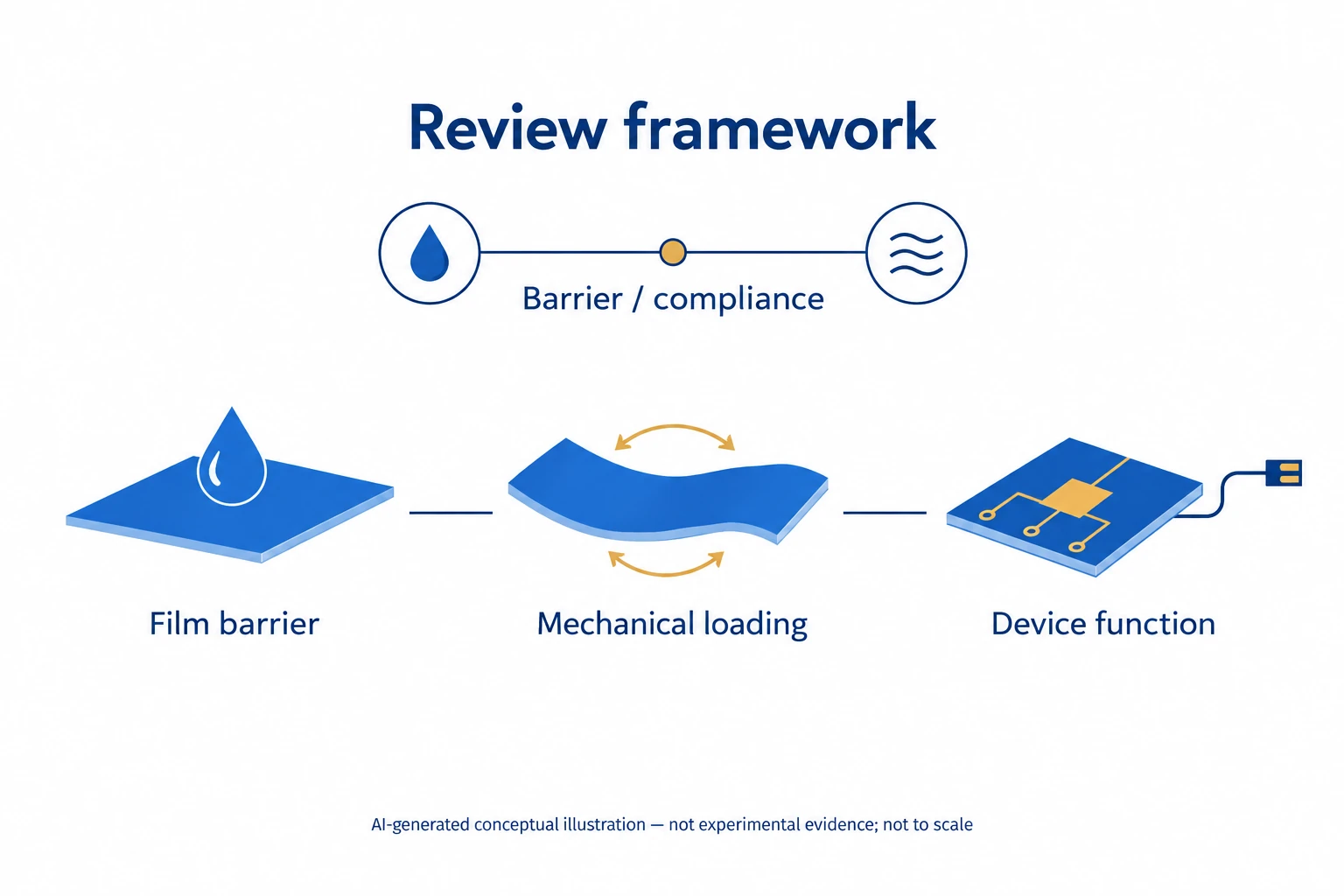
AI-generated concept: the review separates film-barrier tests, mechanical loading and device-function tests. The icons identify categories of evidence rather than measurements of permeability or retained function.
Generated for this library to illustrate the design; it is not a figure from the paper and does not show measured data.
Scope of the review
The review covers WVTR measurement techniques (gravimetric cup, isostatic MOCON, electrochemical impedance spectroscopy, calcium corrosion test, tritium permeation, quadrupole mass spectrometry, infrared imaging and finite element simulation) with their detection ranges in Table 1, and mechanical tests including cyclic bending, uniaxial tensile, cyclic elongation, peel-off and bilayer cantilever measurement of thermal expansion. Tables 2 to 6 compile reported WVTR values with temperature, humidity and deposition method for single-layer, inorganic multilayer and hybrid multilayer barriers, together with device-level lifetimes and their criteria (LT50, LT70, LT90).
Main points of the review
On measurement, the review notes that isostatic methods become unreliable below about 10−5 g m−2 day−1 because water adsorbed on chamber walls can exceed the permeated flux, whereas the calcium test reaches 10−6 to 10−8 g m−2 day−1 and tritium permeation has a theoretical detection limit of 2.4 × 10⁻⁸ g m−2 day−1, at the cost of radioactive handling. Mechanical tests are presented as complementary to WVTR, since bending- or strain-induced microcracks create permeation paths.
Among cited TFE studies, a 25 nm atomic layer deposition (ALD) Al2O3 film showed a WVTR of 1.7 × 10⁻⁵ g m−2 day−1 at 38 °C and 85% RH, but single inorganic layers lose integrity once a pinhole or crack forms. Nanolaminates such as Al2O3/ZrO2 extended OLED lifetime to 22 000 h from 8700 h for single Al2O3, and hybrid stacks with soft organic interlayers combined low WVTR with strain tolerance; for example, an Al2O3/silamer structure reached 3.11 × 10⁻⁶ g m−2 day−1 and increased flexible OLED lifetime from 67 h to 897 h. Multifunctional TFE that adds Ag heat spreading, UV-reflecting layers or stress-relieving layers is also summarized, including a reduction of residual stress from 248.5 to 41.36 MPa with a stress-buffer layer.
For stretchable OLEDs, the review sets target conditions from physiology, with joint skin strain up to 30% and organ deformation of 5% to 20%, and describes crack-tolerant multilayers and residual-stress compensation, such as a bilayer that sustained barrier performance to about 2% strain compared with 0.84% for the inorganic layer alone. For bioelectronic devices, it summarizes oil-infused elastomers that operated for 725 days at pH 1.5 and 696 days at pH 4.5, bioresorbable succinate copolyesters that kept Mg traces functional for over 40 days, and a double-sided hybrid encapsulation used for photodynamic therapy OLEDs.
Open questions
The review identifies several open problems: no stretchable encapsulation has yet shown stable performance beyond 10% tensile strain; ALD remains limited industrially by slow deposition, vacuum and precursor costs, batch processing that is incompatible with roll-to-roll production, and sensitivity to large-area defects; and OLED substrates restrict deposition to below about 100 °C, which limits film density. It calls for encapsulation that combines ultra-low permeability with mechanical compliance, thermal management, biodegradability and low immunogenicity.
Related research
Ultraflexible organic photonic skin
Skin-mounted light emitters and photodetectors provide an experimental example of thin encapsulation and conformal contact.
Abstract-based introductionSources used in this summary
This summary is based on the full HTML text of the open-access review (CC BY 4.0), Sections 1 to 6 and Tables 1 to 6. Figure captions were not displayed on the page and were not read, and the cited primary studies were not checked against their original reports.