Overview
This review, co-authored by Jungmok Seo (then at Brigham and Women's Hospital, Harvard Medical School, the Harvard-MIT Division of Health Sciences and Technology and the Korea Institute of Science and Technology), who now leads the BLISS Lab at Yonsei University, surveys high-throughput (HT) platforms for screening and analyzing cell behaviors. It covers 2D and 3D cell-biomaterial microarrays, HT delivery of genes, proteins and drugs, and HT analysis of secreted biomolecules, with examples such as a 3D hydrogel microarray that used 1000-fold less material than conventional assays.
Background
New biomaterials and modification techniques are developed faster than conventional methods can characterize them, and conventional approaches cannot efficiently screen the large number of possible combinations of biochemical and physical microenvironmental cues. HT strategies analyze hundreds to thousands of interactions among biomaterials, biomolecules and cells on one platform, using small amounts of material and cells and testing multiple factors in combination.
How the review is organized
The review groups HT platforms into three categories. The first covers microarrays for controlling cell-biomaterial interactions: 2D platforms made by contact printing, wettability patterning and peptide or protein immobilization, 3D cell-laden hydrogel arrays, mechanical stimulation arrays and microwell or microfluidic systems for cell spheroids. The second covers HT delivery of genes, proteins and drugs, including cell spot microarrays, automated synthesis of polymer carriers and sandwich microarrays for drug toxicity. The third covers HT analysis of gene expression, carbohydrates, enzymes and proteins, including microarray-based PCR, droplet RNA sequencing, glycan and enzyme chips and microfluidic or label-free immunoassays.
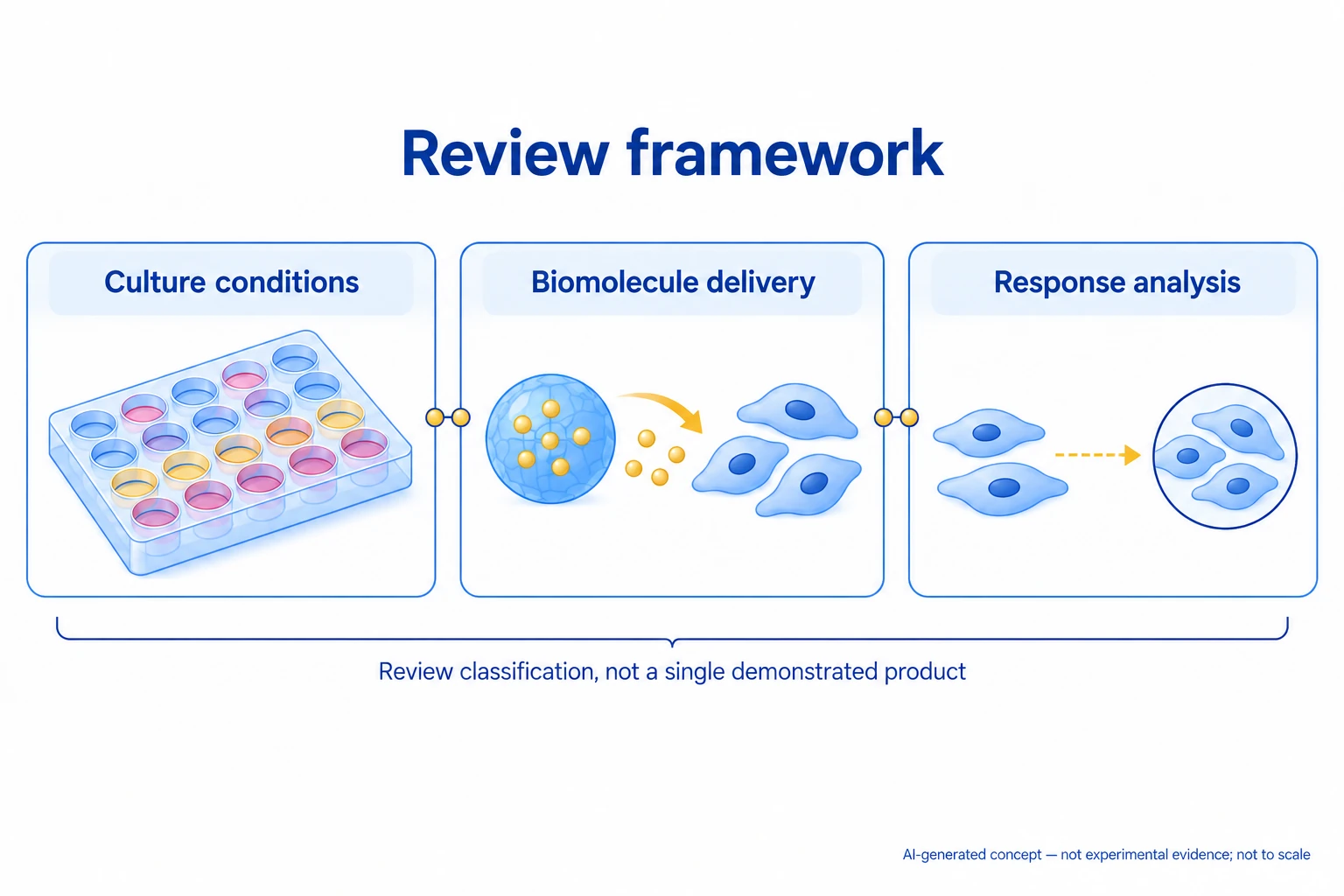
AI-generated, not-to-scale concept of the complementary roles of culture conditions, biomolecule delivery and cell-response analysis in high-throughput screening.
Generated for this library to illustrate the design; it is not a figure from the paper and does not show measured data.
Scope of the review
For each category the review describes representative platforms, the cells used and the reported readouts, and Table 1 summarizes the screened factors, biomaterials and cell types. Examples include rat hepatocytes and mouse embryonic stem cells (ESCs) on extracellular matrix (ECM) arrays, human ESCs on copolymer arrays, mesenchymal and neural stem cells in polyethylene glycol (PEG) microwells of tunable stiffness, HEK 293, HeLa and A549 cells on wettability-patterned substrates, human mesenchymal stem cell (hMSC) spheroids, MCF-7 breast cancer cells for drug screening and human serum samples for immunoassays. Figure 1 is a schematic overview of the three platform categories, and Figures 2 to 10 reproduce panels from the cited studies.
Main points of the review
For 2D screening, the review cites a copolymer microarray built from 496 acrylate-based monomers, where high acrylate content with moderate wettability promoted human ESC colony formation, PEG microwell arrays with shear moduli of 1 to 50 kPa in which stem cell fate correlated with cell density, elastic modulus and ECM protein concentration, and a library of 576 polymers printed to screen fibronectin adsorption. Wettability-patterned platforms allowed seeding of different cell types and medium exchange without pipetting.
For 3D screening, a cell-laden gelatin methacryloyl (GelMA) microarray decreased material usage 1000-fold compared with conventional assays while identifying ECM and growth factor combinations that promoted osteogenic differentiation. A compression array applied strain from 0 to 26% to PEG hydrogels, and simulations showed that deformation of mouse MSC nuclei and cells was not linearly correlated with the applied strain. Microwells formed 12,000 hMSC spheroids at once, with osteogenic or chondrogenic differentiation induced after 8 days within a 14-day culture, and a perfused microwell platform formed uniform spheroids within 3 h and increased proliferation significantly compared with static pellet culture.
For delivery, a cell spot microarray tested small interfering RNA delivery to 92 adherent cell types, fibronectin at certain concentrations increased transfection efficiency compared with type I collagen while collagen gave higher adhesion, and an automated system carried out 2350 polymer formation reactions in a day to screen non-viral gene carriers. A sandwich microarray delivered 320 candidate anti-tumor agents to MCF-7 cells to assess toxicity.
For analysis, a multiplex amplification chip with 91 probes matched the specificity of conventional quantitative real-time PCR (qRT-PCR), droplet sequencing used 12-base cell barcodes giving 16,777,216 possible sequences, and a polysaccharide microarray placed about 20,000 spots on one slide. A microfluidic immunoassay with in-channel antibody patterning used samples of a few microliters and gave results comparable to enzyme-linked immunosorbent assay (ELISA) with improved reproducibility, a 3D alginate immunoassay agreed with Western blotting, and polymer beads encoded with 44 kinds of surface-enhanced Raman scattering (SERS) nanoparticles enabled label-free detection of protein binding.
Open questions
The review notes that HT platforms combining delivered biomolecules, ECM composition and mechanical or electrical stimuli had not been developed, that drug screens relied mostly on live/dead assays measuring only proliferation or death, and that on-chip gene analysis lacked a step for checking DNA concentration. Most HT screening platforms still measured outcomes with conventional non-HT methods, so integration of HT analysis with HT culture was needed. The authors call for real-time detection, more in vivo-like cues such as dynamic strain and electrical stimulation, implantable HT platforms and close collaboration between clinicians and bioengineers for translation.
Related research
Nanoliter-scale synthesis of arrayed biomaterials and application to human embryonic stem cells
Nanoliter-scale synthesis of arrayed biomaterials, cited in this review among the early 2D HT approaches, is a specific example of parallel screening of interactions between human embryonic stem cells and materials. The review places such 2D arrays alongside 3D cultures, delivery screening and analysis of cell-secreted products.
Abstract-based introductionSources used in this summary
This summary is based on the publisher PDF of the review, including Table 1 and figure legends; the cited primary studies were not read.