Overview
This review, by researchers at Chang Gung University and Linkou Chang Gung Memorial Hospital and the BLISS Lab (Jungmok Seo) at Yonsei University, with Jungmok Seo and Kin Fong Lei as corresponding authors, surveys microfluidics-based electrical impedance biosensors. It classifies them into six substrate categories (silicon, printed circuit board, polymer, glass, paper and stretchable) and distinguishes electrical impedance flow cytometry of moving cells from electrochemical impedance spectroscopy (EIS) of stationary samples.
Background
Impedance biosensors read biological responses as electrical signals, and integrating them with microfluidics can improve sensitivity, reduce reagent use and analysis time, and allow automated hand-held or bench-top systems operated without specialist training. Impedance spectra also report cell size, membrane capacitance, cytoplasmic conductivity and cytoplasmic permittivity without fluorescent labels or magnetic modification. The field traces back to Kamentsky's microchannel flow cytometer of 1965, with a throughput of 500 cells per second, Giaever's impedance monitoring of fibroblasts on gold electrodes in 1984 and Ayliffe's single-cell impedance measurement in a microchannel in 1999.
How the review is organized
The review organizes the literature by substrate material rather than by target. Within this structure it separates two technology families: electrical impedance flow cytometry, in which cells or particles pass electrodes in a microchannel, and EIS, usually combined with microcavities, in which static objects such as adherent cells or antibody-bound targets are measured. Opacity, the ratio of high-frequency to low-frequency impedance of a particle, is introduced as one of the parameters used to discriminate cells.
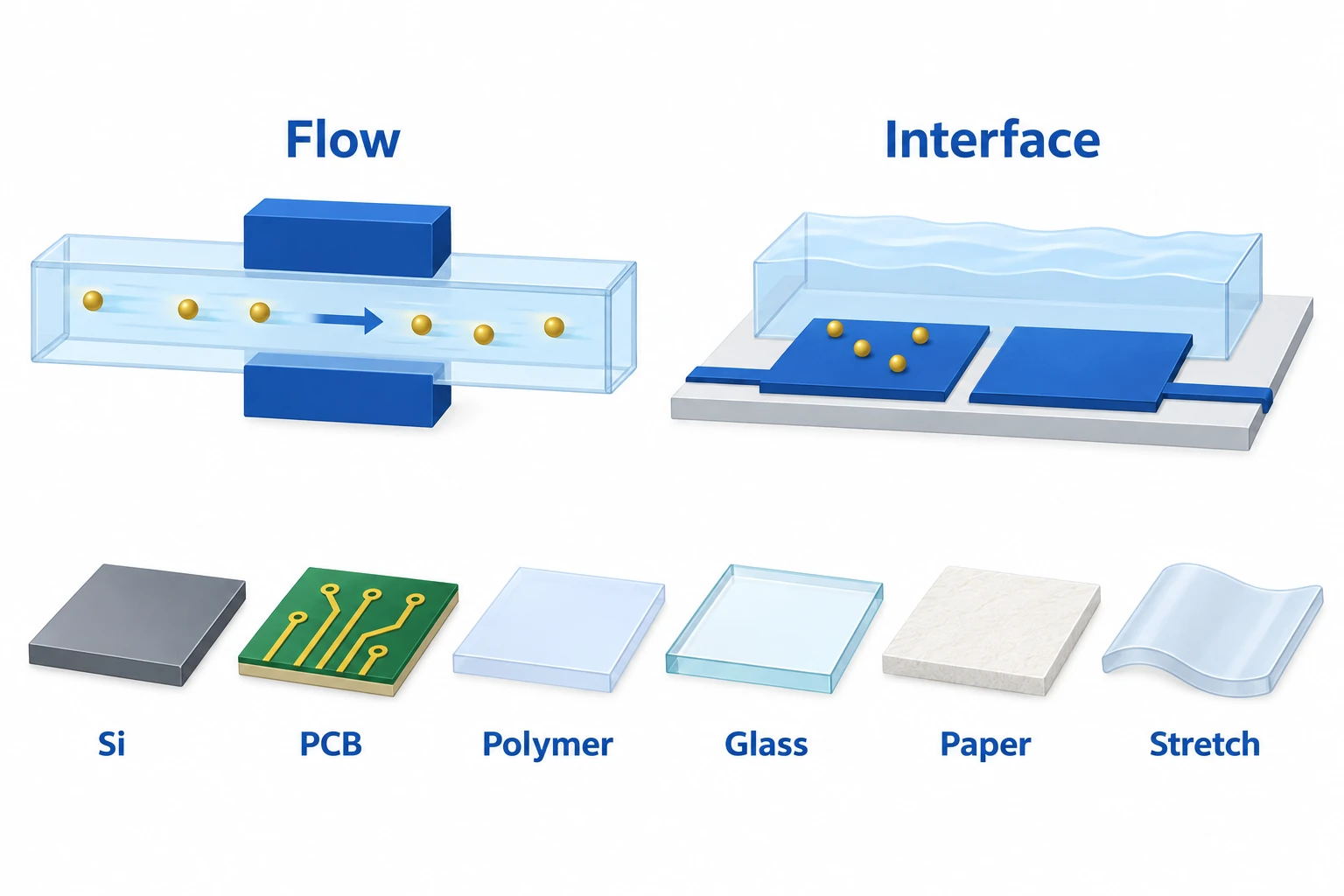
AI-generated concept distinguishing flowing-target and stationary-interface impedance sensing and the review’s substrate categories.
Generated for this library to illustrate the design; it is not a figure from the paper and does not show measured data.
Scope of the review
The review covers silicon-based devices built by micromachining and CMOS processes, printed circuit board (PCB) devices, rigid polymer chips such as cyclic olefin copolymer, PET and PMMA, glass chips, paper-based chips and stretchable skin-mounted devices. The glass section, the largest, is divided into detection of bacteria, blood samples, static cells by EIS, dynamic cells by impedance cytometry, viruses, and other analytes and chemicals. For each category it summarizes electrode materials and geometries, surface functionalization with antibodies or nucleic acid probes, focusing methods such as dielectrophoresis, and reported detection limits.
Main points of the review
Representative figures collected in the review show the range of reported performance. On silicon, interdigitated electrodes with widths and spacings of 250 to 500 nm were made by deep UV lithography, an antibody-based E. coli sensor responded to suspensions as low as 10 CFU/mL, a cortisol sensor covered 1 pM to 10 nM in saliva and magnetic-bead focusing detected prostate-specific antigen at tens or hundreds of fg/mL. On polymer, gold electrodes 200 nm wide with 500 nm spacing were patterned on cyclic olefin copolymer, and a screen-printed PET sensor detected endotoxin at 500 pg mL−1 within half an hour. On glass, dielectrophoretic focusing increased Salmonella sensitivity by 4 to 4.5 times with a detection limit of 8 cells/mL, and an electro-osmotic vortex hybridized 90% of target DNA within 141 s with a detection limit of 0.5 aM. A paper sensor detected alpha-fetoprotein at 1 ng/mL in PBS, and a wearable sweat sensor detected cortisol down to 88 pM.
The authors relate substrate choice to application. PCB electrodes, such as gold electrodes at 250 μm spacing used to detect the transgenic protein Cry1Ab from 0 to 0.2 nM at 358.3 Hz, are limited in sensitivity by conventional line widths and suit fast sensing with modest sensitivity requirements. Polymer chips are hard like glass but suited to mass production, and paper chips offer low material cost, with fine electrodes and antibody immobilization identified as their key technologies. Stretchable devices currently measure mostly on the skin, and conductive hydrogels are suggested as a helpful technology for them.
Across all categories, the authors identify microfabrication of microelectrodes and chemical bonding of recognition molecules as the key technologies. They conclude that the development of the underlying principle, especially of impedance flow cytometry, has mostly stagnated since 2014, that specific antigen–antibody binding may not easily become a breakthrough point, and that paper-based and stretchable chips are expected to become the focus of future development.
Related research
Micromachined impedance spectroscopy flow cytometer for cell analysis and particle sizing
Gawad's abstract describes multifrequency impedance measurements of individual particles in glass–polyimide channels.
Abstract-based introductionSources used in this summary
This summary is based on the open-access full text in Europe PMC (PMC9855525), including figure captions and author information; the cited primary studies were not consulted.