Overview
This review, co-authored by Jungmok Seo (then at the Korea Institute of Science and Technology, and one of the two corresponding authors), who now leads the BLISS Lab at Yonsei University, examines how flexible surfaces can repel both water and oils while staying transparent. It compares pattern transfer, nanoparticle assembly and thiol-ene chemistry, citing results such as a femtosecond-laser-templated PDMS surface with a water contact angle of 154.5° ± 1.7° and transparency over 91%.
Background
Self-cleaning, liquid-repellent surfaces are sought for windows, lenses, display screens and solar cell covers, where they must also transmit light and, increasingly, bend or stretch. Superamphiphobicity requires surface roughness that traps air beneath the liquid in the Cassie-Baxter state together with a low-surface-energy layer, but a rougher surface tends to have lower transparency. The review introduces contact angle, contact angle hysteresis and the Young, Wenzel and Cassie-Baxter models, and notes that the Wenzel and Cassie-Baxter theories predict contact angles on rough surfaces only qualitatively.
How the review is organized
After the wetting fundamentals and wetting transitions between Wenzel, Cassie and hybrid states, the review organizes fabrication into three approaches. Pattern transfer to polymers includes nanocone molding from anodic alumina templates, colloidal lithography with plasma etching, T-shaped microstructures in ethylene-vinyl acetate (EVA), combined UV imprinting and anodic aluminum oxide (AAO) templating, diffuser lithography, femtosecond-laser templates, wrinkled PDMS and hot-pulled polycarbonate nanofur. Nanoparticle assembly includes flame spray pyrolysis of silica, sprayed fluorinated polyhedral oligomeric silsesquioxane (F-POSS) on PDMS pillars and sol-gel or spray coating of silica. The thiol-ene approach covers functionalization of silicone nanofilament layers on nanofibrillated cellulose (NFC) films. Table 1 summarizes reported transparent superhydrophobic surfaces on polymer substrates.
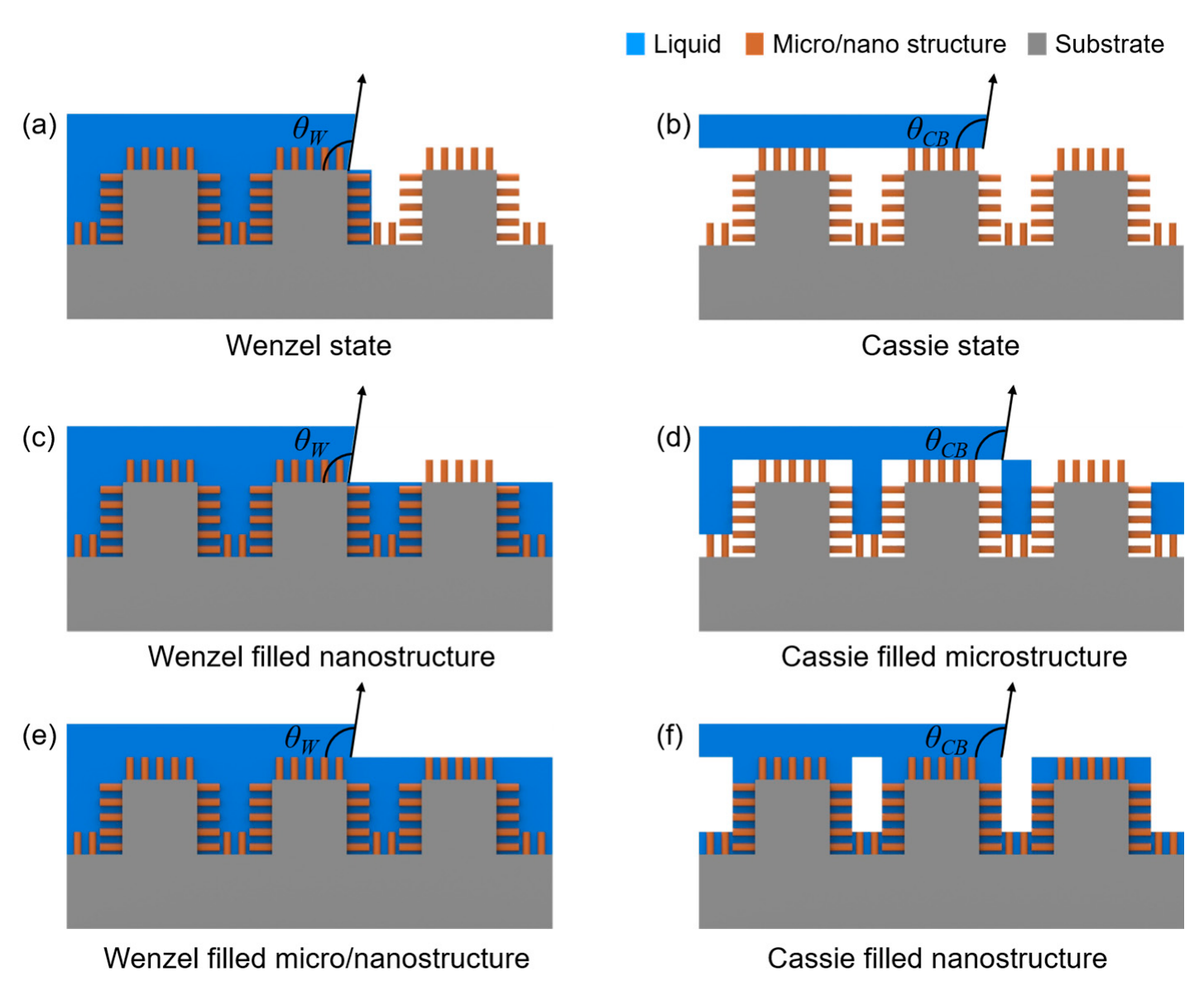
Review schematic comparing six wetting states on hierarchical micro- and nanostructures.
Bichitra Sahoo, Kukro Yoon, Jungmok Seo and Taeyoon Lee (2018). “Chemical and Physical Pathways for Fabricating Flexible Superamphiphobic Surfaces with High Transparency”. Figure 2. DOI: 10.3390/coatings8020047. CC BY 4.0. Cropped to the complete figure from the source PDF; figure content is unchanged.
Source figure and caption ↗ · DOI: 10.3390/coatings8020047 ↗ · CC BY 4.0 ↗
Scope of the review
As a review, the article compiles the substrates, structures, surface treatments and reported values of representative studies: water and oil contact angles, contact angle hysteresis, optical transmittance at specified wavelengths, stretching, bending or abrasion cycles, and device-level tests such as solar cell efficiency recovery after dust exposure. Figure 1 and Figure 2 illustrate wetting models and states, and the remaining figures reproduce panels from the cited studies.
Main points of the review
Among pattern transfer methods, a PDMS nanocone film showed a water contact angle of 152° and reduced the reflectance of a CdTe solar cell by 4%. An alumina nanopyramid film raised the transmittance of polyethylene terephthalate (PET) at 550 nm from 82% to 88%, which fell to 79% after fluorocarbon coating; on a dye-sensitized solar cell, efficiency fell from 4.39% to 4.1% with the film and from there to 2.14% after dust deposition, and recovered to 3.82% after self-cleaning, a 93.2% recovery compared with 46.1% for an uncovered cell. Gold nanocone arrays on Teflon reached 145°, and stretchable EVA films showed 157.6° for water and 148.8° for hexadecane and could be stretched from 5 to 21 cm and fully recovered.
Femtosecond-laser-templated PDMS reached 154.5° ± 1.7° with transparency over 91% and less than 1% light loss compared with flat PDMS. Wrinkled PDMS maintained superhydrophobicity after 1000 stretching cycles, reported as a water contact angle of 150° in the text and as above 160° with hysteresis below 3° in the figure legend, while wrinkle length increased by only about 11 µm. In hierarchically roughened micropillar films on PET, transmittance decreased from the 92% of bare PET at 550 nm after roughening.
Among nanoparticle assembly methods, flame-sprayed silica nanotextures reached up to 99.97% transmittance at 600 nm for a 15 s deposition (the text gives 100), with a 13% loss at 120 s, and coated uneven geometries including a glass tube with an aspect ratio of 15. Sprayed F-POSS/PDMS on PDMS pillars with D* values from 10 to 100 repelled both water and low-surface-tension liquids, and transmittance decreased as D* increased. Spray-coated chain-like silica made paper, fabric and shoes repel muddy water, coffee and orange juice.
With thiol-ene chemistry, NFC films changed from a contact angle of 33° for bare film and 123° with silicone nanofilaments to above 158° with hysteresis below 3° after functionalization, withstood 100 cycles of bending and abrasion under a 10 g load, and could be patterned into superhydrophobic-superhydrophilic domains for bio-applications. A silica layer replicated from a hydrogel template kept its water repellency after 500 cycles of stretching at 100% strain. In comparing the approaches, the review states that pattern transfer performs well for repelling very low surface tension liquids with mechanical durability, while nanoparticle assembly offers the greatest flexibility in substrate choice.
Open questions
The review states that no single surface yet has the resistance to mechanical wear required by industrial standards, that fabrication and flexibility reporting are not standardized, and that flexibility tests should follow ASTM-type procedures for industrial coatings. Most published works have not reported flexibility or stretchability performance for outdoor use. Long-chain fluorocarbons, which can decompose into perfluorooctanoic acid and are classified by the U.S. Environmental Protection Agency as emerging contaminants, motivate fluorine-free coatings. High transmittance further requires control of roughness and a low refractive index, and the authors call for a theoretical model beyond the Wenzel and Cassie models, which apply only to special conditions.
Related research
Designing superoleophobic surfaces
DOI: 10.1126/science.1148326 ↗
Re-entrant curvature, surface chemistry and roughness work together to repel low-surface-tension liquids. The review cites this study among oil-repellent surfaces and surveys re-entrant textures that must also remain transparent and flexible.
Abstract-based introductionSources used in this summary
This summary is based on the publisher PDF of the review, including Table 1 and figure legends; the cited primary studies were not read.