Overview
This review from the Nanobio Device Laboratory at Yonsei University, co-authored by Jungmok Seo (then at the School of Electrical and Electronic Engineering, Yonsei University), who now leads the BLISS Lab at Yonsei University, surveys the key components required for electronic textiles and the energy devices needed to power them. It covers polymer-, carbon- and metal-based conductive textiles, fiber transistors, light-emitting diodes and pressure sensors, and textile energy harvesting and storage devices, citing results such as a stretchable Ag fiber with 2450 S/cm that stretched up to 900% strain.
Background
Electronic textiles (E-textiles) integrate electronic functions into fabrics, and sensors, transistors, light-emitting devices and solar cells have been built into textiles. These components cannot operate without sufficient electrical energy, so energy harvesting and storage devices that keep the flexibility and wearability of fabrics are needed for E-textiles to be adopted in practice.
How the review is organized
The review proceeds from interconnection to function to power. It first treats conductive textiles as the base element for transferring power and data, then fiber-based electronic components, and finally textile-based energy harvesting from human motion, solar cells on textiles and fabric-based supercapacitors, before discussing limitations.
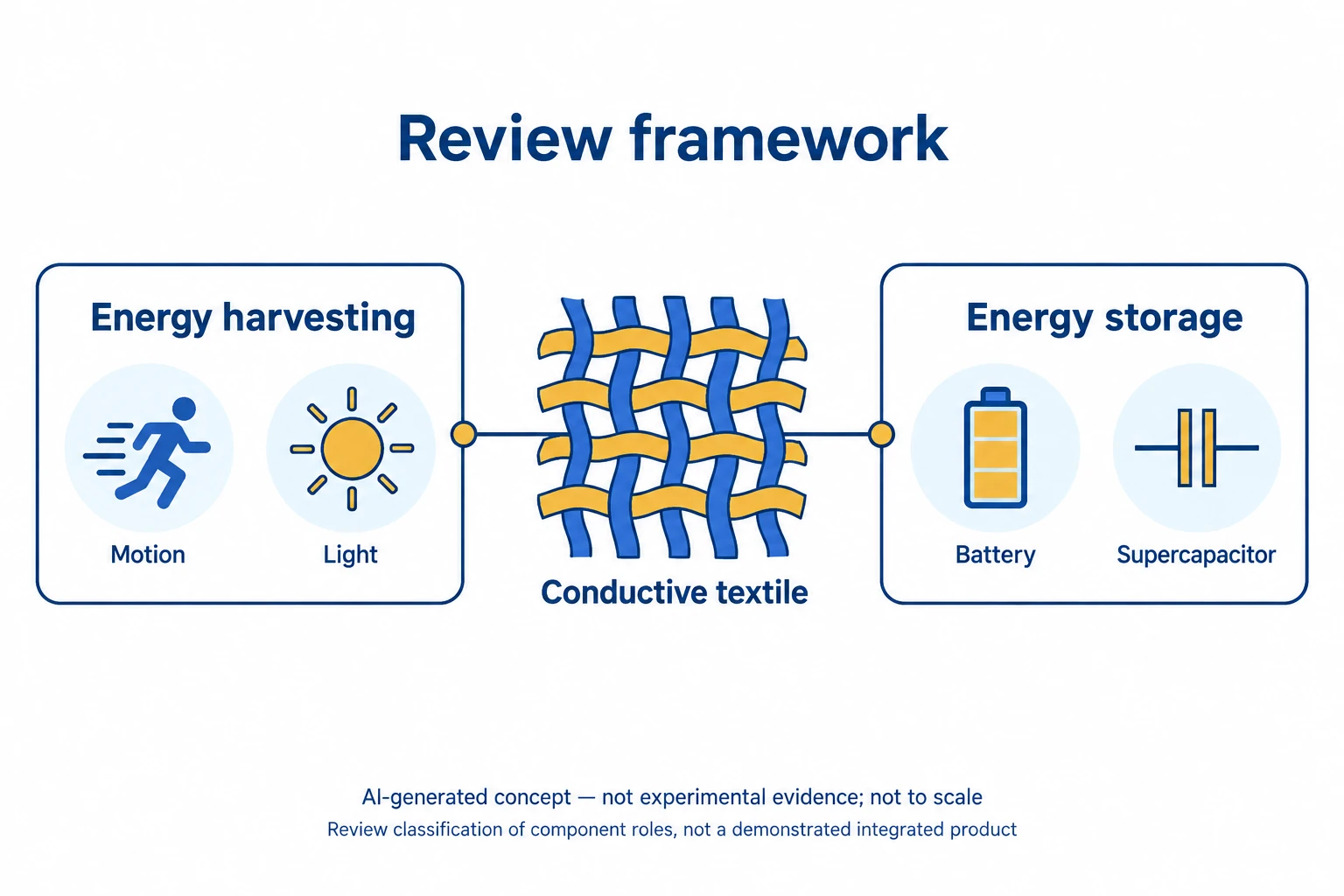
This AI-generated, not-to-scale concept diagram groups the roles of conductive textiles and energy-harvesting and storage components. Motion, light, battery and supercapacitor symbols describe functions; they do not depict a fully self-powered garment, a combined product or experimental results.
Generated for this library to illustrate the design; it is not a figure from the paper and does not show measured data.
Scope of the review
Section 2 and Table 1 compare conductive textiles by material class (conductive polymers such as polypyrrole, poly(3,4-ethylenedioxythiophene):polystyrene sulfonate (PEDOT:PSS) and polyaniline; carbon nanotubes (CNTs) and graphene; metal plating, liquid metal and Ag nanomaterials), fabrication technique, advantages, disadvantages and electrical properties. Section 3 covers fiber organic field-effect transistors (F-OFETs) and organic electrochemical transistors (OECTs), fiber light-emitting devices and textile pressure sensors. Section 4 covers piezoelectric, triboelectric (TENG) and thermoelectric generators (TEGs), dye-sensitized, CdSe and perovskite fiber solar cells, and supercapacitors, followed by current limitations in Section 5.
Main points of the review
Among conductive textiles, the review cites a PEDOT:PSS dip-coated fabric that reached 0.1 S/cm after one soak and up to 2 S/cm after repeated soaking, wet-spun polyaniline fibers with about 1000 S/cm in bulk, CNT-coated cotton yarn with 125 S/cm, and iodine-doped CNT fibers with about 6.7 × 10^4 S/cm. Vacuum deposition of metals on fibers is limited by instrument cost, sample size and incompatibility with batch processing, so solution-based and composite approaches are emphasized: a liquid-metal-filled elastomer fiber remained continuous after 700% strain, an Ag nanoparticle/polymer-coated Kevlar fiber contained more than 80 wt % Ag and changed little in resistance during 3000 folding tests, and adding Ag nanowires to an Ag nanoparticle/styrene-block-butadiene-styrene (SBS) fiber gave 2450 S/cm and stretching up to 900% strain.
For electronic components, F-OFETs reached on-off ratios of about 10^4 but need high operating voltages and complex fabrication, while fiber OECTs operate at low voltage and could in principle reach about 100,000 transistors/cm2 with 10 µm fibers; their long response time and low switching frequency remain hurdles. An electrospun F8BT/PEO nanofiber OLED showed an external quantum efficiency of 0.5% and 2300 cd·m^-2 at 6 V. Textile pressure sensors included a woven sensor responding to 0.98 to 9.8 N/cm2 and a capacitive sensor of PDMS-coated Ag-SBS fibers that detected an 8 mg grain and was sewn into a glove and clothes to control a drone and a spider robot.
Reported textile energy harvesters include a BaTiO3/polyvinyl chloride fiber nanogenerator giving 1.9 V and 24 nA on a bent arm, a hyper-stretchable piezoelectric composite that stretched beyond 200% strain without cracking and gave about 4 V and 500 nA, a textile TENG giving 139 V and 39 μA on an arm, and a metal-free cotton-thread generator whose rectified voltage reached 2.4 V with a charging time of 27 s in a power shirt. A fabric TEG produced about 147 nW in a cold (5 °C) environment and about 8.1 nW in a hot (25 °C) environment with skin at 32 °C, and a PEDOT:PSS fabric TEG with 5 strips gave 12.29 nW at ΔT = 75.2 K.
Fiber solar cells reached power conversion efficiencies of 3.90% for a CNT fiber dye-sensitized cell (0.69 V, 9.84 mA·cm^-2), 2.9% for a CdSe nanowire/CNT yarn cell and 3.03% for a CNT fiber-supported perovskite cell. For storage, the review describes MnO2-coated hydrogenated ZnO nanowire supercapacitors on carbon cloth combined with dye-sensitized solar cells, and an energy fiber that both harvested and stored solar energy with a maximum efficiency of about 1% and storage capacity of about 65%.
Open questions
The authors identify toxicity of electrolytes and other materials in contact with skin, washability and long-term durability (they found no study on repeatedly washable textiles with integrated electronics), packaging failure from cracking and poor bending of fiber-based electronics, biocompatibility, and the lack of collaboration between the electronics and textile industries needed for mass production. They name mass production, integration into clothes, non-toxic technology and long-term usage as the issues to resolve before commercialization.
Related research
Highly stretchable electric circuits from a composite material of silver nanoparticles and elastomeric fibres
The related paper, cited in this review among metal-based conductive textiles, describes stretchable conductive paths and circuits made from Ag particles in SBS fibre mats, a concrete example of the interconnect materials that the review surveys before turning to energy devices.
Abstract-based introductionRESEARCH NEWS
Research in the news
Sources used in this summary
This summary is based on the publisher PDF of the open-access review, including Table 1 and figure legends; the cited primary studies were not read, and for the power shirt the text gives a 10 nF capacity while the Figure 9d legend names a 2.2 μF capacitor.