Research context and placement
Substrate, electrode and channel fabrication/joining motivate a provisional manufacturing placement. Most systems are in vitro microfluidics rather than soft interconnect–component interfaces, so ambiguity is retained.
Boundary case: assigned to the closest interface for navigation. Read the rationale and cross-links together; the primary theme does not delimit the study. Placement of foundational work does not establish direct bioelectronic application.
Research background
Impedance sensing depends on how samples meet electrodes. This review connects substrates with fabrication, flow and electrode geometry. The label impedance sensing includes both changes at binding interfaces and signals from cells passing through channels. Distinguishing these modes is necessary before interpreting why a study changes its substrate, electrode or flow configuration.
Approach and advances
Silicon enables micromachined electrodes but entails process requirements. Commercial PCB fabrication is mature, yet conventional linewidth/spacing constrains electrode miniaturization and sensitivity improvement. Choosing an accessible fabrication platform is not always the same as choosing the smallest electrodes. The classification exposes this manufacturing trade-off, while analyte-specific sensitivity still depends on electrode functionalization and measurement conditions.
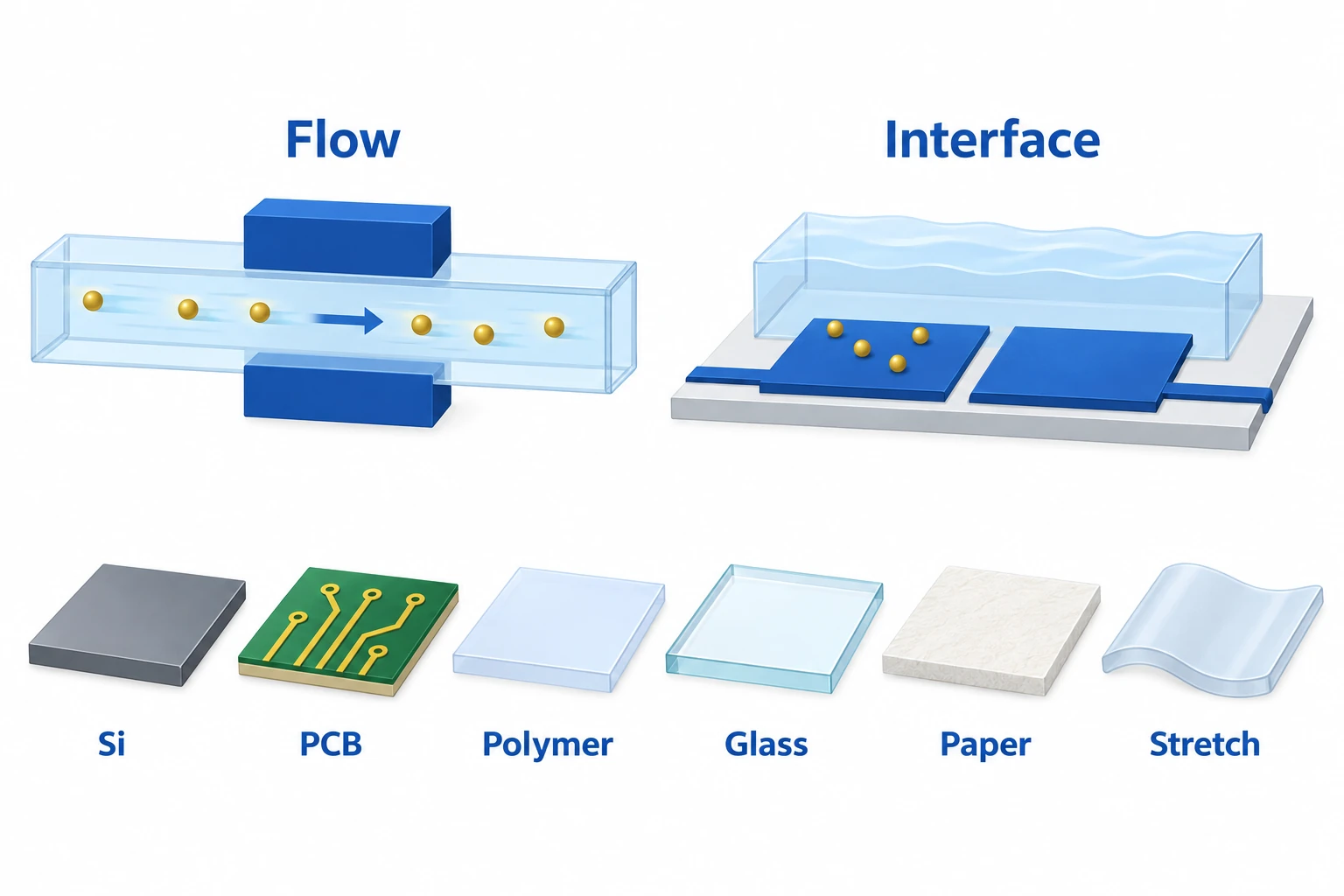
AI-generated concept distinguishing flowing-target and stationary-interface impedance modes and substrate categories in the review. Liquid, electrode and target arrangements are explanatory simplifications, not an actual measurement cell, binding mechanism, dimensions or performance ranking.
Approval is limited to the two measurement modes and substrate categories supported by selected main text. Exact experimental apparatus, protocols, chemical binding, quantitative performance and clinical diagnosis are excluded.
This is not a reproduced paper figure and does not establish permission to reuse the original figure.
Generated in ChatGPT on the web from concepts in a public paper and checked for conceptual consistency within the selected main-text reading and stated independent-review scope. This does not claim a complete main-text or supplement audit. Display processing is limited to WebP encoding, without cropping or content editing.
Evaluation and conditions
Flow focusing and electrode geometry change electrical interrogation. Stationary-interface and flowing-cell measurements must be distinguished. For flowing cells, transit position relative to electrodes matters. For stationary samples, binding and interfacial measurement conditions become central; comparing their detection limits can therefore compare different targets and measurement questions.
Key findings
The review highlights paper’s low cost while retaining electrode patterning and surface binding as challenges. Substrate selection therefore connects cost with fabrication and analyte presentation. The review’s outcome is a map of linked design choices rather than a winning substrate. Even paper-based devices can target different uses through their electrodes and surface chemistry, preventing performance generalization from the substrate name alone.
Limits and open questions
Frequency, spacing, flow and target size affect comparison. Commercial prospects require device-specific user and sample validation. Future directions in a review are not validated product performance. This account adds no numerical sensitivity or throughput ranking and identifies the primary-study conditions needed before making such comparisons.
Related external research
Micromachined impedance spectroscopy flow cytometer for cell analysis and particle sizing
Gawad’s abstract describes individual-particle multifrequency impedance in glass/polyimide channels, grounding the review’s electrode/flow/substrate comparisons.
Single-cell flow measurements and antigen-binding detection limits are not interchangeable metrics.
Abstract checkedCorresponding-author verification
Jungmok Seo: corresponding authorThis record concerns Jungmok Seo’s correspondence designation. Author order or an asterisk alone is not treated as confirmation; this check is separate from verification of the research content.
- Correspondence evidence source ↗
Correspondence: [email] (J.S.); [email] (K.F.L.)
contrib/xref[@ref-type="corresp"] → c1-biosensors-13-00083 · public_repository_xml_author_and_correspondence_read
- Main-text review scope
- Europe PMC XML §§2–8: substrate categories, flow/electrode/fabrication discussion and conclusions. Additional targeted main-text reading in this pass: §2 opening/final paragraphs; §3 opening/final paragraphs (PCB linewidth); §6 final paragraph (paper cost and electrodes) This additional reading refers to main text, not supplementary information.
- Supplementary review scope
- Supplementary information was not read. No supplementary material is listed as reviewed, and a complete SI audit is not claimed.
- Pending verification
- SI was not read. Substrate rankings and clinical readiness require primary-study verification; this account is limited to the review’s classifications and measurement distinctions.
COVERAGE & OUTREACH
Coverage and outreach
Links are checked for their relationship to this paper. Media publication does not establish independent reporting or additional experimental validation.
No related outreach link was verified against its body within these searches. This does not establish that none exists.
Channel coverage and search log for all 101 records →Sources and verification scope
Europe PMC XML §§2–8: substrate categories, flow/electrode/fabrication discussion and conclusions. Additional targeted main-text reading in this pass: §2 opening/final paragraphs; §3 opening/final paragraphs (PCB linewidth); §6 final paragraph (paper cost and electrodes) This additional reading refers to main text, not supplementary information.
The additional commentary is editorially approved within the stated evidence scope. This does not imply complete verification of all main-text and supplementary material.
- Additional main-text review scope
- Europe PMC XML §§2–8: substrate categories, flow/electrode/fabrication discussion and conclusions. Additional targeted main-text reading in this pass: §2 opening/final paragraphs; §3 opening/final paragraphs (PCB linewidth); §6 final paragraph (paper cost and electrodes) This additional reading refers to main text, not supplementary information.
- Additional supplementary review scope
- Supplementary information was not read. No supplementary material is listed as reviewed, and a complete SI audit is not claimed.
- Public publication baseline ↗ · #65 · 2026-10-03
- Crossref metadata ↗: Only public bibliographic metadata registered with Crossref was checked. This does not mean that the publisher page, abstract, or full text was read; full-text verification in the school Chrome session remains pending. license_urls lists registered links and does not establish permission to redistribute text or figures. It may include TDM or posting-policy links.
- A Review on Microfluidics-Based Impedance Biosensors ↗
public_repository_full_text · Sections 2–8; article DOI 10.3390/bios13010083 - A Review on Microfluidics-Based Impedance Biosensors ↗
public_repository_full_text · Sections 2–8; article DOI 10.3390/bios13010083 - A Review on Microfluidics-Based Impedance Biosensors ↗
public_repository_full_text · §2 opening/final paragraphs; §3 opening/final paragraphs (PCB linewidth); §6 final paragraph (paper cost and electrodes) - A Review on Microfluidics-Based Impedance Biosensors ↗
independent_reviewer_selected_main_text · §§2,3,6 selected paragraphs plus focusing-electrode examples. - Additional commentary source ↗
Research background · Sections 2–8; article DOI 10.3390/bios13010083 · public_repository_full_text - Additional commentary source ↗
Evaluation and conditions · Sections 2–8; article DOI 10.3390/bios13010083 · public_repository_full_text - Additional commentary source ↗
Limits and open questions · Sections 2–8; article DOI 10.3390/bios13010083 · public_repository_full_text - Additional commentary source ↗
Connections to related work · Micromachined impedance spectroscopy flow cytometer for cell analysis and particle sizing; DOI 10.1039/b103933b; PubMed abstract previously read; Europe PMC REST core abstractText and title/DOI/author metadata rechecked 2026-10-03; external full text not reviewed. · public_abstract_rechecked_via_EuropePMC_API - Additional commentary source ↗
Approach and advances · §2 opening/final paragraphs; §3 opening/final paragraphs (PCB linewidth); §6 final paragraph (paper cost and electrodes) · public_repository_full_text - Additional commentary source ↗
Key findings · §2 opening/final paragraphs; §3 opening/final paragraphs (PCB linewidth); §6 final paragraph (paper cost and electrodes) · public_repository_full_text