Research context and placement
Printed stretchable conductive patterns and electrical recovery after cutting were tested. Tissue adhesion/mechanics are secondary; this subtheme includes stretchable electrodes as well as fibers.
Research background
Conductive printing needs flow and shape retention. This study adds recovery after damage. An ink that flows too readily can lose its printed shape, whereas a persistently elastic network resists nozzle extrusion. Rheology is therefore a design variable in its own right, not something established by measuring conductivity after fabrication.
Approach and advances
Weak hydrogen bonds permit shear-thinning during heated extrusion, while the network supports printed form afterward. TA-free PVA/PAA remained predominantly elastic within the tested temperature range, unlike the more extrusion-compatible TA-containing inks. This comparison examines TA-mediated network behavior, while CNTs add electrical pathways. Processing and restoration of conduction are therefore linked design requirements, rather than consequences of filler loading alone.
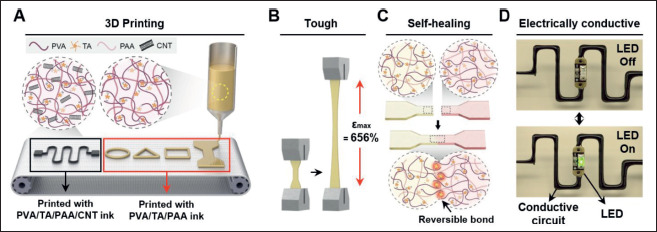
3D printing, stretching, self-healing and conductive-circuit demonstrations of multimaterial hydrogel inks.
Soo A Kim, Yeontaek Lee, Kijun Park et al.. “3D printing of mechanically tough and self-healing hydrogels with carbon nanotube fillers”. Figure 1. DOI: 10.18063/ijb.765. CC BY 4.0. Public original image copied byte-for-byte, with no resizing, cropping, annotations or re-encoding.
Source figure and caption ↗ · DOI: 10.18063/ijb.765 ↗ · CC BY 4.0 ↗
Evaluation and conditions
Rheology and shape tests precede cutting/rejoining. Motion sensing connects restored conduction to function. Cutting/rejoining interrupts and restores an electrical path, whereas mechanical recovery tests restored load bearing. Motion sensing demonstrates deformation-to-signal conversion, not stability throughout an extended wearing period.
Key findings
Cutting switched a printed LED circuit off, and rejoining restored illumination. This directly demonstrates restored continuity, but does not by itself establish identical resistance or complete recovery of load-bearing behavior. It complements the separate electrical and mechanical tests rather than replacing fracture-toughness or long-term stability measurements.
Limits and open questions
The reviewed demonstrations do not establish stability under sweat, dehydration and prolonged real-world loading. Hydration and damage location govern comparison. Print direction and joined area can change electrical and mechanical paths even for similar cuts. This account stays with the verified printing/recovery tests and does not turn skin-contact demonstrations into chronic-contact safety evidence.
Related external research
3D printing of conducting polymers
DOI: 10.1038/s41467-020-15316-7 ↗
Yuk prints PEDOT:PSS paths with insulation; the focal comparison is restoration of conductive paths after cutting a CNT composite network.
PEDOT:PSS bending and hydrogel cutting impose different damage; conductivity and healing ratios cannot be ranked directly.
Full text checkedCorresponding-author verification
Jungmok Seo: corresponding authorThis record concerns Jungmok Seo’s correspondence designation. Author order or an asterisk alone is not treated as confirmation; this check is separate from verification of the research content.
- Correspondence evidence source ↗
Corresponding author: Jungmok Seo
author-notes/corresp[@id="cor1"] · public_repository_xml_author_and_correspondence_read
- Main-text review scope
- Local published PDF pp. 9–12: printing rheology, recovery/electrical testing, Fig. 5 and Conclusion; public XML front matter and Figure 1 separately read. Additional targeted main-text reading in this pass: Local PDF rheology/printability, Fig. 2c–d (TA-free control and shear thinning); §3.8 Fig. 5 (LED cutting/rejoining) This additional reading refers to main text, not supplementary information. The independent approval review also read selected Europe PMC XML §§3.2–3.3 and §3.8; this does not establish review of the entire XML.
- Supplementary review scope
- Supplementary information was not read. No supplementary material is listed as reviewed, and a complete SI audit is not claimed.
- Pending verification
- SI was not read. Signal stability under sweat, dehydration and prolonged repeated loading remains unverified; this account is limited to printing and cutting/rejoining demonstrations.
COVERAGE & OUTREACH
Coverage and outreach
Links are checked for their relationship to this paper. Media publication does not establish independent reporting or additional experimental validation.
No related outreach link was verified against its body within these searches. This does not establish that none exists.
Channel coverage and search log for all 101 records →Sources and verification scope
Local published PDF pp. 9–12: printing rheology, recovery/electrical testing, Fig. 5 and Conclusion; public XML front matter and Figure 1 separately read. Additional targeted main-text reading in this pass: Local PDF rheology/printability, Fig. 2c–d (TA-free control and shear thinning); §3.8 Fig. 5 (LED cutting/rejoining) This additional reading refers to main text, not supplementary information. The independent approval review also read selected Europe PMC XML §§3.2–3.3 and §3.8; this does not establish review of the entire XML.
The additional commentary is editorially approved within the stated evidence scope. This does not imply complete verification of all main-text and supplementary material.
- Additional main-text review scope
- Local published PDF pp. 9–12: printing rheology, recovery/electrical testing, Fig. 5 and Conclusion; public XML front matter and Figure 1 separately read. Additional targeted main-text reading in this pass: Local PDF rheology/printability, Fig. 2c–d (TA-free control and shear thinning); §3.8 Fig. 5 (LED cutting/rejoining) This additional reading refers to main text, not supplementary information.
- Additional supplementary review scope
- Supplementary information was not read. No supplementary material is listed as reviewed, and a complete SI audit is not claimed.
- Public publication baseline ↗ · #69 · 2026-10-03
- Crossref metadata ↗: Only public bibliographic metadata registered with Crossref was checked. This does not mean that the publisher page, abstract, or full text was read; full-text verification in the school Chrome session remains pending. license_urls lists registered links and does not establish permission to redistribute text or figures. It may include TDM or posting-policy links.
- 3D printing of mechanically tough and self-healing hydrogels with carbon nanotube fillers ↗
publisher_registered_abstract_via_Crossref · message.abstract - 3D printing of mechanically tough and self-healing hydrogels with carbon nanotube fillers ↗
local_pdf_read · BLS12_IntJBioprint_2023_Self_Healing_Hydrogel_Ink_MAIN.pdf; pp. 9–12; Fig. 5; Conclusion; title and DOI matched; PDF not redistributed - 3D printing of mechanically tough and self-healing hydrogels with carbon nanotube fillers ↗
local_pdf_read · pp. 9–12; Fig. 5; Conclusion; title and DOI matched; PDF not redistributed - 3D printing of mechanically tough and self-healing hydrogels with carbon nanotube fillers ↗
local_pdf_read · Local PDF rheology/printability, Fig. 2c–d (TA-free control and shear thinning); §3.8 Fig. 5 (LED cutting/rejoining) - 3D printing of mechanically tough and self-healing hydrogels with carbon nanotube fillers ↗
independent_reviewer_selected_main_text · §§3.2–3.3 and §3.8: network formation, TA-free rheology, LED cutting/rejoining. - Additional commentary source ↗
Research background · BLS12_IntJBioprint_2023_Self_Healing_Hydrogel_Ink_MAIN.pdf; pp. 9–12; Fig. 5; Conclusion; title and DOI matched; PDF not redistributed · local_pdf_read - Additional commentary source ↗
Evaluation and conditions · BLS12_IntJBioprint_2023_Self_Healing_Hydrogel_Ink_MAIN.pdf; pp. 9–12; Fig. 5; Conclusion; title and DOI matched; PDF not redistributed · local_pdf_read - Additional commentary source ↗
Limits and open questions · BLS12_IntJBioprint_2023_Self_Healing_Hydrogel_Ink_MAIN.pdf; pp. 9–12; Fig. 5; Conclusion; title and DOI matched; PDF not redistributed · local_pdf_read - Additional commentary source ↗
Connections to related work · DOI 10.1038/s41467-020-15316-7; Results: multi-material printing of PEDOT:PSS and insulating PDMS; electrical performance and Fig. 3b–c bending; device demonstration and Fig. 4. Selected main-text paragraphs rechecked; SI not audited. · public_repository_selected_full_text - Additional commentary source ↗
Approach and advances · Local PDF rheology/printability, Fig. 2c–d (TA-free control and shear thinning); §3.8 Fig. 5 (LED cutting/rejoining) · local_pdf_read - Additional commentary source ↗
Key findings · Local PDF rheology/printability, Fig. 2c–d (TA-free control and shear thinning); §3.8 Fig. 5 (LED cutting/rejoining) · local_pdf_read