Research context and placement
The central interface reduces nonspecific adhesion and friction on deforming biomaterials. Electrical insulation and protective-layer compatibility form a secondary packaging connection.
Research background
Stretching can crack antifouling coatings. L-VIP links deformation tolerance with lubrication. Antifouling depends on preserving the lubricated interface. A gap opened by substrate stretching can make the initially measured repellency a poor description of the interface during use.
Approach and advances
A stretchable adhesive, fluoropolymer and lubricant accommodate deformation. The adhesive connects the coating to its substrate, while the fluoropolymer/lubricant system forms the exposed interface. These roles make attachment, stretching-induced cracks and resistance to fouling separate but linked properties.
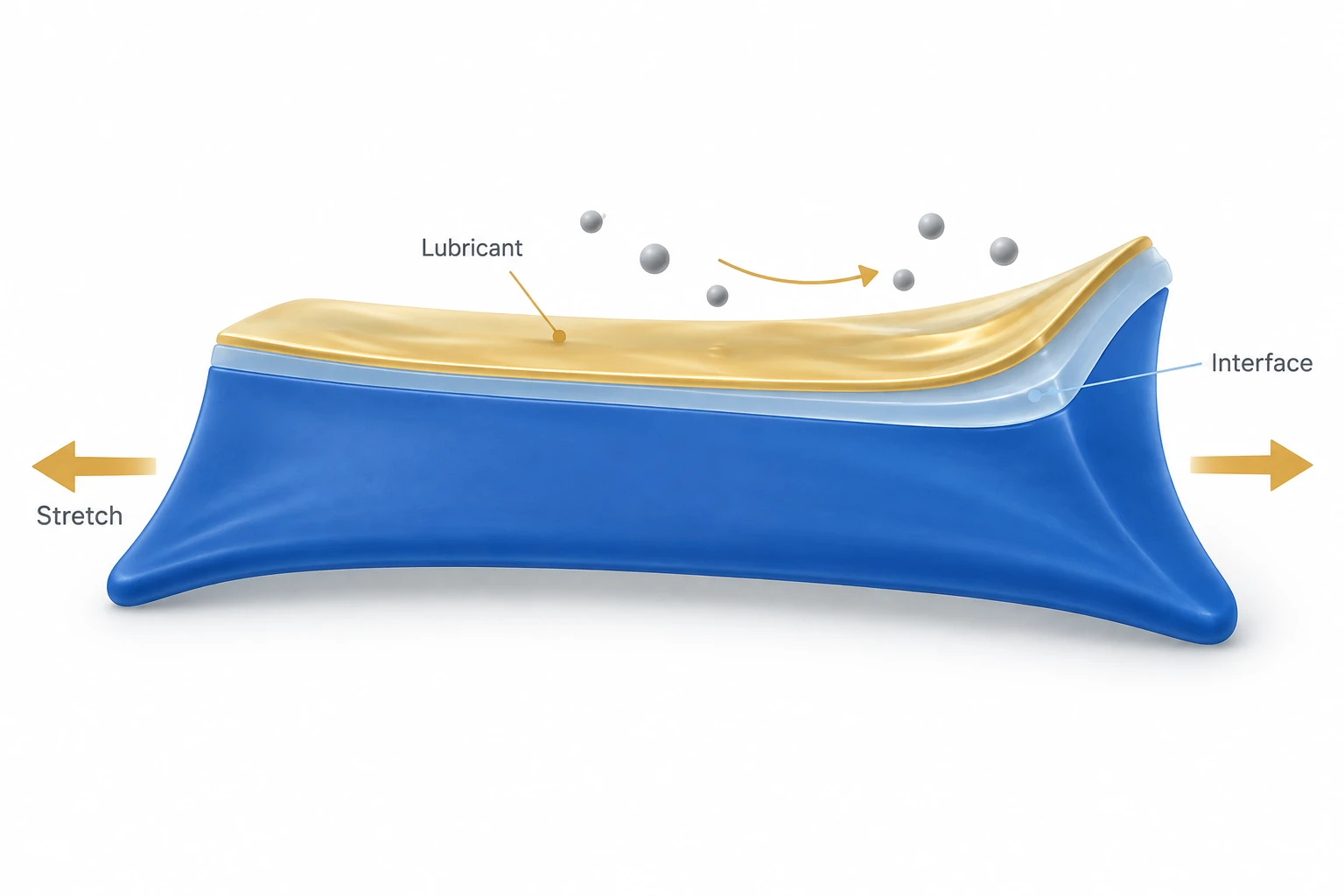
AI-generated concept of the L-VIP design goal: maintaining a lubricated interface on a deforming substrate. Colored bands and arrows are functional symbols, not actual layer counts, thicknesses or particle trajectories. This is not experimental evidence of maintenance-free lubricant life or an in vivo treatment outcome.
Approved as a nonquantitative concept of a deforming substrate with a continuous lubricated interface, provided the AI-generated label and bounded caption below accompany it. This approval does not treat it as a reconstruction of the actual L-VIP layer stack, fabrication or measurements. Library illustration of the functional relationship between interface continuity and accommodated deformation. Excluded: Actual cross section, layer count/thickness or molecular structure; Quantitative strain, cycle counts or damage thresholds; Particle trajectories, forces or bacterial killing; Direct comparative performance across substrates; Unreplenished in vivo lifetime or treatment efficacy.
This is not a reproduced paper figure and does not establish permission to reuse the original figure.
Generated in ChatGPT on the web from concepts in a public paper and checked for conceptual consistency within the selected main-text reading and stated independent-review scope. This does not claim a complete main-text or supplement audit. Display processing is limited to WebP encoding, without cropping or content editing.
Evaluation and conditions
Blood-droplet behavior is compared on stretched bare and L-VIP-coated Ecoflex; repeated stretching compares cracks against conventional lubricant-infused coatings. Subcutaneous PVA implantation and insulation address separate functions. Droplet behavior shows contact with the deformed interface, while microscopy supplies structural evidence for retained or altered function. Tissue response and insulation were evaluated separately, rather than inferred from a droplet demonstration.
Key findings
Unlike conventional coatings, L-VIP retained repellency without cracks during tested cycling. Exceeding its stretchability produced defects and changed wetting. The paired observation of cracks in conventional coatings and retained L-VIP structure makes this more than a comparison of initial wetting angles. It tests whether the layered interface remains functional while the substrate moves.
Limits and open questions
Postimplantation antifouling/contact-angle testing followed renewed PFPE immersion. It therefore includes the recovered coating’s function after conditioning, rather than establishing retention of the original lubricant without replenishment. Short-term tissue response, depletion during repeated use and fluorinated-liquid persistence remain different questions. This account explains observed interface function without inferring maintenance-free implantation life.
Related external research
Bioinspired self-repairing slippery surfaces with pressure-stable omniphobicity
Compare lubricant retention with L-VIP’s interface during stretching.
Pressure stability in the external abstract is not equivalent to crack resistance on stretchable substrates.
Abstract checkedCorresponding-author verification
Jungmok Seo: corresponding authorThis record concerns Jungmok Seo’s correspondence designation. Author order or an asterisk alone is not treated as confirmation; this check is separate from verification of the research content.
- Correspondence evidence source ↗
Corresponding Author — Jungmok Seo
Jungmok Seo author detail; Corresponding Author label · publisher_author_detail_read
- Main-text review scope
- Local published PDF: coating structure; deformation/crack and antifouling results; biological tests; electrical insulation discussion; pp. 11–12 Conclusion. Additional targeted main-text reading in this pass: Local PDF §2.2, Fig. 2e–j (bare Ecoflex; cyclic stretching versus conventional coating); §2.5, Fig. 5d–f (retrieved samples immersed again in PFPE before antifouling/contact-angle testing) This additional reading refers to main text, not supplementary information.
- Supplementary review scope
- Supplementary information was not read. No supplementary material is listed as reviewed, and a complete SI audit is not claimed.
- Pending verification
- SI was not read. Quantitative insulation lifetime and lubricant depletion require further verification. PFPE reimmersion of retrieved samples was confirmed in the main text; maintenance-free implantation life is not established.
COVERAGE & OUTREACH
Coverage and outreach
Links are checked for their relationship to this paper. Media publication does not establish independent reporting or additional experimental validation.
몸에 넣는 의료기기 감염 억제…유연한 방오코팅 기술 ↗
Seo’s team, Advanced Functional Materials and the distinctive V4D4/fluoropolymer stretchable antifouling coating match #72.
Body read Read the byline, date and body. Explicit attribution to Yonsei identifies institutional-source reporting; anticipated benefits are not used as additional experimental evidence.
Unverified candidates and access limits (1)
Unverified candidate · [공과대학] 서정목 교수팀, 신축성과 유연성을 지닌 방오코팅기술 개발 ↗
The indexed Seo/Kim names, journal and stretchable antifouling coating identify a candidate for #72; direct opening failed, so it is not confirmed.
Body access limited Read only the indexed title, 24.04.30 date and excerpt. The web tool reported the URL inaccessible.
Sources and verification scope
Local published PDF: coating structure; deformation/crack and antifouling results; biological tests; electrical insulation discussion; pp. 11–12 Conclusion. Additional targeted main-text reading in this pass: Local PDF §2.2, Fig. 2e–j (bare Ecoflex; cyclic stretching versus conventional coating); §2.5, Fig. 5d–f (retrieved samples immersed again in PFPE before antifouling/contact-angle testing) This additional reading refers to main text, not supplementary information.
The additional commentary is editorially approved within the stated evidence scope. This does not imply complete verification of all main-text and supplementary material.
- Additional main-text review scope
- Local published PDF: coating structure; deformation/crack and antifouling results; biological tests; electrical insulation discussion; pp. 11–12 Conclusion. Additional targeted main-text reading in this pass: Local PDF §2.2, Fig. 2e–j (bare Ecoflex; cyclic stretching versus conventional coating); §2.5, Fig. 5d–f (retrieved samples immersed again in PFPE before antifouling/contact-angle testing) This additional reading refers to main text, not supplementary information.
- Additional supplementary review scope
- Supplementary information was not read. No supplementary material is listed as reviewed, and a complete SI audit is not claimed.
- Public publication baseline ↗ · #72 · 2026-10-03
- Crossref metadata ↗: Only public bibliographic metadata registered with Crossref was checked. This does not mean that the publisher page, abstract, or full text was read; full-text verification in the school Chrome session remains pending. Crossref's primary publication year is 2023; the original year 2024 also occurs among online/print publication dates, so this is not classified as a substantive mismatch. license_urls lists registered links and does not establish permission to redistribute text or figures. It may include TDM or posting-policy links.
- Lubricant-Infused Polymeric Interfaces: A Stretchable and Anti-Fouling Surface for Implantable Biomaterials ↗
public_publisher_abstract · Abstract - Lubricant-Infused Polymeric Interfaces: A Stretchable and Anti-Fouling Surface for Implantable Biomaterials ↗
local_pdf_read · BLS17_AdvFunctMater_2024_Antifouling_Interface_MAIN.pdf; Results; pp. 11–12 Conclusion; crack formation test; title and DOI matched; PDF not redistributed - Lubricant‐Infused Polymeric Interfaces: A Stretchable and Anti‐Fouling Surface for Implantable Biomaterials ↗
local_pdf_read · Results; pp. 11–12 Conclusion; crack formation test; title and DOI matched; PDF not redistributed - Lubricant‐Infused Polymeric Interfaces: A Stretchable and Anti‐Fouling Surface for Implantable Biomaterials ↗
local_pdf_read · Local PDF §2.2, Fig. 2e–j (bare Ecoflex; cyclic stretching versus conventional coating); §2.5, Fig. 5d–f (retrieved samples immersed again in PFPE before antifouling/contact-angle testing) - Lubricant‐Infused Polymeric Interfaces: A Stretchable and Anti‐Fouling Surface for Implantable Biomaterials ↗
independent_reviewer_selected_main_text · Local published PDF §2.2 Fig.2e–j and §2.5, retrieved-sample PFPE reimmersion. - Additional commentary source ↗
Research background · BLS17_AdvFunctMater_2024_Antifouling_Interface_MAIN.pdf; Results; pp. 11–12 Conclusion; crack formation test; title and DOI matched; PDF not redistributed · local_pdf_read - Additional commentary source ↗
Approach and advances · BLS17_AdvFunctMater_2024_Antifouling_Interface_MAIN.pdf; Results; pp. 11–12 Conclusion; crack formation test; title and DOI matched; PDF not redistributed · local_pdf_read - Additional commentary source ↗
Connections to related work · Bioinspired self-repairing slippery surfaces with pressure-stable omniphobicity; DOI 10.1038/nature10447; previously verified abstract · abstract - Additional commentary source ↗
Evaluation and conditions · Local PDF §2.2, Fig. 2e–j (bare Ecoflex; cyclic stretching versus conventional coating); §2.5, Fig. 5d–f (retrieved samples immersed again in PFPE before antifouling/contact-angle testing) · local_pdf_read - Additional commentary source ↗
Key findings · Local PDF §2.2, Fig. 2e–j (bare Ecoflex; cyclic stretching versus conventional coating); §2.5, Fig. 5d–f (retrieved samples immersed again in PFPE before antifouling/contact-angle testing) · local_pdf_read - Additional commentary source ↗
Limits and open questions · Local PDF §2.2, Fig. 2e–j (bare Ecoflex; cyclic stretching versus conventional coating); §2.5, Fig. 5d–f (retrieved samples immersed again in PFPE before antifouling/contact-angle testing) · local_pdf_read