Research context and placement
Modulus control, limited swelling and viscoelasticity address tissue mismatch; Fig. 4 and Methods 2.7–2.9 directly evaluate the porcine-skin interface and adhesion. CNT conduction and stretchable sensing form the secondary routing connection.
Hydrogel inks for 3D-printed soft electronics
A printable hydrogel must flow during deposition, retain its shape afterward and follow skin movement in use. Electrical sensing adds a conductive-path requirement. THIN adjusts a common polymer network with different functional additions rather than fixing one composition for every task.
Approach and advances
In the PVA/tannic-acid/PAA network, THIN-X uses XLG nanoclay for physical interactions and mechanical/shape control. THIN-C uses functionalized carbon nanotubes for conduction, with mechanical effects as well. Filler changes therefore need not improve conductivity, strength and stretchability simultaneously.
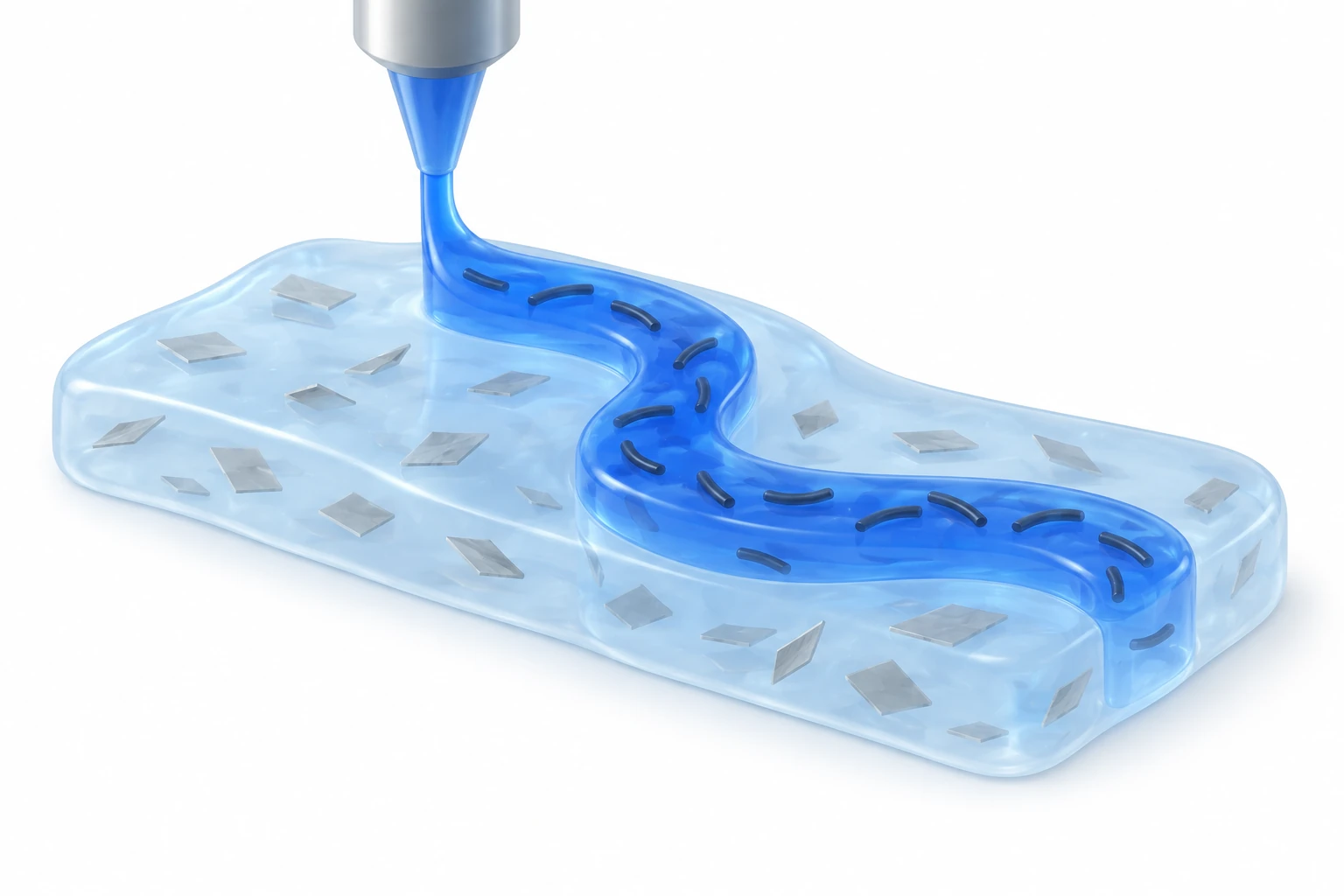
AI-generated printing concept separating a nanoclay-containing THIN-X support from a functionalized-CNT-containing THIN-C conductive path. Formulation, filler distribution, device geometry and recovery performance are not reproduced.
Gray plates and short curves symbolize nanoclay and CNTs. They do not measure size, loading, orientation, dispersion or a percolating network. Transparency exposes conceptual internal roles; skin adhesion and whole-device repair are not implied.
This is not a reproduced paper figure and does not establish permission to reuse the original figure.
Generated in ChatGPT on the web from concepts in a public paper and checked for conceptual consistency within the selected main-text reading and stated independent-review scope. This does not claim a complete main-text or supplement audit. Display processing is limited to WebP encoding, without cropping or content editing.
Evaluation and conditions
Rheology addresses extrusion and shape retention, mechanical tests address deformation, and resistance measurements address sensing. Porcine-skin adhesion is another endpoint. Adhesion involving additional NHS functionalization should not be assigned indiscriminately to every base formulation.
Key findings
After five minutes of rejoining cut THIN-X, fracture stress and the stress–strain response were reported to return to initial levels. Separation away from the rejoined interface further supports the dynamic-bond recovery mechanism. This mechanical result does not establish simultaneous repair of wiring, skin adhesion or an entire printed device.
Limits and open questions
Comparisons need nozzle/path conditions, hydration, specimen dimensions and electrode layout. Repeated-use changes in water content and attachment remain follow-up questions. The inspected experiments do not establish long-term human use or clinical-grade sensing.
Related external research
3D printing of conducting polymers
DOI: 10.1038/s41467-020-15316-7 ↗
Yuk prints intrinsically conducting PEDOT:PSS structures and neural electrodes; THIN tunes a CNT-filled hydrogel network.
Conduction and hydration differ, so conductivity alone cannot rank them. External printing, properties and device sections were read.
Full text checkedCorresponding-author verification
Jungmok Seo: corresponding authorThis record concerns Jungmok Seo’s correspondence designation. Author order or an asterisk alone is not treated as confirmation; this check is separate from verification of the research content.
- Correspondence evidence source ↗
* Corresponding author. ** Corresponding author. E-mail addresses: [redacted] (K. Park), [redacted] (J. Seo).
Published PDF page 1: correspondence/author information; title and DOI page 1 · local_published_pdf_read
- Main-text review scope
- Publisher retrieval returned 403 and PubMed metadata was cross-checked. Read local published PDF Methods §2.7–2.9, Results §3–4, Fig. 4, Conclusion and pp. 3–8 on THIN-X/THIN-C roles. This is not a complete SI audit.
- Supplementary review scope
- Supporting information was not comprehensively read. A main-text citation to supplementary results does not count as direct inspection of those results.
- Pending verification
- https://www.sciencedirect.com/science/article/abs/pii/S0956566324002628 returned 403. Verify supplementary and prolonged-exposure evidence at school.
COVERAGE & OUTREACH
Coverage and outreach
Links are checked for their relationship to this paper. Media publication does not establish independent reporting or additional experimental validation.
No related outreach link was verified against its body within these searches. This does not establish that none exists.
Channel coverage and search log for all 101 records →Sources and verification scope
Publisher retrieval returned 403 and PubMed metadata was cross-checked. Read local published PDF Methods §2.7–2.9, Results §3–4, Fig. 4, Conclusion and pp. 3–8 on THIN-X/THIN-C roles. This is not a complete SI audit.
The additional commentary is editorially approved within the stated evidence scope. This does not imply complete verification of all main-text and supplementary material.
- Additional main-text review scope
- Publisher retrieval returned 403 and PubMed metadata was cross-checked. Read local published PDF Methods §2.7–2.9, Results §3–4, Fig. 4, Conclusion and pp. 3–8 on THIN-X/THIN-C roles. This is not a complete SI audit.
- Additional supplementary review scope
- Supporting information was not comprehensively read. A main-text citation to supplementary results does not count as direct inspection of those results.
- Public publication baseline ↗ · #77 · 2026-10-03
- Crossref metadata ↗: Only public bibliographic metadata registered with Crossref was checked. This does not mean that the publisher page, abstract, or full text was read; full-text verification in the school Chrome session remains pending. license_urls lists registered links and does not establish permission to redistribute text or figures. It may include TDM or posting-policy links.
- Modulus-tunable Multifunctional Hydrogel Ink with Nanofillers for 3D-Printed Soft Electronics ↗
public_bibliography · PubMed title and DOI - Modulus-tunable Multifunctional Hydrogel Ink with Nanofillers for 3D-Printed Soft Electronics ↗
local_pdf_read · BLS05_BiosensBioelectron_2024_Modulus_Tunable_Hydrogel_Ink_MAIN.pdf; Methods 2.7–2.9; Fig. 4 porcine-skin interface/adhesion; Sections 3–4; wearable strain sensor; Conclusion; title and DOI matched; PDF not redistributed - Modulus-tunable multifunctional hydrogel ink with nanofillers for 3D-Printed soft electronics ↗
local_published_pdf_selected_full_text_read · PDF pp. 3–8: THIN design, printing, mechanics and sensor results - Modulus-tunable multifunctional hydrogel ink with nanofillers for 3D-Printed soft electronics ↗
local_published_pdf_selected_full_text_read · PDF pp. 3–6: THIN-X nanoclay versus THIN-C functionalized CNT roles - Modulus-tunable multifunctional hydrogel ink with nanofillers for 3D-Printed soft electronics ↗
local_published_pdf_selected_full_text_read · Methods §2.7–2.9; Fig. 4 porcine-skin adhesion; NHS-functionalization distinction; printed-sensor results - Modulus-tunable multifunctional hydrogel ink with nanofillers for 3D-Printed soft electronics ↗
local_published_pdf_selected_full_text_read · PDF p. 7: self-healing Results and Fig. 3F–H; fracture-stress definition and five-minute rejoining condition - Modulus-tunable multifunctional hydrogel ink with nanofillers for 3D-Printed soft electronics ↗
local_published_pdf_selected_full_text_read · §3–4; editorial hydration, geometry and repeated-use comparison conditions - Modulus-tunable multifunctional hydrogel ink with nanofillers for 3D-Printed soft electronics ↗
independent_reviewer_selected_main_text · Local published-PDF text p.3–8; §2.6–2.12, §3.1–3.4, Figure 1–4 captions. Source cutoff mid-§3.4 is retained as a scope limit. - Additional commentary source ↗
Research background · PDF pp. 3–8: THIN design, printing, mechanics and sensor results · local_published_pdf_selected_full_text_read - Additional commentary source ↗
Approach and advances · PDF pp. 3–6: THIN-X nanoclay versus THIN-C functionalized CNT roles · local_published_pdf_selected_full_text_read - Additional commentary source ↗
Evaluation and conditions · Methods §2.7–2.9; Fig. 4 porcine-skin adhesion; NHS-functionalization distinction; printed-sensor results · local_published_pdf_selected_full_text_read - Additional commentary source ↗
Key findings · PDF p. 7: self-healing Results and Fig. 3F–H; fracture-stress definition and five-minute rejoining condition · local_published_pdf_selected_full_text_read - Additional commentary source ↗
Limits and open questions · §3–4; editorial hydration, geometry and repeated-use comparison conditions · local_published_pdf_selected_full_text_read - Additional commentary source ↗
Connections to related work · THIN conductive composite design; external conducting-polymer printing Results · local_published_pdf_selected_full_text_read - Additional commentary source ↗
Connections to related work · 3D printing of conducting polymers; DOI 10.1038/s41467-020-15316-7; previously verified selected Results · public_external_selected_full_text_read