Research context and placement
Joining dry components and hydrogel–dry interfaces enables assembly of wearable and acute implanted devices. This is an extended component-integration assignment: heterogeneous material assembly extends beyond an interconnect–chip electrical junction.
Boundary case: assigned to the closest interface for navigation. Read the rationale and cross-links together; the primary theme does not delimit the study. Placement of foundational work does not establish direct bioelectronic application.
Bonding dissimilar materials in soft electronics
Soft electronics combine hydrogels, elastomers and electrodes. Even compliant components cannot function together if their interfaces separate. dHAPT focuses on the joining layer rather than requiring every component material to be redesigned.
Approach and advances
The approach uses dried PVA–tannic-acid layers and water-dependent chain mobility. Dry–dry and wet–dry joining start from different states. Dry–dry assembly includes a thermal water-removal step, so the methods should not be described as identical instantaneous bonding conditions.
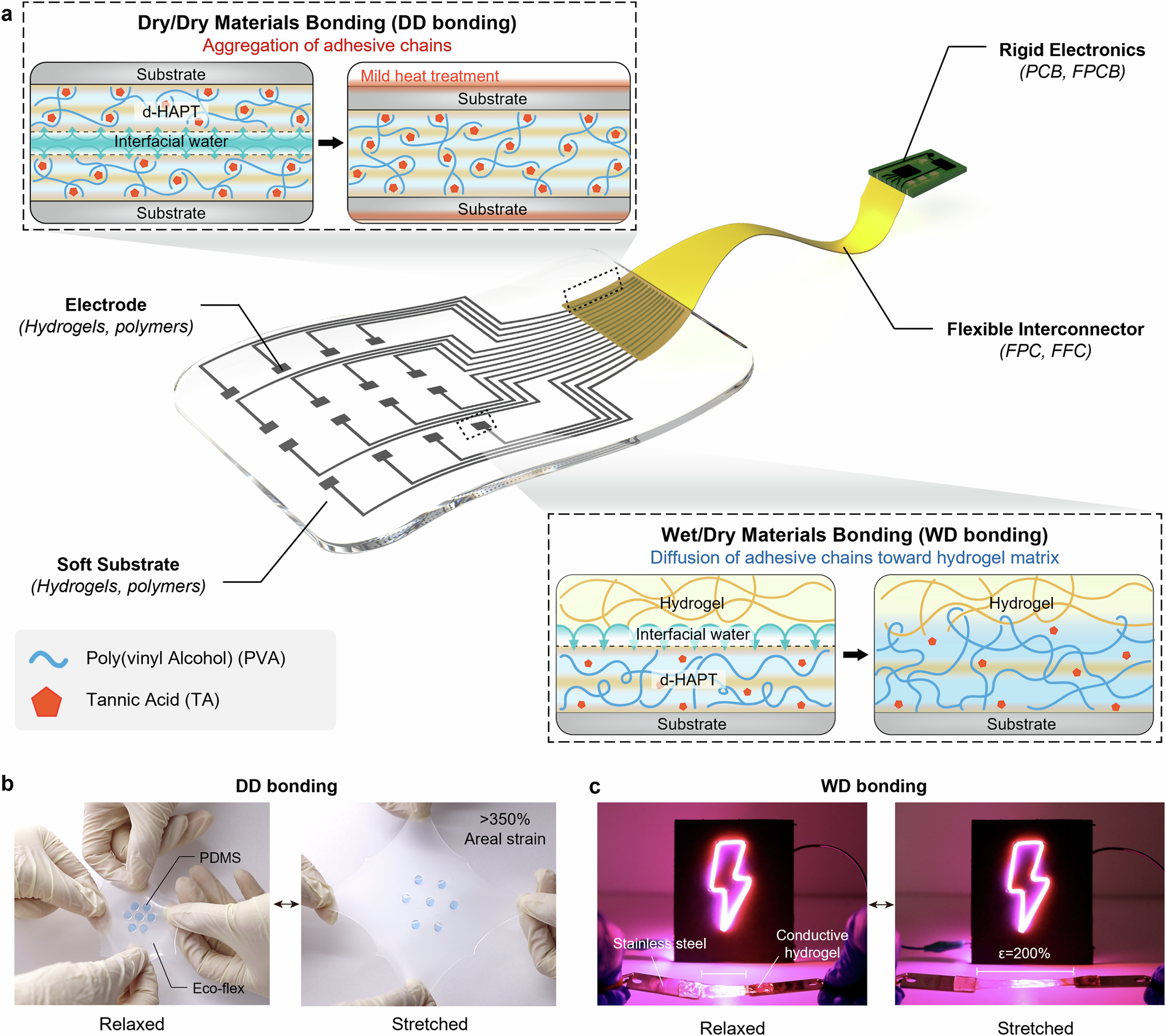
Original paper figure showing d-HAPT bonding across soft substrates, electrodes, interconnects and circuitry, with stretching demonstrations. This is not an AI-generated illustration.
Yejin Jo, Yurim Lee, Jeong Hyun Heo et al.. “Universal hydrogel adhesives with robust chain entanglement for bridging soft electronic materials”. Figure 1. DOI: 10.1038/s41528-024-00327-x. CC BY 4.0. Existing lossless WebP asset reused; original figure pixel content unchanged.
Source figure and caption ↗ · DOI: 10.1038/s41528-024-00327-x ↗ · CC BY 4.0 ↗
Evaluation and conditions
Lap shear and T-peel impose different loading modes. Material, thickness, hydration and assembly conditions must accompany comparisons. Biocompatibility and device demonstrations address additional questions rather than serving as alternative measurements of bond strength.
Key findings
In wet–dry joining, hydrogel on dHAPT-treated Ecoflex stretched with the substrate and retained its interface even when the specimen fractured. On untreated Ecoflex, it delaminated instead. This contrast connects water-mediated joining to deformation transfer between components, without establishing lifetime for every material pair.
Limits and open questions
Follow-up questions concern repeated deformation and water exchange. Acute animal demonstrations do not establish chronic implantation safety. Different pretreatments and adhesive thicknesses prevent simple numeric ranking, and supplements or raw data were not comprehensively audited.
Related external research
Instant tough bonding of hydrogels for soft machines and electronics
Public Results and Bonding to diverse materials were read. Wirthl et al. use cyanoacrylate dispersions for rapid interfacial polymerization, providing a different assembly route from d-HAPT rehydration.
The external study primes silicone substrates. Strength rankings require matched pretreatment, gel composition and peeling tests.
Full text checkedCorresponding-author verification
Jungmok Seo: corresponding authorThis record concerns Jungmok Seo’s correspondence designation. Author order or an asterisk alone is not treated as confirmation; this check is separate from verification of the research content.
- Correspondence evidence source ↗
Correspondence and requests for materials should be addressed to Jungmok Seo.
Published PDF page 13: correspondence/author information; title and DOI page 1 · local_published_pdf_read
- Main-text review scope
- Publisher metadata, abstract, and main-text sections on bonding, mechanical tests and biological applications were read on the public web. Supplements and raw data were not audited. Comparison conditions and follow-up questions are editorial proposals. Rechecked treated/untreated Ecoflex comparison in the WD bonding/durability section, Fig. 4b–c, of the matching local published PDF.
- Supplementary review scope
- Supporting information was not comprehensively read. A main-text citation to supplementary results does not count as direct inspection of those results.
- Pending verification
- Check comparator-adhesive conditions in the supplementary tables and reconcile fatigue/immersion data through school Chrome. Figure 1 reuse conditions are stated below the figure.
COVERAGE & OUTREACH
Coverage and outreach
Links are checked for their relationship to this paper. Media publication does not establish independent reporting or additional experimental validation.
Innovative Hydrogel Adhesives for Seamless Integration of Soft Electronic Devices ↗
The Behind the Paper post identifies the full title, authors and s41528-024-00327-x link and explains d-HAPT dry/wet bonding.
Body read Read the author, date and body. This is the corresponding author’s explanation hosted by a publisher community, not an independent editorial assessment.
연세대 서정목 교수팀, 만능 유연 전자소자 접착 기술 개발 ↗
Seo, Jo and Lee, npj Flexible Electronics and multilayer-hydrogel bonding of dissimilar electronic materials match #80.
Body read Read the date and body. The story relays university/research-team material and is treated as reporting of the same institutional announcement.
연세대 서정목 교수팀, 유연 전자소자 접착 기술 개발 ↗
Seo, Jo and Lee, npj Flexible Electronics and multilayer-hydrogel bonding of dissimilar electronic materials match #80.
Body read Read the date and body. The story relays university/research-team material and is treated as reporting of the same institutional announcement.
Sources and verification scope
Publisher metadata, abstract, and main-text sections on bonding, mechanical tests and biological applications were read on the public web. Supplements and raw data were not audited. Comparison conditions and follow-up questions are editorial proposals. Rechecked treated/untreated Ecoflex comparison in the WD bonding/durability section, Fig. 4b–c, of the matching local published PDF.
The additional commentary is editorially approved within the stated evidence scope. This does not imply complete verification of all main-text and supplementary material.
- Additional main-text review scope
- Publisher metadata, abstract, and main-text sections on bonding, mechanical tests and biological applications were read on the public web. Supplements and raw data were not audited. Comparison conditions and follow-up questions are editorial proposals. Rechecked treated/untreated Ecoflex comparison in the WD bonding/durability section, Fig. 4b–c, of the matching local published PDF.
- Additional supplementary review scope
- Supporting information was not comprehensively read. A main-text citation to supplementary results does not count as direct inspection of those results.
- Public publication baseline ↗ · #80 · 2026-10-03
- Crossref metadata ↗: Only public bibliographic metadata registered with Crossref was checked. This does not mean that the publisher page, abstract, or full text was read; full-text verification in the school Chrome session remains pending. license_urls lists registered links and does not establish permission to redistribute text or figures. It may include TDM or posting-policy links.
- Universal hydrogel adhesives with robust chain entanglement for bridging soft electronic materials ↗
public_web_full_text · Abstract; Results: DD bonding mechanism and durability / WD bonding mechanism; Methods: Bonding process, Lap shear tests, T-peel tests, In vivo biocompatibility test, Implantable bioelectronic device applications. Checked 2026-10-03. - Universal hydrogel adhesives with robust chain entanglement for bridging soft electronic materials ↗
public_publisher_selected_full_text_read · Abstract; Results: DD bonding mechanism and durability; WD bonding mechanism - Universal hydrogel adhesives with robust chain entanglement for bridging soft electronic materials ↗
public_publisher_selected_full_text_read · Results: DD and WD bonding mechanisms; Methods: Bonding process, including DD thermal water removal - Universal hydrogel adhesives with robust chain entanglement for bridging soft electronic materials ↗
public_publisher_selected_full_text_read · Methods: Lap shear tests; T-peel tests; In vivo biocompatibility; Implantable bioelectronic applications - Universal hydrogel adhesives with robust chain entanglement for bridging soft electronic materials ↗
public_publisher_selected_full_text_read · Results: WD bonding mechanism and durability, Fig. 4b–c; treated versus untreated Ecoflex with PAAm–alginate hydrogel - Universal hydrogel adhesives with robust chain entanglement for bridging soft electronic materials ↗
local_published_pdf_selected_full_text_read · Matching published PDF: WD bonding mechanism and durability, Fig. 4b–c paragraphs reread - Universal hydrogel adhesives with robust chain entanglement for bridging soft electronic materials ↗
public_publisher_selected_full_text_read · Methods: bonding and acute biological applications; editorial durability questions - Universal hydrogel adhesives with robust chain entanglement for bridging soft electronic materials ↗
independent_reviewer_selected_main_text · Title/DOI-matched locally held published PDF pp.5–7,9; dry–dry and wet–dry bonding and Ecoflex delamination comparison - Additional commentary source ↗
Research background · Abstract; Results: DD bonding mechanism and durability; WD bonding mechanism · public_publisher_selected_full_text_read - Additional commentary source ↗
Approach and advances · Results: DD and WD bonding mechanisms; Methods: Bonding process, including DD thermal water removal · public_publisher_selected_full_text_read - Additional commentary source ↗
Evaluation and conditions · Methods: Lap shear tests; T-peel tests; In vivo biocompatibility; Implantable bioelectronic applications · public_publisher_selected_full_text_read - Additional commentary source ↗
Key findings · Results: WD bonding mechanism and durability, Fig. 4b–c; treated versus untreated Ecoflex with PAAm–alginate hydrogel · public_publisher_selected_full_text_read - Additional commentary source ↗
Key findings · Matching published PDF: WD bonding mechanism and durability, Fig. 4b–c paragraphs reread · local_published_pdf_selected_full_text_read - Additional commentary source ↗
Limits and open questions · Methods: bonding and acute biological applications; editorial durability questions · public_publisher_selected_full_text_read - Additional commentary source ↗
Connections to related work · Bonding mechanism; related cyanoacrylate paper Results and silicone-primer conditions · public_publisher_selected_full_text_read - Additional commentary source ↗
Connections to related work · Instant tough bonding of hydrogels for soft machines and electronics; DOI 10.1126/sciadv.1700053; previously verified selected Results · public_external_selected_full_text_read