Research context and placement
It separates nonspecific drug loss at lubricated channels from necessary cell attachment on the culture membrane. As an in vitro organ model, its connection to device–host response is extended and remains ambiguous.
Boundary case: assigned to the closest interface for navigation. Read the rationale and cross-links together; the primary theme does not delimit the study. Placement of foundational work does not establish direct bioelectronic application.
Drug loss and cell-culture interfaces in organ-on-a-chip models
PDMS can absorb small molecules, changing the dose reaching cells in an organ chip. Making every surface nonadhesive would also complicate culture. This study separates the roles of drug-contacting channel walls and the cell-supporting substrate.
Approach and advances
Lubricated channel walls address nonspecific loss, while an ECM-coated semiporous PET membrane supports cells. The design assigns different attachment requirements to different regions. Uniform repellency across the entire chip would not serve both purposes.
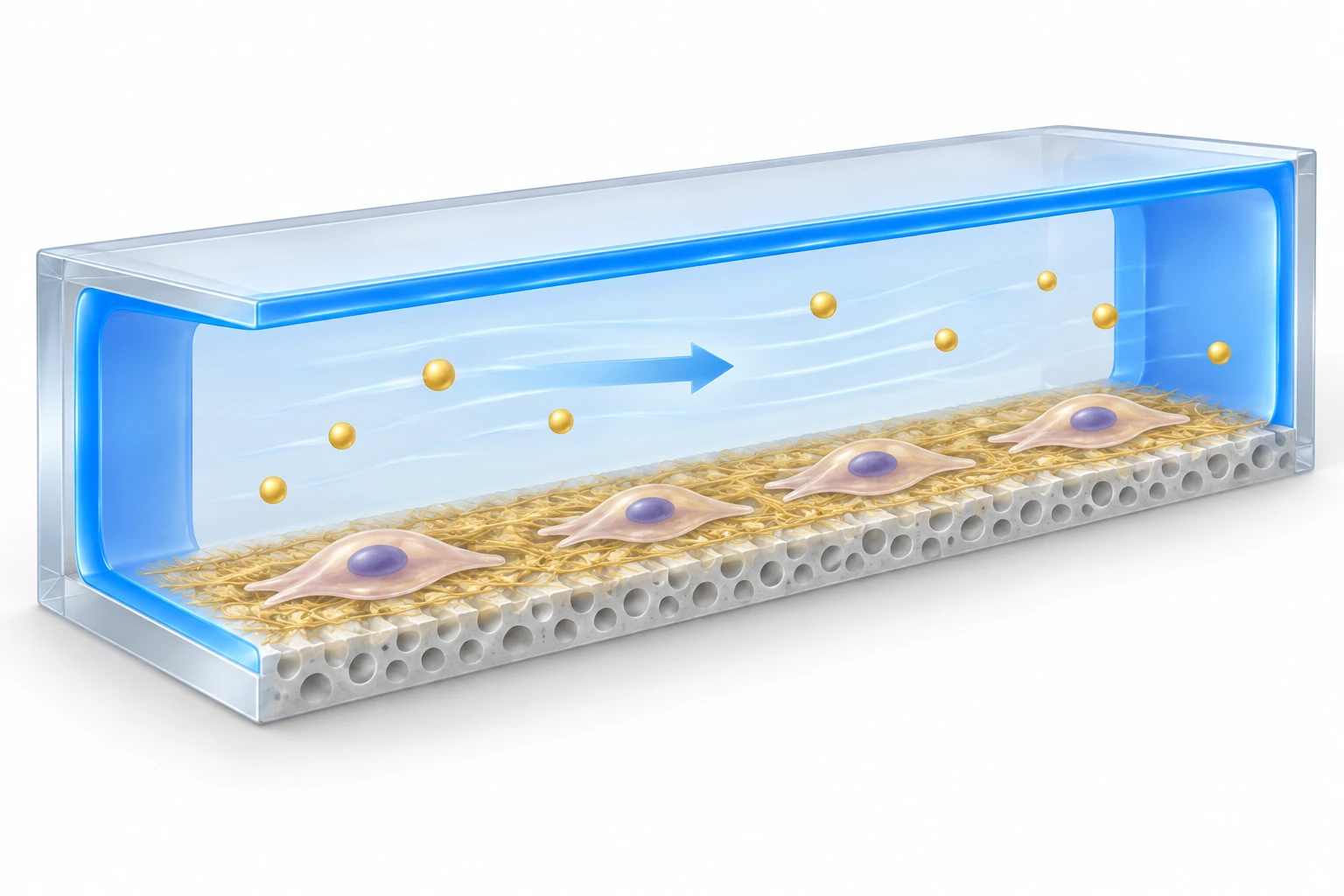
AI-generated concept separating PreD’s lubricated channel walls from its ECM-coated PET cell-support membrane. Only one simplified channel is shown; this is not evidence of drug recovery, toxicity prediction or organ function.
The lower channel is omitted. Enlarged pores, thickness, ECM fibers, cells and solutes are symbols rather than actual pore architecture, morphology, concentration or flow fields. Gold does not signify metal.
This is not a reproduced paper figure and does not establish permission to reuse the original figure.
Generated in ChatGPT on the web from concepts in a public paper and checked for conceptual consistency within the selected main-text reading and stated independent-review scope. This does not claim a complete main-text or supplement audit. Display processing is limited to WebP encoding, without cropping or content editing.
Evaluation and conditions
Empty-chip fluorescence and drug recovery measure losses in the fluid pathway. Gut toxicity and blood–brain-barrier transport ask biological questions in cell-containing chips. Improved recovery alone cannot establish the clinical predictive validity of those models.
Key findings
The gut-model DEX concentration series reported a lower IC50 in PreD than in the conventional chip under matched flow and exposure. This connects reduced device loss with a changed cellular toxicity readout. It remains specific to the DEX/Caco-2 conditions, not validation of clinical toxicity prediction for every drug.
Limits and open questions
Comparisons need molecular properties, concentration, flow, exposure and cell/membrane conditions. Coating durability and broader drug recovery remain follow-up questions. The authors also require further clinical-predictivity validation; this is not an established clinical replacement test.
Related external research
PDMS absorption of small molecules and consequences in microfluidic applications
Toepke and Beebe identify concentration changes caused by PDMS partitioning; PreD addresses this through coating and culture-compartment design.
The external abstract establishes the problem, not uniform loss or coating benefit for every molecule.
Abstract checkedCorresponding-author verification
Jungmok Seo: corresponding authorThis record concerns Jungmok Seo’s correspondence designation. Author order or an asterisk alone is not treated as confirmation; this check is separate from verification of the research content.
- Correspondence evidence source ↗
Corresponding Author — Jungmok Seo
Author information: Tae-Eun Park and Jungmok Seo blocks · public_publisher_author_information_read
- Main-text review scope
- Read public Wiley text on drug recovery, gut/BBB models and conclusions. The authors explicitly require further validation of clinical predictive value.
- Supplementary review scope
- Supporting information was not comprehensively read. A main-text citation to supplementary results does not count as direct inspection of those results.
- Pending verification
- Verify the supplementary drug panel, oxygen-transport evidence and longer culture limits at school.
COVERAGE & OUTREACH
Coverage and outreach
Links are checked for their relationship to this paper. Media publication does not establish independent reporting or additional experimental validation.
Innovative PreD Chip for Drug Testing developed ↗
The feature explicitly supplies the exact title and DOI 10.1002/smll.202402431 and identifies the Seo–Park PreD collaboration.
Body read Read the feature body and Find out more citation. No feature publication date was visible; the paper date was not substituted.
연세대, UNIST와 '약물 테스트 칩, PreD' 개발 ↗
Seo, Kim, Park and Choi, Small, and PFPE-coated PDMS PreD technology match #81.
Body read Read the body, byline and date. It explicitly attributes the announcement to Yonsei; no independent follow-up testing or outside-expert validation was established.
Sources and verification scope
Read public Wiley text on drug recovery, gut/BBB models and conclusions. The authors explicitly require further validation of clinical predictive value.
The additional commentary is editorially approved within the stated evidence scope. This does not imply complete verification of all main-text and supplementary material.
- Additional main-text review scope
- Read public Wiley text on drug recovery, gut/BBB models and conclusions. The authors explicitly require further validation of clinical predictive value.
- Additional supplementary review scope
- Supporting information was not comprehensively read. A main-text citation to supplementary results does not count as direct inspection of those results.
- Public publication baseline ↗ · #81 · 2026-10-03
- Crossref metadata ↗: Only public bibliographic metadata registered with Crossref was checked. This does not mean that the publisher page, abstract, or full text was read; full-text verification in the school Chrome session remains pending. license_urls lists registered links and does not establish permission to redistribute text or figures. It may include TDM or posting-policy links.
- Lubricant-Coated Organ-on-a-Chip for Enhanced Precision in Preclinical Drug Testing ↗
public_web_full_text · Drug recovery; gut model; BBB model; Section 3 Conclusion - Lubricant‐Coated Organ‐on‐a‐Chip for Enhanced Precision in Preclinical Drug Testing ↗
public_publisher_selected_full_text_read · §2.1: channel-wall versus cell-substrate design; drug-recovery explanation - Lubricant‐Coated Organ‐on‐a‐Chip for Enhanced Precision in Preclinical Drug Testing ↗
public_publisher_selected_full_text_read · §2.1: lubricated walls and ECM-coated semiporous PET membrane - Lubricant‐Coated Organ‐on‐a‐Chip for Enhanced Precision in Preclinical Drug Testing ↗
public_publisher_selected_full_text_read · Empty-chip drug recovery; gut toxicity model; BBB transport model - Lubricant‐Coated Organ‐on‐a‐Chip for Enhanced Precision in Preclinical Drug Testing ↗
public_publisher_selected_full_text_read · §2.4 Sensitive Drug Toxicity Test, Fig. 4B–D; one-day exposure and matched 30 µL/h flow described in main text - Lubricant‐Coated Organ‐on‐a‐Chip for Enhanced Precision in Preclinical Drug Testing ↗
public_publisher_selected_full_text_read · §3 Conclusion: clinical predictive validation; editorial comparison conditions - Lubricant‐Coated Organ‐on‐a‐Chip for Enhanced Precision in Preclinical Drug Testing ↗
independent_reviewer_selected_main_text · Public Wiley §2.1 architecture, §2.2–2.3 recovery/cell assays, §2.4 DEX toxicity; BBB sections not independently fully read in this pass - Additional commentary source ↗
Research background · §2.1: channel-wall versus cell-substrate design; drug-recovery explanation · public_publisher_selected_full_text_read - Additional commentary source ↗
Approach and advances · §2.1: lubricated walls and ECM-coated semiporous PET membrane · public_publisher_selected_full_text_read - Additional commentary source ↗
Evaluation and conditions · Empty-chip drug recovery; gut toxicity model; BBB transport model · public_publisher_selected_full_text_read - Additional commentary source ↗
Key findings · §2.4 Sensitive Drug Toxicity Test, Fig. 4B–D; one-day exposure and matched 30 µL/h flow described in main text · public_publisher_selected_full_text_read - Additional commentary source ↗
Limits and open questions · §3 Conclusion: clinical predictive validation; editorial comparison conditions · public_publisher_selected_full_text_read - Additional commentary source ↗
Connections to related work · PDMS drug-loss discussion; external abstract · public_publisher_selected_full_text_read - Additional commentary source ↗
Connections to related work · PDMS absorption of small molecules and consequences in microfluidic applications; DOI 10.1039/b612140c; previously verified Abstract · public_external_abstract_read