Research context and placement
The central process joins electrodes, receiving coils and a soft substrate through different inks. Tissue contact and stimulation provide a secondary connection; placement does not rely on sensing performance alone.
Research background
Wound geometry changes the fit and placement of electrodes and coils. CARE addresses a fabrication workflow that begins with the wound shape. Geometry recognition must be connected to delivered stimulation to assess what customization accomplishes.
Approach and advances
Depth imaging informs electrode and coil design, followed by sequential robotic printing of different inks. The workflow links geometry to fabrication. However, wound data are manually transferred to MATLAB, so the demonstrated process is not fully autonomous.
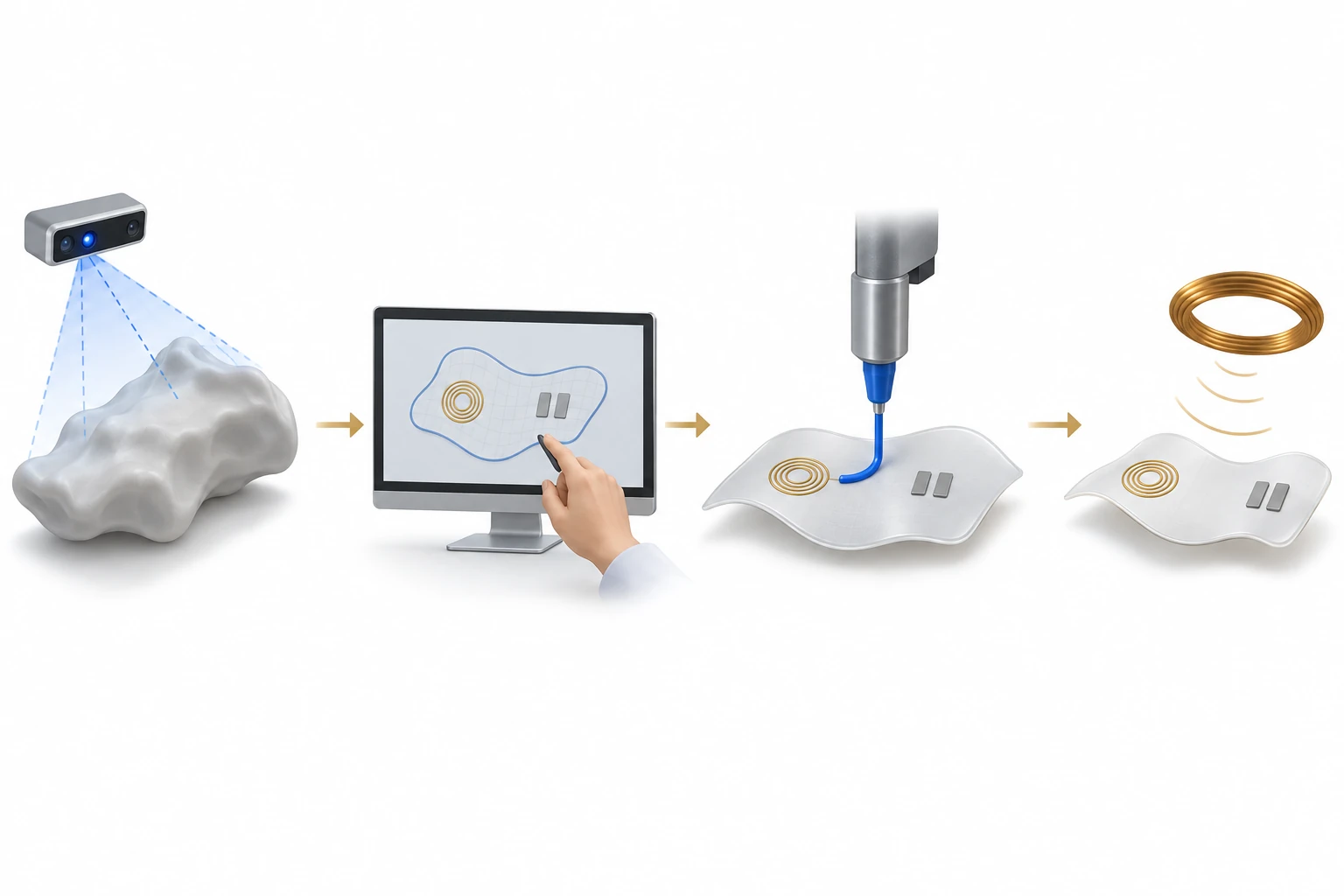
AI-generated, not-to-scale concept of CARE’s geometry-informed, manually assisted design and sequential printing with different inks. The printing scene shows one moment with one active nozzle; other ink stages are omitted. The electrodes and receiving coil on the carrier and the separate external excitation coil are functional symbols, not an actual circuit, experimental evidence or a clinical-treatment result.
A generic phantom, design screen and flexible carrier illustrate fabrication roles only. Other ink-printing stages and detailed electrical routing are omitted. Actual layer count, material colors, circuit connections, nozzle geometry, coil turns or alignment, fields, power-transfer performance, healing, dimensions and proportions are not reconstructed. This is neither microscopy nor a fabrication instruction.
This is not a reproduced paper figure and does not establish permission to reuse the original figure.
Generated in ChatGPT on the web from concepts within the stated public-evidence scope and independently reviewed as a concept. This is not verification of the complete article body or supplementary information. Only display WebP encoding was applied, without cropping, resizing or content editing.
Evaluation and conditions
Wireless coupling depends on coil geometry, distance and load. Simulated tissue fields and cell proliferation, migration and vascular assays address separate steps. A modeled field is not an in-vivo dose measurement, and cell culture is not animal wound closure.
Key findings
Compared with unstimulated cultures, stimulated fibroblasts and endothelial cells showed greater migration, and endothelial tube assays produced more junctions. Migration and tube assays used a 20% duty cycle with different exposure times; proliferation and other readouts used separate settings. These remain cell-level observations, not demonstrated animal wound closure or patient-specific optimal treatment.
Limits and open questions
Manual data transfer and the external excitation hardware remain workflow constraints. Motion-dependent coupling and reproducible dose also need validation. Biological claims here remain bounded to the inspected fibroblast and endothelial-cell assessments, not clinical treatment efficacy.
Related external research
Wireless, closed-loop, smart bandage with integrated sensors and stimulators for advanced wound care and accelerated healing
DOI: 10.1038/s41587-022-01528-3 ↗
Jiang addresses closed-loop sensing/stimulation and animal wounds; CARE emphasizes fabrication of personalized electrodes and coils.
External evidence is the public abstract; animal healing cannot be ranked directly against CARE cell-migration assays.
Abstract checkedCorresponding-author verification
Jungmok Seo: corresponding authorThis record concerns Jungmok Seo’s correspondence designation. Author order or an asterisk alone is not treated as confirmation; this check is separate from verification of the research content.
- Correspondence evidence source ↗
Corresponding Author — Jungmok Seo
Author information: all three Corresponding Author blocks; local PDF pp. 1–2 email match · public_publisher_author_information_read
- Correspondence evidence source ↗
J. Seo; E-mail: [redacted]
Published PDF page 1: linked author affiliation and E-mail; title and DOI · local_published_pdf_read
- Main-text review scope
- Read publisher Abstract and pp. 10–12, Figs. 5–6 and Conclusion of the title/DOI-matched local published PDF. Rechecked manual MATLAB transfer, wireless operation and cellular-assay boundaries. Local PDF access is distinct from publisher-web full text.
- Supplementary review scope
- Supporting information was not comprehensively read. A main-text citation to supplementary results does not count as direct inspection of those results.
- Pending verification
- Verify supplementary circuit/coil optimization at school; assess any later automation separately from this publication.
COVERAGE & OUTREACH
Coverage and outreach
Links are checked for their relationship to this paper. Media publication does not establish independent reporting or additional experimental validation.
Large Scale Ultrafast Manufacturing of Wireless Soft Bioelectronics Enabled by Autonomous Robot Arm Printing Assisted by a Computer Vision‐Enabled Guidance System for Personalized Wound Healing ↗
The coauthor’s post states the full paper title and describes CARE’s computer-vision/robot-arm manufacturing; the account name matches the author list.
Body read Read the public post body and paper-link card without login. Only the relative date “1y” was visible, so no exact date is assigned; no engagement actions were taken.
Sources and verification scope
Read publisher Abstract and pp. 10–12, Figs. 5–6 and Conclusion of the title/DOI-matched local published PDF. Rechecked manual MATLAB transfer, wireless operation and cellular-assay boundaries. Local PDF access is distinct from publisher-web full text.
The additional commentary is editorially approved within the stated evidence scope. This does not imply complete verification of all main-text and supplementary material.
- Additional main-text review scope
- Read publisher Abstract and pp. 10–12, Figs. 5–6 and Conclusion of the title/DOI-matched local published PDF. Rechecked manual MATLAB transfer, wireless operation and cellular-assay boundaries. Local PDF access is distinct from publisher-web full text.
- Additional supplementary review scope
- Supporting information was not comprehensively read. A main-text citation to supplementary results does not count as direct inspection of those results.
- Public publication baseline ↗ · #82 · 2026-10-03
- Crossref metadata ↗: Only public bibliographic metadata registered with Crossref was checked. This does not mean that the publisher page, abstract, or full text was read; full-text verification in the school Chrome session remains pending. Crossref's primary publication year is 2024; the original year 2025 also occurs among online/print publication dates, so this is not classified as a substantive mismatch. license_urls lists registered links and does not establish permission to redistribute text or figures. It may include TDM or posting-policy links.
- Large Scale Ultrafast Manufacturing of Wireless Soft Bioelectronics Enabled by Autonomous Robot Arm Printing Assisted by a Computer Vision-Enabled Guidance System for Personalized Wound Healing ↗
public_publisher_abstract · Abstract - Large Scale Ultrafast Manufacturing of Wireless Soft Bioelectronics Enabled by Autonomous Robot Arm Printing Assisted by a Computer Vision-Enabled Guidance System for Personalized Wound Healing ↗
local_pdf_read · BLS15_AdvHealthcareMater_2025_Robot_Printed_Bioelectronics_MAIN.pdf; pp. 10–12, Fig. 6 and Conclusion; title and DOI matched; PDF not redistributed - Large Scale Ultrafast Manufacturing of Wireless Soft Bioelectronics Enabled by Autonomous Robot Arm Printing Assisted by a Computer Vision‐Enabled Guidance System for Personalized Wound Healing ↗
local_published_pdf_selected_full_text_read · PDF pp. 10–11: integrated workflow and Conclusion - Large Scale Ultrafast Manufacturing of Wireless Soft Bioelectronics Enabled by Autonomous Robot Arm Printing Assisted by a Computer Vision‐Enabled Guidance System for Personalized Wound Healing ↗
local_published_pdf_selected_full_text_read · PDF pp. 10–11: design/printing workflow; manual MATLAB transfer limitation in Conclusion - Large Scale Ultrafast Manufacturing of Wireless Soft Bioelectronics Enabled by Autonomous Robot Arm Printing Assisted by a Computer Vision‐Enabled Guidance System for Personalized Wound Healing ↗
local_published_pdf_selected_full_text_read · PDF p. 10 and Fig. 5: wireless operation; p. 12 and Fig. 6: cellular evaluation - Large Scale Ultrafast Manufacturing of Wireless Soft Bioelectronics Enabled by Autonomous Robot Arm Printing Assisted by a Computer Vision‐Enabled Guidance System for Personalized Wound Healing ↗
local_published_pdf_selected_full_text_read · PDF p. 11: cellular-response Results; p. 12 Fig. 6D–G: migration and tube-formation controls, with assay-specific exposure/duty cycles - Large Scale Ultrafast Manufacturing of Wireless Soft Bioelectronics Enabled by Autonomous Robot Arm Printing Assisted by a Computer Vision‐Enabled Guidance System for Personalized Wound Healing ↗
local_published_pdf_selected_full_text_read · PDF p. 11: manual transfer and external hardware limitations; p. 12: cell-assessment scope - Large Scale Ultrafast Manufacturing of Wireless Soft Bioelectronics Enabled by Autonomous Robot Arm Printing Assisted by a Computer Vision‐Enabled Guidance System for Personalized Wound Healing ↗
independent_reviewer_selected_main_text · Local published-PDF text p.10–12, Figure 5–6 captions, §2.6, Conclusion portion on those pages - Additional commentary source ↗
Research background · PDF pp. 10–11: integrated workflow and Conclusion · local_published_pdf_selected_full_text_read - Additional commentary source ↗
Approach and advances · PDF pp. 10–11: design/printing workflow; manual MATLAB transfer limitation in Conclusion · local_published_pdf_selected_full_text_read - Additional commentary source ↗
Evaluation and conditions · PDF p. 10 and Fig. 5: wireless operation; p. 12 and Fig. 6: cellular evaluation · local_published_pdf_selected_full_text_read - Additional commentary source ↗
Key findings · PDF p. 11: cellular-response Results; p. 12 Fig. 6D–G: migration and tube-formation controls, with assay-specific exposure/duty cycles · local_published_pdf_selected_full_text_read - Additional commentary source ↗
Limits and open questions · PDF p. 11: manual transfer and external hardware limitations; p. 12: cell-assessment scope · local_published_pdf_selected_full_text_read - Additional commentary source ↗
Connections to related work · PDF pp. 10–12; external abstract · local_published_pdf_selected_full_text_read - Additional commentary source ↗
Connections to related work · Wireless, closed-loop, smart bandage with integrated sensors and stimulators for advanced wound care and accelerated healing; DOI 10.1038/s41587-022-01528-3; previously verified Abstract · public_external_abstract_read