Research context and placement
Lubrication and immobilized BDNF combine resistance to nonspecific attachment with neural interaction. The focus on surface–tissue responses during chronic recording supports a host-interaction assignment.
Fiber probes for neural recording and tissue interaction
An implanted neural probe must record signals while remaining in prolonged contact with tissue. Suppressing nonspecific attachment is useful, but eliminating beneficial neuronal interactions is not the objective. TAB connects this selectivity problem to a flexible fiber-probe interface.
Approach and advances
The lubricated interface is combined with BDNF-related functionality to retain targeted neuronal interaction while resisting nonspecific adhesion. The principle is selective interaction, not universal cell repellency. Probe functionality and surface biology remain distinct design layers.
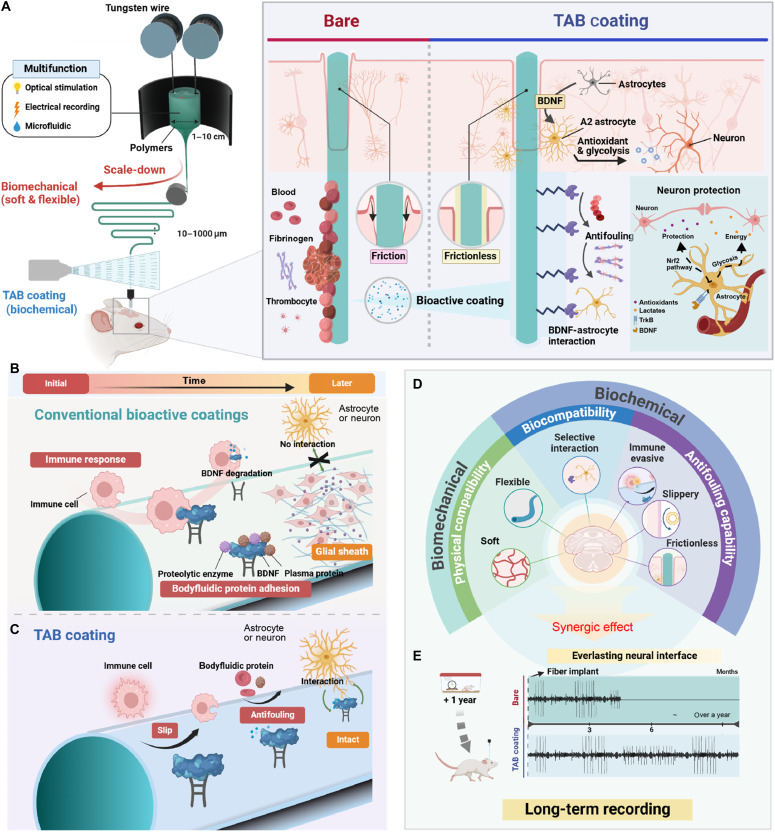
Flexible neural-fiber construction, TAB versus conventional coatings, and mechanical/biochemical functions.
Tae Young Kim, Yeonzu Son, Keun-Young Yook et al.. “Bioadaptive liquid-infused multifunctional fibers for long-term neural recording via BDNF stabilization and enhanced neural interaction”. Figure 1. DOI: 10.1126/sciadv.adz1228. CC BY-NC 4.0. Existing original JPEG asset reused without changes.
Source figure and caption ↗ · DOI: 10.1126/sciadv.adz1228 ↗ · CC BY-NC 4.0 ↗
Noncommercial academic use requires author/source attribution, the license link and disclosure of changes.
Evaluation and conditions
Long-term recording requires electrode counts and analysis windows, not duration alone. Tissue-response and electrical-recording endpoints answer different questions. The read Fig. 6 analysis does not justify inferring survival of every electrode or unreported animal denominators.
Key findings
TAB-coated fibers provided representative single-unit recordings up to twelve months. Comparative statistics used a separate eight-month window, during which detected units per electrode were maintained in coated fibers but declined in bare fibers. Representative duration and statistical coverage do not establish identical twelve-month performance for every electrode or a lifetime multiplier.
Limits and open questions
Further comparison requires electrode attrition and matched recording criteria. A long observation period does not permit inventing supplementary conditions or lifetime multipliers. This is an account of the read results, not a complete raw-data reanalysis.
Related external research
Multifunctional fibers for simultaneous optical, electrical and chemical interrogation of neural circuits in vivo
Publisher abstract and metadata were read. Canales et al. integrate recording, optics and fluid delivery in drawn fibers; TAB adds a focus on surface biochemistry and host response.
External full text was not read. Study duration also reflects endpoints, so reported durations cannot establish a device-lifetime improvement factor.
Abstract checkedCorresponding-author verification
Jungmok Seo: corresponding authorThis record concerns Jungmok Seo’s correspondence designation. Author order or an asterisk alone is not treated as confirmation; this check is separate from verification of the research content.
- Correspondence evidence source ↗
*Corresponding author. Email: [redacted] (J.S.); [redacted] (S.P.)
Published PDF page 1: correspondence/author information; title and DOI page 1 · local_published_pdf_read
- Main-text review scope
- The public web supplied PubMed metadata, abstract and captions. Publisher/PMC retrieval errors required reading the matching local publisher PDF for neural-recording Results, Discussion and Fig. 6 (local_pdf_read). Supplements and raw data were not audited.
- Supplementary review scope
- Supporting information was not comprehensively read. A main-text citation to supplementary results does not count as direct inspection of those results.
- Pending verification
- Reconcile the latest publisher version and supplements through school Chrome, including electrode placement, long-term sample attrition and single-unit tracking criteria. Figure 1 is included under CC BY-NC 4.0 for this noncommercial academic library.
COVERAGE & OUTREACH
Coverage and outreach
Links are checked for their relationship to this paper. Media publication does not establish independent reporting or additional experimental validation.
서정목 교수팀, 뇌-컴퓨터 인터페이스 장기 안정성 극복할 신경 전극 코팅 기술 개발 ↗
TAB/BDNF, Seo/Park/Kim/Son and Science Advances identify #85.
Body read The release body and date were read. Performance statements were used for identity matching, not as independent evidence.
Bioadaptive Liquid-Infused Multifunctional Fibers for Long-Term Neural Recording via BDNF Stabilization and Enhanced Neural Interaction ↗
The exact title, Prof. Seongjun Park, TAB/BDNF description and linked DOI match.
Body read The English Research Highlights body was read. No displayed absolute publication date was found.
뇌·컴퓨터 인터페이스 신호 1년 이상 기록한다 ↗
The article explicitly supplies DOI 10.1126/sciadv.adz1228; TAB and the team match.
Body read The article body and date were read. Its study description and quotations track the institutional release; it is not counted as verified independent reporting.
[22일 대학가] 세종대·중앙대·한양대·연세대 ↗
The Yonsei subsection identifies #85 through TAB/BDNF, Seo/Park and Science Advances.
Partial body read The date and Yonsei subsection were read. Other universities' studies were excluded. The subsection relays the Yonsei announcement's narrative and quotations.
New paper on neural recording technology published in Science Advances ↗
The exact title, DOI 10.1126/sciadv.adz1228, TAB and coauthors are stated.
Body read The public post and linked paper title were read. Only a relative timestamp was shown, so the date is null. This is author promotion, not independent validation.
Device–tissue interfaces: prior studies, ELFS biliary stents and FLUID ureteral stents ↗
The post describes prior work on long-term neural recording through bioadaptive interfaces. DOI 10.1126/sciadv.adz1228, documented as the destination of the in-body shortened link, matches the title and DOI of #85 in the public 101-paper catalogue.
Body read Based on a verification record documenting the post body, “Worldwide” visibility and DOI destinations of six shortened links in a logged-in session. The publication date was determined from the “4 hours” display observed at 22:37 KST on 2026-10-03; the exact publication time remains unverified. DOI destinations were checked on LinkedIn’s external-link notice screens; this does not represent a new review of publisher full text. This is researcher-authored promotion, not independent reporting or additional experimental validation.
Unverified candidates and access limits (1)
Unverified candidate · Bioadaptive liquid-infused multifunctional fibers for long-term neural recording via BDNF stabilization and enhanced neural interaction ↗
The indexed presentation title matches, but the presentation body and author match remain unverified.
Body access limited The presentation detail page could not be opened. This title-only candidate is excluded from verified counts.
Sources and verification scope
The public web supplied PubMed metadata, abstract and captions. Publisher/PMC retrieval errors required reading the matching local publisher PDF for neural-recording Results, Discussion and Fig. 6 (local_pdf_read). Supplements and raw data were not audited.
The additional commentary is editorially approved within the stated evidence scope. This does not imply complete verification of all main-text and supplementary material.
- Additional main-text review scope
- The public web supplied PubMed metadata, abstract and captions. Publisher/PMC retrieval errors required reading the matching local publisher PDF for neural-recording Results, Discussion and Fig. 6 (local_pdf_read). Supplements and raw data were not audited.
- Additional supplementary review scope
- Supporting information was not comprehensively read. A main-text citation to supplementary results does not count as direct inspection of those results.
- Public publication baseline ↗ · #85 · 2026-10-03
- Crossref metadata ↗: Only public bibliographic metadata registered with Crossref was checked. This does not mean that the publisher page, abstract, or full text was read; full-text verification in the school Chrome session remains pending. No license link is present in Crossref; redistribution rights have not been established.
- Bioadaptive liquid-infused multifunctional fibers for long-term neural recording via BDNF stabilization and enhanced neural interaction ↗
public_web_abstract_and_captions · Bibliographic record; Abstract; Figs. 1-6 captions. DOI 10.1126/sciadv.adz1228, Science Advances 11(37), eadz1228. Checked 2026-10-03. - Matching local publisher PDF: TAB-coated multifunctional fibers ↗
local_pdf_read · PDF/article p. 11: Long-term electrophysiology recording and Discussion; p. 12: Fig. 6G-I (electrode counts and analysis window); p. 1 and final article-information page: title/DOI and CC BY-NC statement. Publisher/PMC public-web full text not verified. - Bioadaptive liquid-infused multifunctional fibers for long-term neural recording via BDNF stabilization and enhanced neural interaction ↗
local_published_pdf_selected_full_text_read · PDF p. 11: Discussion; public Abstract and Figs. 1–6 captions - Bioadaptive liquid-infused multifunctional fibers for long-term neural recording via BDNF stabilization and enhanced neural interaction ↗
public_web_abstract_and_captions_read · Abstract and Figs. 1–6 captions - Bioadaptive liquid-infused multifunctional fibers for long-term neural recording via BDNF stabilization and enhanced neural interaction ↗
local_published_pdf_selected_full_text_read · PDF p. 11: Long-term electrophysiology recording; p. 12: Fig. 6G–I electrode counts and analysis window - Bioadaptive liquid-infused multifunctional fibers for long-term neural recording via BDNF stabilization and enhanced neural interaction ↗
local_published_pdf_selected_full_text_read · PDF p. 11: long-term electrophysiology Results; p. 12: Fig. 6C–I, representative 12-month recordings versus 8-month comparative analysis - Bioadaptive liquid-infused multifunctional fibers for long-term neural recording via BDNF stabilization and enhanced neural interaction ↗
local_published_pdf_selected_full_text_read · PDF pp. 11–12; editorial denominator and comparison questions - Bioadaptive liquid-infused multifunctional fibers for long-term neural recording via BDNF stabilization and enhanced neural interaction ↗
independent_reviewer_selected_main_text · Title/DOI-matched locally held published PDF pp.1,11–12 and Fig.6 caption/statistics window - Additional commentary source ↗
Research background · PDF p. 11: Discussion; public Abstract and Figs. 1–6 captions · local_published_pdf_selected_full_text_read - Additional commentary source ↗
Research background · Abstract and Figs. 1–6 captions · public_web_abstract_and_captions_read - Additional commentary source ↗
Approach and advances · PDF p. 11: Discussion; public Abstract and Figs. 1–6 captions · local_published_pdf_selected_full_text_read - Additional commentary source ↗
Approach and advances · Abstract and Figs. 1–6 captions · public_web_abstract_and_captions_read - Additional commentary source ↗
Evaluation and conditions · PDF p. 11: Long-term electrophysiology recording; p. 12: Fig. 6G–I electrode counts and analysis window · local_published_pdf_selected_full_text_read - Additional commentary source ↗
Key findings · PDF p. 11: long-term electrophysiology Results; p. 12: Fig. 6C–I, representative 12-month recordings versus 8-month comparative analysis · local_published_pdf_selected_full_text_read - Additional commentary source ↗
Limits and open questions · PDF pp. 11–12; editorial denominator and comparison questions · local_published_pdf_selected_full_text_read - Additional commentary source ↗
Connections to related work · PDF p. 11: Discussion; external abstract · local_published_pdf_selected_full_text_read - Additional commentary source ↗
Connections to related work · Multifunctional fibers for simultaneous optical, electrical and chemical interrogation of neural circuits in vivo; DOI 10.1038/nbt.3093; previously verified Abstract · public_external_abstract_read