Research context and placement
Locally read interlayer adhesion, barrier and electrical-insulation evidence fits protective packaging. Acute inflammatory/tissue responses after seven-day subcutaneous implantation support a host cross-link, without establishing chronic biocompatibility.
Protective encapsulation and biofouling in soft implants
Soft implant encapsulation must deform while limiting water and ion ingress. Stiff barriers can fracture, whereas compliant polymers may remain permeable. MOLE addresses this trade-off alongside biofouling by assigning different roles to bonded layers and the outer interface.
Approach and advances
Amine-functionalized silicone and Parylene C form bonded layers addressing delamination and ingress. The oil-infused outer silicone changes the biological contact interface. Antifouling at that surface and electrical protection within the encapsulation are related but distinct functions.
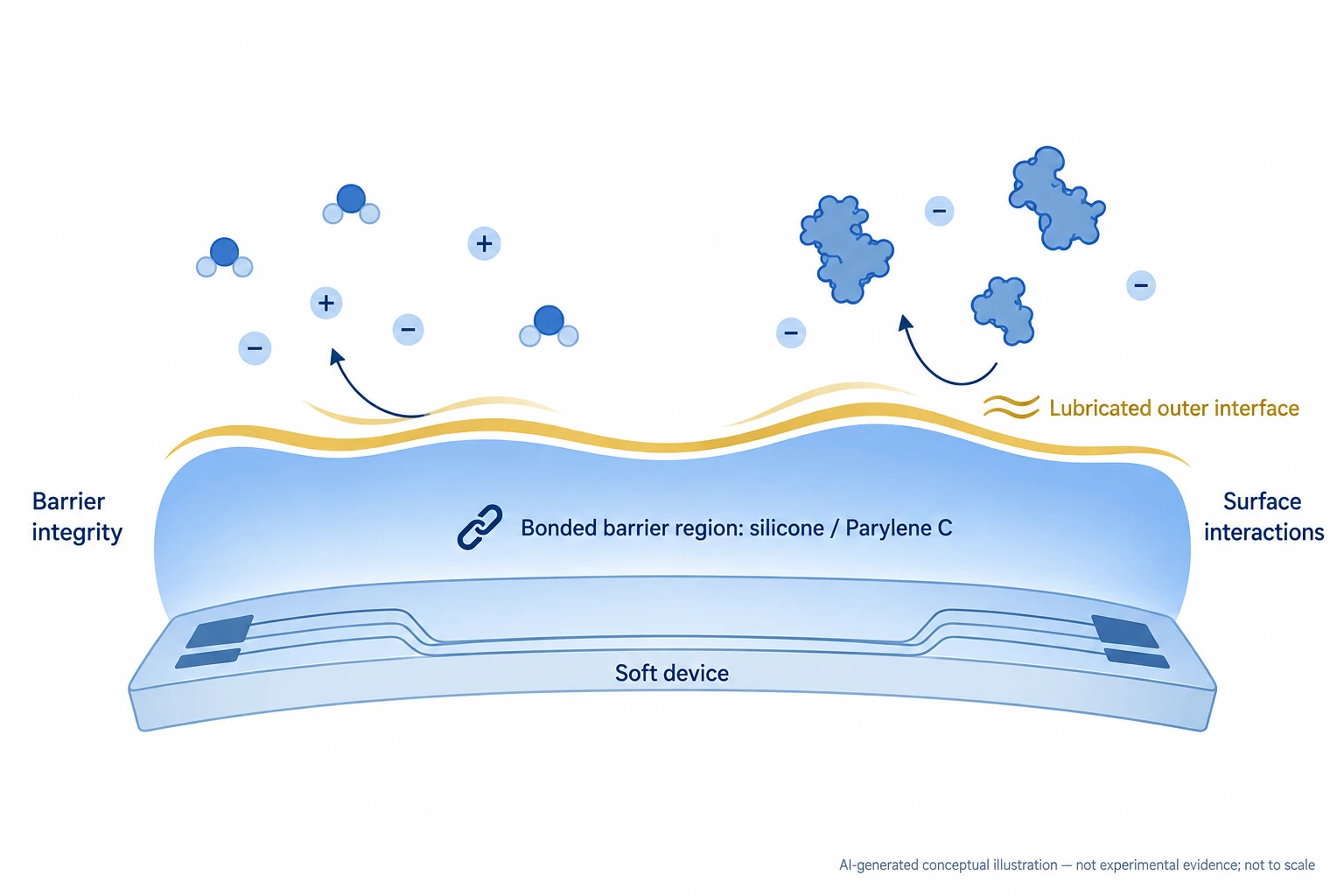
AI-generated concept separating MOLE’s bonded barrier and outer lubricated interface. Electrical protection against water/ion ingress and control of surface attachment require separate evaluations. The image does not reproduce the actual stack or test results.
These are functional regions, not layer counts, thicknesses, bonding chemistry or circuitry. Outward arrows do not specify species-level reflection, expulsion or complete exclusion. The gold lubricant alone is not presented as an indefinite barrier to all ingress.
This is not a reproduced paper figure and does not establish permission to reuse the original figure.
Generated in ChatGPT on the web from concepts in a public paper and checked for conceptual consistency within the selected main-text reading and stated independent-review scope. This does not claim a complete main-text or supplement audit. Display processing is limited to WebP encoding, without cropping or content editing.
Evaluation and conditions
Mechanical tests examine separation; leakage current and impedance in PBS examine electrical isolation. Fouling assays and subcutaneous implantation address biological interaction. The magnesium antenna S11 readout tracks a moisture-sensitive component, rather than the lifetime of every implant architecture.
Key findings
In the PBS electrochemical assessments, MOLE retained high impedance and low leakage longer than the Parylene C comparator. This supports delayed formation of conductive ingress pathways, but impedance change and leakage failure are different criteria. Protein and tissue assessments remain separate evidence for the biological interface.
Limits and open questions
The seven-day implantation window does not establish chronic host response or lubricant retention. Accelerated-temperature testing requires a justified failure model before conversion to physiological lifetime. Longer-term deformation, oil retention and safety remain follow-up questions.
Related external research
Ultraflexible organic photonic skin
The comparator demonstrates conformable encapsulated light-emitting/detecting devices; MOLE addresses bonded layers and fouling in implantation.
On-skin operation is not equivalent to implanted barrier lifetime or immune response.
Abstract checkedCorresponding-author verification
Jungmok Seo: corresponding authorThis record concerns Jungmok Seo’s correspondence designation. Author order or an asterisk alone is not treated as confirmation; this check is separate from verification of the research content.
- Correspondence evidence source ↗
Correspondence: Su Ryon Shin; Jungmok Seo
Published PDF page 1: correspondence/author information; title and DOI page 1 · local_published_pdf_read
- Main-text review scope
- Read selected text, conclusion and leakage-current methods on pages 1–3 and 7–12 of the title/DOI-matched published PDF; rechecked pages 9–12. This is distinct from direct publisher-web full-text access.
- Supplementary review scope
- Supporting information was not comprehensively read. A main-text citation to supplementary results does not count as direct inspection of those results.
- Pending verification
- SI and the basis for accelerated-aging extrapolation remain to be checked. Acute observations and accelerated tests are not presented as long-term clinical lifetime.
COVERAGE & OUTREACH
Coverage and outreach
Links are checked for their relationship to this paper. Media publication does not establish independent reporting or additional experimental validation.
No related outreach link was verified against its body within these searches. This does not establish that none exists.
Channel coverage and search log for all 101 records →Sources and verification scope
Read selected text, conclusion and leakage-current methods on pages 1–3 and 7–12 of the title/DOI-matched published PDF; rechecked pages 9–12. This is distinct from direct publisher-web full-text access.
The additional commentary is editorially approved within the stated evidence scope. This does not imply complete verification of all main-text and supplementary material.
- Additional main-text review scope
- Read selected text, conclusion and leakage-current methods on pages 1–3 and 7–12 of the title/DOI-matched published PDF; rechecked pages 9–12. This is distinct from direct publisher-web full-text access.
- Additional supplementary review scope
- Supporting information was not comprehensively read. A main-text citation to supplementary results does not count as direct inspection of those results.
- Public publication baseline ↗ · #89 · 2026-10-03
- Crossref metadata ↗: Only public bibliographic metadata registered with Crossref was checked. This does not mean that the publisher page, abstract, or full text was read; full-text verification in the school Chrome session remains pending. license_urls lists registered links and does not establish permission to redistribute text or figures. It may include TDM or posting-policy links.
- Mechanically Robust and Anti-biofouling Hybrid Encapsulation via Layered Organic–Liquid Interfaces for Implantable Devices ↗
publisher_registered_abstract_via_Crossref · Crossref response message.abstract, title and DOI; read 2026-10-03; distinguished from direct publisher-site access. - Mechanically Robust and Anti-biofouling Hybrid Encapsulation via Layered Organic–Liquid Interfaces for Implantable Devices ↗
PubMed_abstract_via_Europe_PMC_API · MED/41574976; DOI 10.1002/smll.202510949; abstractText actually read via Europe PMC core API; abstractText, title and doi checked 2026-10-03. - Mechanically Robust and Anti-biofouling Hybrid Encapsulation via Layered Organic–Liquid Interfaces for Implantable Devices ↗
publisher_direct_access_failed · Retrieval error; direct publisher full text not read; 2026-10-03 - Ultraflexible organic photonic skin ↗
PubMed_abstract_via_Europe_PMC_API · MED/27152354; abstractText; DOI 10.1126/sciadv.1501856; read 2026-10-03. - Mechanically Robust and Anti-biofouling Hybrid Encapsulation via Layered Organic–Liquid Interfaces for Implantable Devices ↗
locally_held_publisher_PDF_selected_full_text · Locally held published PDF; title and DOI matched on p. 1. Selected text: pp. 2–3 (architecture), pp. 7–8 (barrier/electrical endpoints), pp. 9–10 (mouse implantation and acute host response), pp. 10–11 (§3 Conclusions), p. 12 (§4.10 Leakage Current Measurement and Electrochemical Impedance Spectroscopy). SI not read. Checked 2026-10-03. - Mechanically Robust and Anti‐Biofouling Hybrid Encapsulation via Layered Organic–Liquid Interfaces for Implantable Devices ↗
local_published_pdf_selected_full_text_read · PDF pp. 1–2: introduction - Mechanically Robust and Anti‐Biofouling Hybrid Encapsulation via Layered Organic–Liquid Interfaces for Implantable Devices ↗
local_published_pdf_selected_full_text_read · PDF pp. 2–3: architecture; p. 11: §4.1 - Mechanically Robust and Anti‐Biofouling Hybrid Encapsulation via Layered Organic–Liquid Interfaces for Implantable Devices ↗
local_published_pdf_selected_full_text_read · PDF pp. 9–10: implant/antenna evaluation; p. 12: §4.10 - Mechanically Robust and Anti‐Biofouling Hybrid Encapsulation via Layered Organic–Liquid Interfaces for Implantable Devices ↗
local_published_pdf_selected_full_text_read · PDF p. 7: PEIS and leakage-current Results; Fig. 4d–g; p. 12 §4.10 defines leakage testing - Mechanically Robust and Anti‐Biofouling Hybrid Encapsulation via Layered Organic–Liquid Interfaces for Implantable Devices ↗
local_published_pdf_selected_full_text_read · PDF p. 11: Conclusions, future validation paragraph - Mechanically Robust and Anti‐Biofouling Hybrid Encapsulation via Layered Organic–Liquid Interfaces for Implantable Devices ↗
independent_reviewer_selected_main_text · Title/DOI-matched locally held published PDF pp.2–3,7–12; Fig.4 EIS/leakage and Fig.5 implant endpoints; selected leakage-current methods - Additional commentary source ↗
Research background · PDF pp. 1–2: introduction · local_published_pdf_selected_full_text_read - Additional commentary source ↗
Approach and advances · PDF pp. 2–3: architecture; p. 11: §4.1 · local_published_pdf_selected_full_text_read - Additional commentary source ↗
Evaluation and conditions · PDF pp. 9–10: implant/antenna evaluation; p. 12: §4.10 · local_published_pdf_selected_full_text_read - Additional commentary source ↗
Key findings · PDF p. 7: PEIS and leakage-current Results; Fig. 4d–g; p. 12 §4.10 defines leakage testing · local_published_pdf_selected_full_text_read - Additional commentary source ↗
Limits and open questions · PDF p. 11: Conclusions, future validation paragraph · local_published_pdf_selected_full_text_read - Additional commentary source ↗
Connections to related work · Abstract; DOI 10.1126/sciadv.1501856; prior evidence verification reused · public_external_abstract_read - Additional commentary source ↗
Connections to related work · PDF pp. 9–10: subcutaneous implant evaluation · local_published_pdf_selected_full_text_read