Research context and placement
Immunomodulation and the wound microenvironment are central; tissue adhesion provides a secondary connection.
Research background
Wet adhesion alone cannot sustain a chronic-wound interface. Exudate changes the contact surface, movement loads the gel, and inflammation evolves over time. The review connects adhesion, mechanical integrity, transport and immunomodulation rather than treating them as independent features.
Approach and advances
Strong attachment can conflict with atraumatic removal, while excessive swelling can weaken contact. Inflammation and reactive oxygen species also have stage-dependent roles. The useful design question is therefore when and how much each function is needed, rather than how many functions can be added.
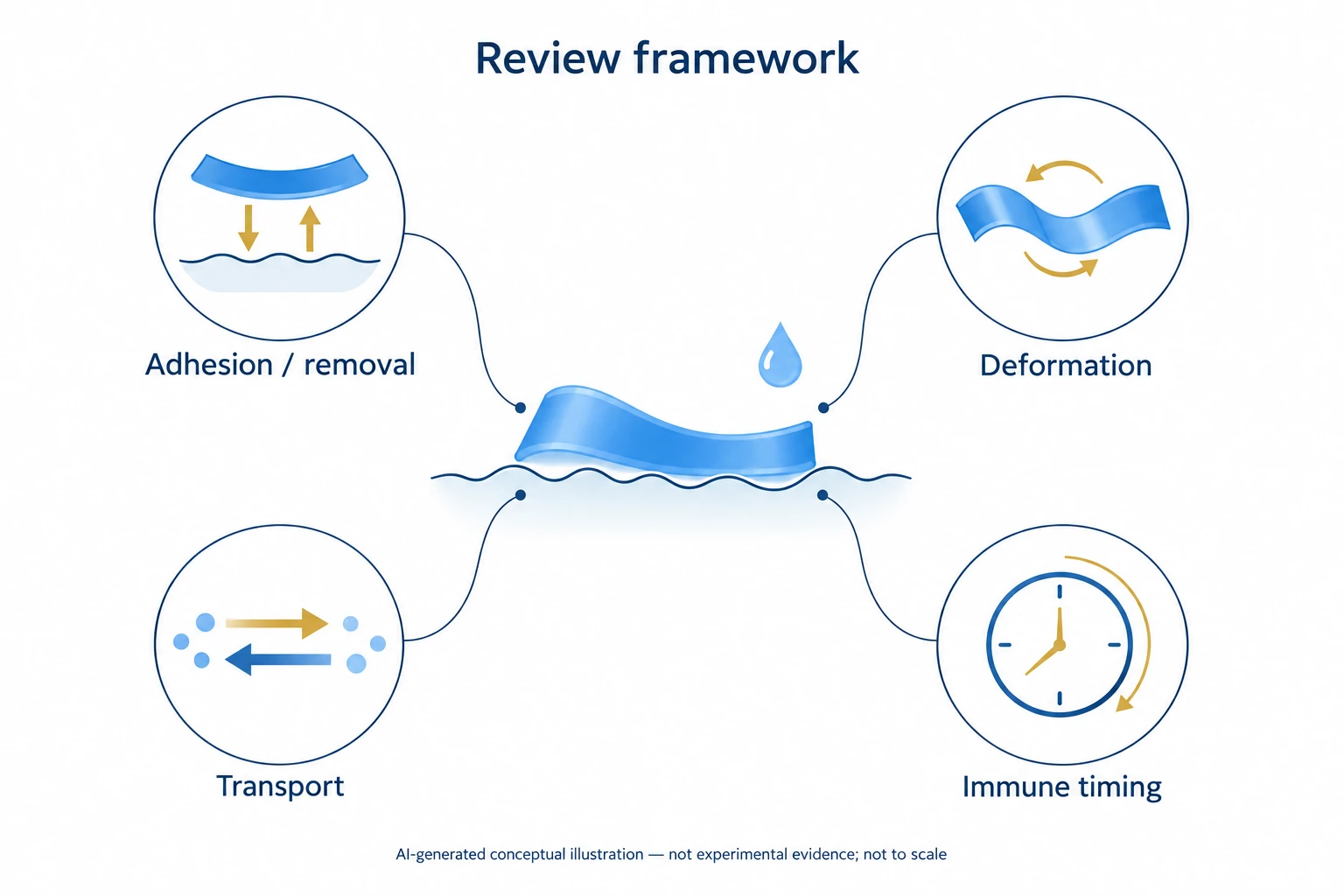
AI-generated concept: a review framework for hydrogel adhesion/removal, deformation, transport and the timing of immune regulation at chronic-wound interfaces. It is not experimental evidence of material performance or clinical efficacy; shapes and proportions are illustrative.
Qualitative review categories only. Clock hands do not specify treatment times, and arrows do not quantify adhesion, removal injury, permeability or immune suppression. Molecular and tissue microstructures are not reproduced.
This is not a reproduced paper figure and does not establish permission to reuse the original figure.
Generated in ChatGPT on the web from concepts in a public paper and checked for conceptual consistency within the selected main-text reading and stated independent-review scope. This does not claim a complete main-text or supplement audit. Display processing is limited to WebP encoding, without cropping or content editing.
Evaluation and conditions
This is a review, not a new-device trial. Its framework separates wound cause and stage, exudate, loading, removal injury and immune-assessment timing. Gross wound closure alone cannot establish both interface durability and appropriately timed immunomodulation.
Key findings
Sensing offers a route from wound-state measurements to treatment adjustment. Detecting a change and safely acting on it remain separate validation steps. The sensing discussion therefore supports a design direction, not a claim that clinical closed-loop wound care is established.
Limits and open questions
Rodent wound contraction differs from persistent inflammation and impaired perfusion in human chronic wounds. Translation also depends on reproducible manufacturing, sterilization and longer-term safety. The cited experiments and regulatory pathways were not independently audited here.
Related external research
Wireless, closed-loop, smart bandage with integrated sensors and stimulators for advanced wound care and accelerated healing
DOI: 10.1038/s41587-022-01528-3 ↗
A mouse system integrating sensing, stimulation and detachable hydrogel exemplifies the review's adaptive-design category.
A specific closed-loop device and a heterogeneous hydrogel review cannot be directly ranked.
Abstract checkedCorresponding-author verification
Jungmok Seo: corresponding authorThis record concerns Jungmok Seo’s correspondence designation. Author order or an asterisk alone is not treated as confirmation; this check is separate from verification of the research content.
- Correspondence evidence source ↗
Corresponding author. Jungmok Seo
front/article-meta/contrib-group and author-notes; name-to-corresp reference and email · public_repository_xml_read
- Main-text review scope
- Read public XML required properties (sec6), sensing-integration introduction (sec20), future challenges (sec22), and conclusions (sec23); cited experiments and regulatory assertions were not independently audited.
- Supplementary review scope
- Supporting information was not comprehensively read. A main-text citation to supplementary results does not count as direct inspection of those results.
- Pending verification
- Further explanation of the efficacy of individual designs requires checking the cited original studies and test conditions. Regulatory and approval pathways were not established in this library article. BioRender figure reuse rights remain a separate pending issue.
COVERAGE & OUTREACH
Coverage and outreach
Links are checked for their relationship to this paper. Media publication does not establish independent reporting or additional experimental validation.
Bioadhesive hydrogels and the SCOPE electroceutical patch — Jungmok Seo의 연구 소개 ↗
The opening names the exact review title of #98 and first authors Kayoung Son and Soo A Kim.
Body read The public post body was read. Review #98 is distinguished from the later discussion of experimental SCOPE paper #88. Only a relative time (23h) was visible, so the date remains unconfirmed.
Sources and verification scope
Read public XML required properties (sec6), sensing-integration introduction (sec20), future challenges (sec22), and conclusions (sec23); cited experiments and regulatory assertions were not independently audited.
The additional commentary is editorially approved within the stated evidence scope. This does not imply complete verification of all main-text and supplementary material.
- Additional main-text review scope
- Read public XML required properties (sec6), sensing-integration introduction (sec20), future challenges (sec22), and conclusions (sec23); cited experiments and regulatory assertions were not independently audited.
- Additional supplementary review scope
- Supporting information was not comprehensively read. A main-text citation to supplementary results does not count as direct inspection of those results.
- Public publication baseline ↗ · #98 · 2026-10-03
- Crossref metadata ↗: Only public bibliographic metadata registered with Crossref was checked. This does not mean that the publisher page, abstract, or full text was read; full-text verification in the school Chrome session remains pending. license_urls lists registered links and does not establish permission to redistribute text or figures. It may include TDM or posting-policy links.
- Source for updated publication metadata ↗
Bibliographic and publication-status check; separate from main-text review. - Bioadhesive Hydrogels as Immunomodulatory Interfaces for Chronic Wound Healing: From Microenvironmental Regulation Mechanism to Engineering Strategies ↗
public_publisher_abstract · Abstract; Highlights; Background; checked 2026-10-03 - Wireless, closed-loop, smart bandage with integrated sensors and stimulators for advanced wound care and accelerated healing ↗
public_external_abstract · Abstract and DOI metadata; read 2026-10-03. - Bioadhesive hydrogels as immunomodulatory interfaces for chronic wound healing: from microenvironmental regulation mechanism to engineering strategies ↗
public_repository_selected_full_text_read · sec6: Required properties - Bioadhesive hydrogels as immunomodulatory interfaces for chronic wound healing: from microenvironmental regulation mechanism to engineering strategies ↗
public_repository_selected_full_text_read · sec6: wound subtype/stage requirements and temporally regulated inflammation - Bioadhesive hydrogels as immunomodulatory interfaces for chronic wound healing: from microenvironmental regulation mechanism to engineering strategies ↗
public_repository_selected_full_text_read · sec22: model limitations and translational validation framework - Bioadhesive hydrogels as immunomodulatory interfaces for chronic wound healing: from microenvironmental regulation mechanism to engineering strategies ↗
public_repository_selected_full_text_read · sec20: sensing-integrated introductory paragraphs; sec22–23 - Bioadhesive hydrogels as immunomodulatory interfaces for chronic wound healing: from microenvironmental regulation mechanism to engineering strategies ↗
public_repository_selected_full_text_read · sec22: model and manufacturing limitations; sec23 - Bioadhesive hydrogels as immunomodulatory interfaces for chronic wound healing: from microenvironmental regulation mechanism to engineering strategies ↗
independent_reviewer_selected_main_text · Public XML sec6; sec20 opening; sec22 selected translation/challenges paragraphs; sec23 conclusion - Additional commentary source ↗
Research background · sec6: Required properties · public_repository_selected_full_text_read - Additional commentary source ↗
Approach and advances · sec6: wound subtype/stage requirements and temporally regulated inflammation · public_repository_selected_full_text_read - Additional commentary source ↗
Evaluation and conditions · sec22: model limitations and translational validation framework · public_repository_selected_full_text_read - Additional commentary source ↗
Key findings · sec20: sensing-integrated introductory paragraphs; sec22–23 · public_repository_selected_full_text_read - Additional commentary source ↗
Limits and open questions · sec22: model and manufacturing limitations; sec23 · public_repository_selected_full_text_read - Additional commentary source ↗
Connections to related work · sec20: sensing integration; external abstract · public_repository_selected_full_text_read - Additional commentary source ↗
Connections to related work · Abstract; title and DOI: 10.1038/s41587-022-01528-3; previously verified external evidence reused · public_external_abstract_read