Overview
This study, by researchers at the BLISS Lab (Jungmok Seo) at Yonsei University and the Korea Institute of Science and Technology (KIST), coats silicon neural probes with a lubricated immune-stealthy probe surface (LIPS) that lowers insertion friction and resists biofouling. In mice, LIPS-coated probes recorded signals from 102% more electrodes shortly after insertion, and the period over which signals could be measured increased from 8 to 16 weeks.
Background
Implanted neural probes lose recording sensitivity over time because insertion trauma causes acute inflammation and the foreign body reaction sustains chronic inflammation; the resulting glial sheath pushes neurons beyond the effective recording range. Flexible probes reduce micromotion-related damage but are difficult to insert, and the stiffening coatings or shuttles used to insert them increase friction. Drug-eluting coatings have limited loading capacity and do not prevent protein adsorption, while hydrogel anti-biofouling coatings can swell, which increases the electrode-neuron distance, and can delaminate. Lubricant-infused slippery surfaces inspired by the Nepenthes pitcher plant are nearly frictionless and liquid-repellent, but whether they can be applied to recording electronics without compromising performance had not been tested.
Design and approach
The probe carries 16 recording electrodes (14 × 14 µm2 each) on a silicon shank with a SiO2 surface. Pt black is electroplated onto the Pt electrodes to raise the effective surface area and offset the impedance added by the coating. The surface is then activated by O2 plasma, functionalized with a self-assembled monolayer of trichloro(1H,1H,2H,2H-perfluorooctyl)silane (FOTS) by vapor-phase deposition (two cycles, chosen to limit the impedance increase), and dipped in a perfluoropolyether (PFPE) lubricant (Krytox 101). The lubricant layer is intended to reduce friction during insertion and to block the adhesion of blood, proteins and glial cells that initiates gliosis.
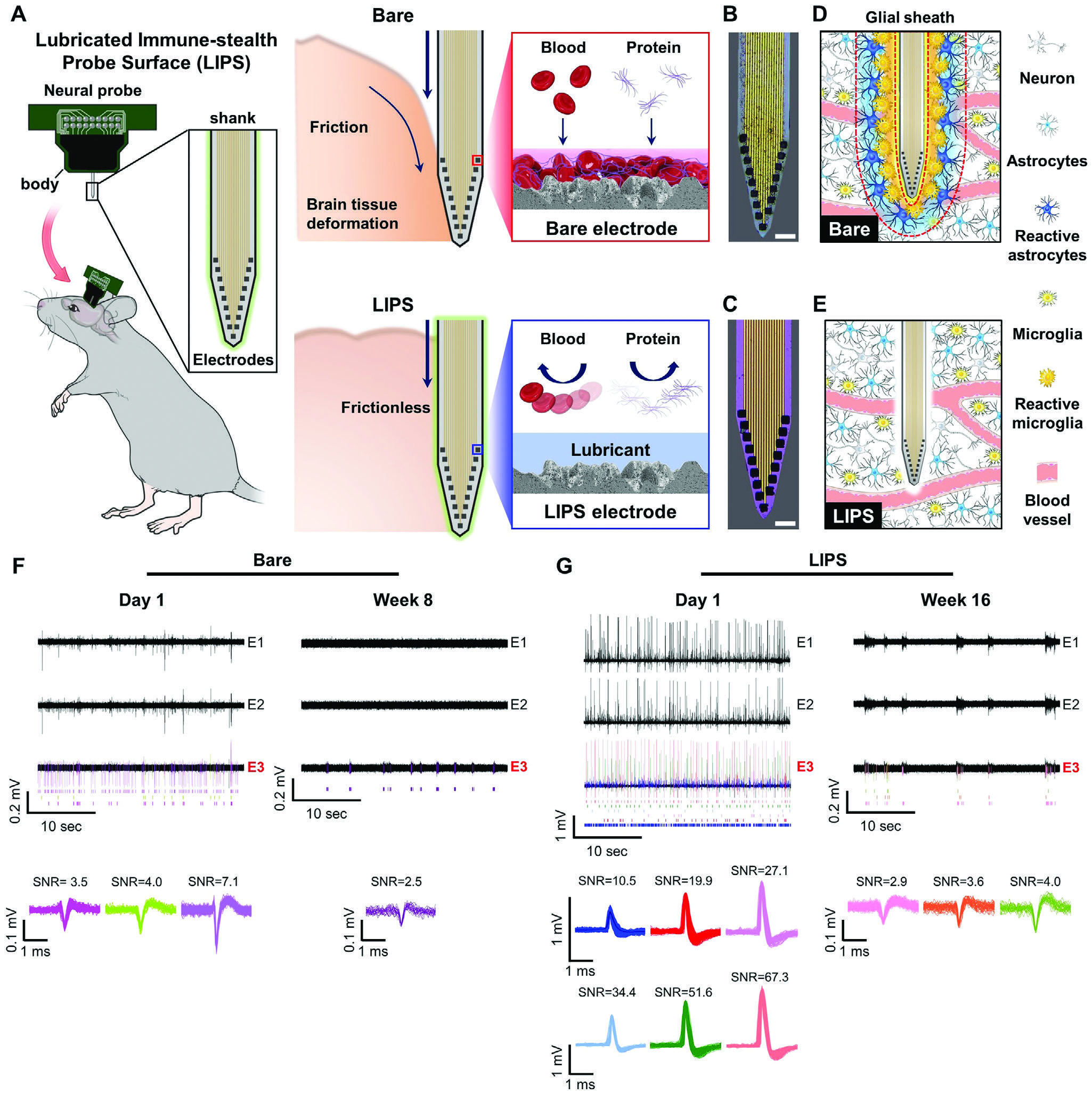
LIPS-coated probe concepts for reducing friction and fouling, alongside representative neural recordings from coated and control probes.
Yeontaek Lee, Hyogeun Shin, Dongwon Lee et al. “A Lubricated Nonimmunogenic Neural Probe for Acute Insertion Trauma Minimization and Long‐Term Signal Recording”. Figure 1. DOI: 10.1002/advs.202100231. CC BY 4.0. Figure dimensions, panels and labels are unchanged.
Source figure and caption ↗ · DOI: 10.1002/advs.202100231 ↗ · CC BY 4.0 ↗
How it was evaluated
The coating was characterized by impedance, contact angle (CA) and sliding angle (SA) with artificial cerebrospinal fluid (aCSF), simulated body fluid (SBF), blood and water. Insertion was modelled by finite element analysis (brain modulus E = 500 Pa, insertion to 1.85 mm, lateral micromotion of 100 µm) and measured in 0.6% agarose brain phantoms at 0.1 mm s−1. Anti-biofouling was tested with blood, fluorescent albumin and SIM-A9 mouse microglia. In adult male C57BL/6 mice, probes were implanted in the hippocampal CA3 region; short-term recordings used eight mice per probe type, long-term weekly recordings used three mice, and immunohistochemistry for Iba1 (microglia) and GFAP (astrocytes) was performed at day 1, week 4 and week 12 (n = 3 per time point). Recordings were made under 1% isoflurane anesthesia, and bare Pt black-coated probes served as controls.
Key results
At 1 kHz, the LIPS-coated electrodes had an impedance of 613 ± 41 kΩ, lower than that of bare Pt electrodes without Pt black (986 ± 55 kΩ). On LIPS-treated SiO2 and Pt black, all tested fluids showed CAs of about 110° and rolled off at tilt angles below 8°, whereas they remained pinned on bare substrates. In the brain phantom, the maximum friction force was 4.7 mN for the bare probe and 0.56 mN for the LIPS-coated probe, and the impulse applied during insertion fell from 34.6 ± 3.5 to 4.9 ± 3.1 mN·s, an 86% reduction. Impedance was unchanged after the first of repeated insertion and extraction cycles.
In blood containing albumin, the bare probe's impedance rose until it exceeded that of the LIPS-coated probe by about 70 kΩ after 7 h, while the LIPS-coated probe stayed near its initial value. Albumin adsorbed on bare SiO2 and Pt black but hardly on LIPS, and after 48 h microglia covered nearly all bare surfaces but did not adhere to LIPS; overall, LIPS showed 98.3% less adhesion than the bare surfaces.
In short-term recordings (about 12 h after surgery), signals were obtained from 116 of 128 electrodes (91%) with LIPS-coated probes and 58 of 128 (45%) with bare probes. LIPS-coated probes yielded about four times as many sorted neurons and about twice as many neurons per electrode; most bare-probe signals were within 0.2 mV, whereas signals above 0.5 mV were common with LIPS, and signals of 1 mV or more were recorded. The insertion damage area was 120% larger for the bare probe, and on day 1 Iba1 and GFAP expression at 0 and 20 µm from the interface was significantly lower around LIPS-coated probes.
In long-term recordings, LIPS-coated probes recorded more than twice as many neural signals as bare probes in the first week, with amplitude and signal-to-noise ratio (SNR) about 1.5 times higher. Signals were detectable for up to 8 weeks with bare probes and up to 16 weeks with LIPS-coated probes. At 4 weeks, amoeboid activated microglia surrounded bare probes, whereas only ramified microglia were seen around LIPS-coated probes, and at 4 and 12 weeks microglia numbers and GFAP expression at 0 and 20 µm were significantly lower around LIPS-coated probes. The introduction summarizes the SNR gain as up to ninefold, whereas the first-week value reported in the results is about 1.5-fold.
Open questions
The authors note that the lubricant coating raises electrode impedance and that its stability in dynamic physiological environments remains a challenge. They propose selective coating that leaves electrode surfaces uncovered and coating materials that hold the lubricant more effectively for long-term chronic use.
Related research
Foreign body reaction to biomaterials
DOI: 10.1016/j.smim.2007.11.004 ↗
The related review traces the foreign body reaction from protein adsorption and macrophage adhesion to the formation of foreign body giant cells. LIPS targets the first of these steps by limiting protein and cell attachment to the probe surface, and it also reduces insertion injury.
Abstract-based introductionRESEARCH NEWS
Research in the news
"인체삽입 의료기기 수명 4배 이상 늘리는 코팅기술 개발" ↗
A Lubricated Nonimmunogenic Neural Probe for Acute Insertion Trauma Minimization and Long-Term Signal Recording (Adv. Sci. 15/2021) ↗
BLISS 이연택 학생 Advanced Science에 논문 게재 & Back cover 선정 ↗
Unverified candidates and access limits (2)
Unverified candidate · 인체 삽입형 의료기기 코팅기술 개발, 의료기기 수명연장과 안정성을 동시에 확보 ↗
Unverified candidate · A new coating extends the lifespan of brain implants ↗
Sources used in this summary
This summary is based on the published PDF of the article (14 pages: abstract, introduction, results, discussion, experimental section and figure legends); the supporting information was not reviewed.