Overview
This study presents a stretchable, adhesive and self-healing single-electrode triboelectric nanogenerator (TENG) built from a carbon nanotube (CNT)-doped hydrogel electrode covered by an Ecoflex elastomer layer, developed by the BLISS Lab (Jungmok Seo) at Yonsei University. The device reached an open-circuit voltage of about 180 V and a short-circuit current of 0.8 μA, and a power management circuit raised the energy stored in a 100 μF capacitor over 1 min from 1.06 μJ with direct charging to 2.93 μJ.
Background
TENGs convert body movement into electrical energy and are candidates for powering wearable devices, but excessive mechanical stress can degrade their performance, and elastomer-based devices adhere poorly to skin because of mechanical mismatch. Soft hydrogels with tissue-like modulus conform to skin, yet their water-rich nature makes them vulnerable to damage, and tough hydrogels still do not address scratching or accidental cutting. In addition, hand tapping at low frequency and the inherently high impedance of TENGs limit the energy that can be stored directly.
Design and approach
The electrode is a double-network hydrogel of polyvinyl alcohol (PVA), tannic acid (TA), polyacrylic acid (PAA) and carboxyl-functionalized CNTs. TA forms weak, reversible hydrogen bonds with PVA, PAA adds covalent bonding with disulfide crosslinks, and the CNTs provide a conductive pathway. N-hydroxysuccinimide (NHS) ester groups introduced on PAA bond covalently to primary amine groups on skin or on amine-functionalized surfaces. Ecoflex covers the electrode as the bottom triboelectrification layer, and skin acts as the opposite layer. A power management circuit composed of a rectifier, an autonomous switch (a silicon-controlled rectifier triggered through a Zener diode) and a DC buck converter transfers energy from a small input capacitor to an output capacitor.
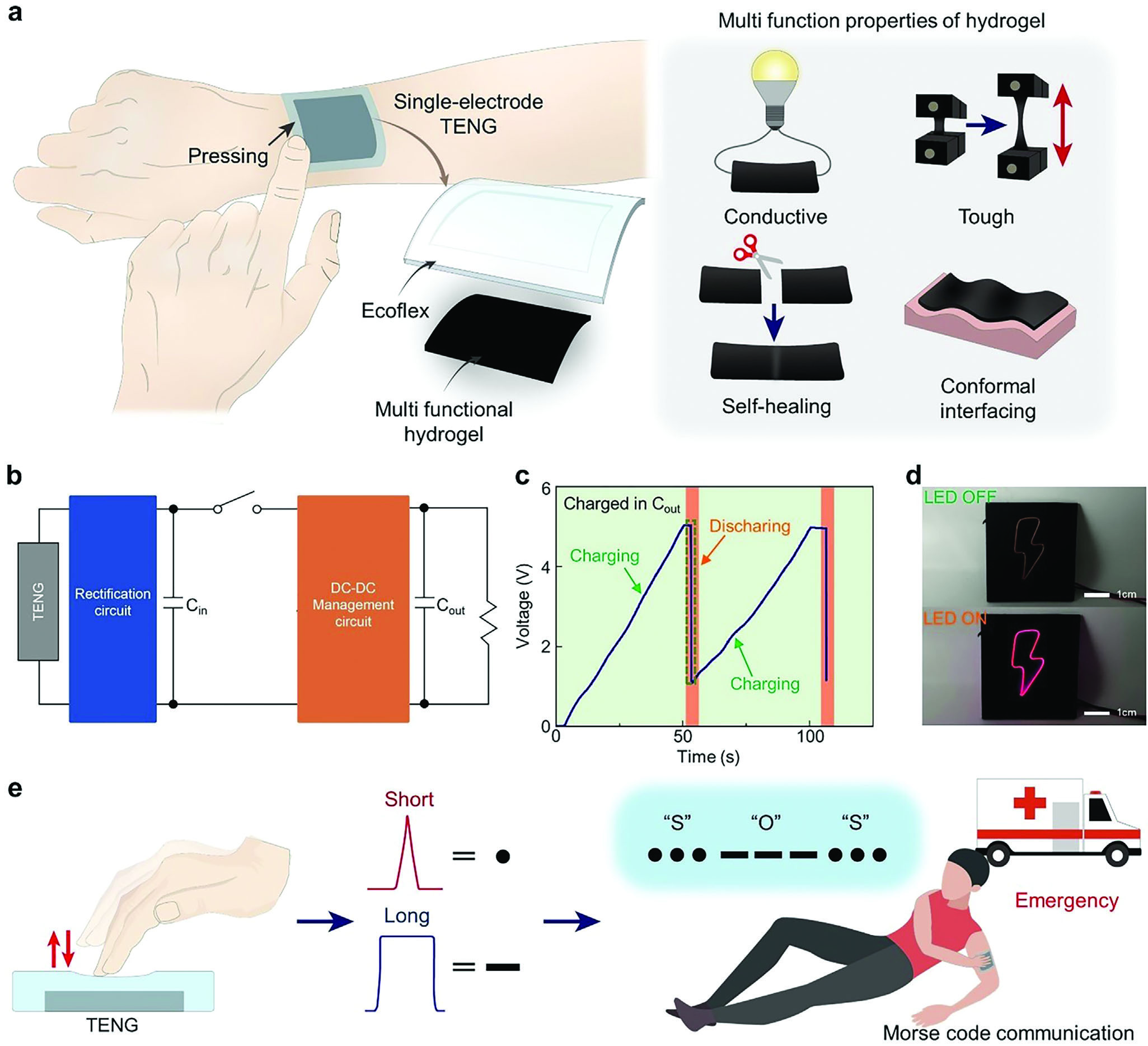
Overview of the multifunctional hydrogel–elastomer triboelectric generator, energy-storage circuitry, LEDs and Morse-code demonstration.
Jinseok Oh, Minkyong Kang, Jae Park et al. “Autonomously Self‐healing, Adhesive, and Stretchable Triboelectric Nanogenerator Using Multifunctional Hydrogel‐Elastomer Double Layer with a Power Management Circuit”. Figure 1. DOI: 10.1002/aelm.202400013. CC BY 4.0. Figure content is unchanged.
Source figure and caption ↗ · DOI: 10.1002/aelm.202400013 ↗ · CC BY 4.0 ↗
How it was evaluated
Hydrogel modulus, cyclic tensile-compression at 10, 25, 50 and 100% strain, stress relaxation at 15% strain, 90 degree peel adhesion to PDMS, glass, Ecoflex and porcine skin, self-healing efficiency and conductivity were measured. TENG output was evaluated by cyclic pressing, after cutting and self-healing, under 0% to 20% strain, over 1000 cycles driven by a step motor at about 0.5 Hz with PDMS as the top layer, at humidity of 30, 45 and 60%, and across load resistances of 100 Ω to 10 GΩ. Managed charging was compared with direct charging, and the device was demonstrated as a password switch and a Morse code input with the TENG attached to VHB film in contact with skin.
Key results
The hydrogel showed a Young's modulus of about 30 kPa, within the soft tissue range of 10–100 kPa, and the modulus could be tuned by the PVA-to-TA ratio (1:1, 1:1.5 and 1:2). It dissipated energy repeatedly in cyclic tensile-compression up to 100% strain and relaxed to half its initial stress within a few seconds at 15% strain, whereas PVA alone showed no stress reduction. Adhesion forces ranged from 65 to 260 N m−1 across the tested materials, and SEM showed no gap at the hydrogel-porcine skin interface.
Cut hydrogels recovered 100% of their tensile strength after 300 s of self-healing at room temperature. The conductivity reached about 1 S m−1 at a CNT concentration threshold of 6 mg mL−1, and the electrical resistance recovered after cutting and contact and after stretching and release.
The TENG produced an open-circuit voltage of about 180 V and a short-circuit current of 0.8 μA. The Abstract reports a maximum power peak of 37.8 mW m−2, and the load measurements gave a maximum peak power of 60.8 μW at a matched resistance of 200 MΩ. The device achieved complete conformal contact with a nonplanar structure after 10 min, recovered its electrical output after damage and self-healing, showed no reduction in voltage under 0% to 20% strain, and operated over 1000 cycles without degradation. No performance degradation was observed at 30, 45 and 60% humidity.
In the first stage, a half-wave rectifier stored more energy with a 0.47 nF input capacitor, and compared with direct charging the power management circuit reduced the load from 100 to 22 MΩ while retaining the output power at 80.7% efficiency. Over 1 min, a 100 μF capacitor reached 0.146 V (1.06 μJ) with direct charging and 0.242 V (2.93 μJ) with the circuit, which the authors described as almost a threefold improvement. Capacitors of 2.2 and 4.7 μF were charged to 5 V after 87 and 172 s, respectively, and the stored energy powered LEDs and a stopwatch. Pressing durations of 1 to 4 s encoded the numbers 1 to 4 in a password switch, and durations of 1 to 2 s and over 2 s encoded Morse code dots and dashes, used to send "peace", "love" and "S.O.S".
Open questions
The authors noted that the load characteristics indicate poor load capacity of the TENG, owing to the low frequency of hand tapping and its intrinsically high load impedance, which motivated the power management circuit.
Related research
Ultrastretchable, transparent triboelectric nanogenerator as electronic skin for biomechanical energy harvesting and tactile sensing
Pu and colleagues combine ionic hydrogel and elastomer for stretchable energy harvesting and touch sensing. This study adds recovery and adhesion alongside power management.
Abstract-based introductionSources used in this summary
This summary is based on the main text, figure legends and Experimental Section of the published version of record (Advanced Electronic Materials, 11-page Wiley PDF, local copy). The Supporting Information (Figures S1–S22) and Videos S1–S2 were not reviewed; values attributed to supporting figures are those stated in the main text.