Overview
This study, by researchers at the BLISS Lab (Jungmok Seo) at Yonsei University and the Korea Institute of Science and Technology (KIST) with clinical collaborators, engraved nano/microstructures directly into an endoscope lens with a femtosecond (fs) laser and infused them with a medical-grade perfluorocarbon lubricant to form a lubricant-infused directly engraved nano-/micro-structured surface (LIDENS). The optimized structure transmitted 84% or more of visible light after lubrication, and a LIDENS-integrated endoscope retained visibility over 80% of its area after repeated dipping in blood.
Background
Endoscopic visibility is lost when body fluids foul the lens or when condensation fogs it. Cleaning by rubbing against tissue, adding suction and irrigation channels, or withdrawing and wiping the endoscope can damage tissue, enlarge the instrument or raise infection risk. Superhydrophilic surfaces prevent fogging but are fouled by viscous body fluids, superhydrophobic surfaces repel blood but fog as nucleated droplets adhere, and the authors note that neither property alone can solve both problems. Lubricant-infused porous coatings made from deposited particles address both, but the particles can be torn off under mechanical stimulus.
Design and approach
Line-by-line fs-laser ablation forms laser-induced periodic surface structures in the glass itself, so the porous layer cannot detach as a separate coating. A higher fluence with wider line spacing (87.84 J/cm2, 10 µm) produced microscale low-spatial-frequency structures (LSFL), whereas a lower fluence with closer spacing (2.44 J/cm2, 5 µm) produced nanoscale-dominant high-spatial-frequency structures (HSFL). The engraved surface is coated with a fluorinated self-assembled monolayer (F-SAM), which lowers surface energy and raises affinity for the lubricant. Of four perfluorocarbon lubricants compared, GPL 103 had a refractive index similar to that of the lens and was used throughout.
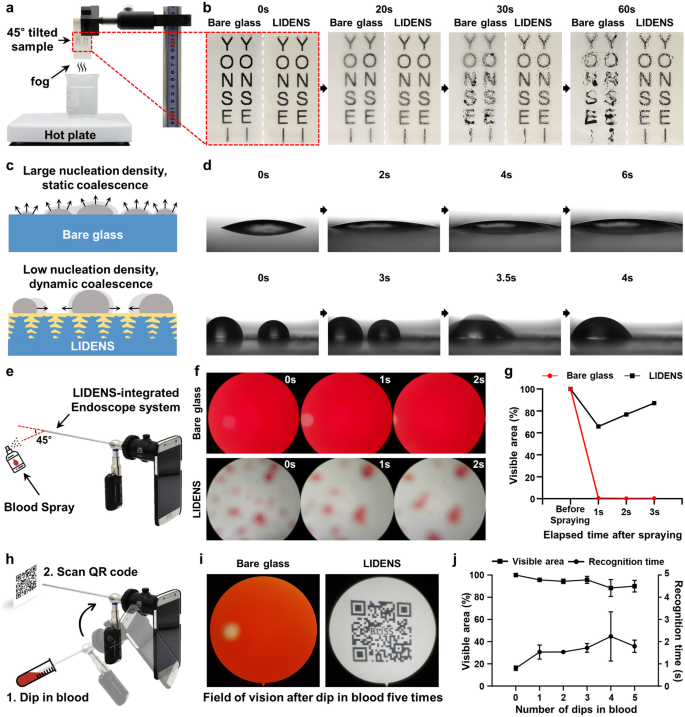
Tests comparing optical visibility of LIDENS-treated glass under steam and blood exposure.
Yeontaek Lee, Yong-Woo Chung, Jaeho Park et al. “Lubricant-infused directly engraved nano-microstructures for mechanically durable endoscope lens with anti-biofouling and anti-fogging properties”. Figure 4. DOI: 10.1038/s41598-020-74517-8. CC BY 4.0. Figure content is unchanged.
Source figure and caption ↗ · DOI: 10.1038/s41598-020-74517-8 ↗ · CC BY 4.0 ↗
How it was evaluated
The authors measured transmittance by UV–visible spectroscopy, surface chemistry by X-ray photoelectron spectroscopy (XPS), and contact angle (CA), contact angle hysteresis (CAH) and sliding angle (SA) for water, blood, simulated body fluid and low-surface-tension liquids. Albumin and fibrinogen adsorption was imaged after 24 h of immersion. Mechanical durability was tested by 30 cycles of tape peeling (2600 N/m adhesive tape) against a commercial particle-based coating (PBC), by 30 cycles of linear abrasion under a 0.5 kg load, and by six autoclave cycles at 121 °C for 15 min, each followed by re-lubrication. Fogging was tested over steaming water at 100% relative humidity, and a 4 mm-diameter LIDENS glass attached to a rigid endoscope with a smartphone camera was exposed to sprayed defibrinated horse blood and to five consecutive dips in blood.
Key results
Before lubrication, the HSFL surface transmitted about 9% more light than the LSFL surface. After lubricant infusion, the LSFL surface transmitted only about 28% of visible light, whereas the HSFL surface showed an eightfold increase and transmitted 84% or more, so HSFL was used for all subsequent LIDENS samples; the abstract reports transparency above 70%. XPS showed a strong F1s peak at about 688 eV after F-SAM coating. Uncoated engraved surfaces were completely wetted (CA ≤ 5°), and F-SAM-coated surfaces reached CAs above 160° for water and blood but still pinned dimethyl sulfoxide and ethylene glycol. After lubricant infusion, the SA stayed at or below 15° for all liquids tested, including 70 vol% ethanol and hexane with surface tensions below 30 mN/m.
On a 45° incline, a blood droplet slid for more than 3 s on bare glass and left stains, whereas on LIDENS it slid off in less than 1.5 s without residue. Bare glass adsorbed substantial albumin and fibrinogen after 24 h, while adsorption on LIDENS was negligible.
After 30 tape-peeling cycles, the F-SAM-coated engraved surface showed no significant topographical change; its CAH rose from about 7° to about 30° right after tape peeling and then by less than 10° over repeated peeling, which the authors suggest may reflect tape adhesive residue and local damage. The PBC detached, with its CA falling by more than 30° and its CAH rising by more than 45°. After 30 abrasion cycles, roughness remained high (Ra > 80 nm, Rq > 99 nm) and CA and CAH rose by less than 2° and 4°. Autoclaving accelerated lubricant evaporation, but after re-lubrication the SA recovered to below 15°; with the lubricant fully removed, the surface returned to a CA above 160°, indicating that the F-SAM survived sterilization. LIDENS also maintained its SA after 28 days of shaking at 60 rpm in phosphate-buffered saline.
Over steaming water, condensate slid off LIDENS while bare glass became covered with pinned droplets, which the authors explain by lower nucleation density and dynamic coalescence of mobile droplets. When blood was sprayed as small droplets (≤ 1 µL), the bare endoscope lost its view immediately and completely, whereas droplets on LIDENS coalesced and slid off so that visibility recovered gradually; a few small droplets remained, which the authors relate to the retention force (less than 10 µN) and the lower surface tension (58 mN/m) of blood. After five consecutive dips in blood, the bare endoscope could not read a QR code, while the LIDENS endoscope could; visibility dropped partially after the fourth dip, recovered after further dipping, and remained over 80% of the area.
Open questions
The authors note that a few small blood droplets below the size needed for gravity-driven removal remained on the lens after spraying, although they could be removed by gentle shaking or repeated dipping. Sterilization accelerated lubricant evaporation, and performance after each autoclave cycle was restored by re-lubrication.
Related research
Bioinspired self-repairing slippery surfaces with pressure-stable omniphobicity
SLIPS holds a lubricating liquid in a porous solid, inspired by the Nepenthes pitcher plant, to repel liquids and recover after damage; LIDENS applies this principle to an endoscope lens by engraving the porous layer directly into the glass, where optical transmission must also be maintained.
Abstract-based introductionSources used in this summary
This summary is based on the full text and figure legends of the open-access article (PMC7566624); the Supplementary Information and the two supplementary videos were not reviewed.