Research context and placement
Public text directly examines the device–host boundary through insertion friction, attachment and electrode impedance.
Insertion friction and surface attachment on neural probes
Neural probes encounter insertion injury and subsequent fouling. LIPS uses lubrication to address both friction and biological attachment. Insertion trauma and subsequent cellular/protein attachment can interfere with recording on different timescales. The study therefore links insertion, fouling and recording assessments rather than relying on a slippery-surface observation alone.
Approach and advances
Lubrication can raise impedance, motivating Pt-black area enhancement. Recording performance depends on both coating and electrode design. The central trade-off is that a low-friction layer can also impede electrical contact. Pt-black electrode design addresses that electrical burden, preventing all recording improvement from being attributed solely to the coating’s biological effect.
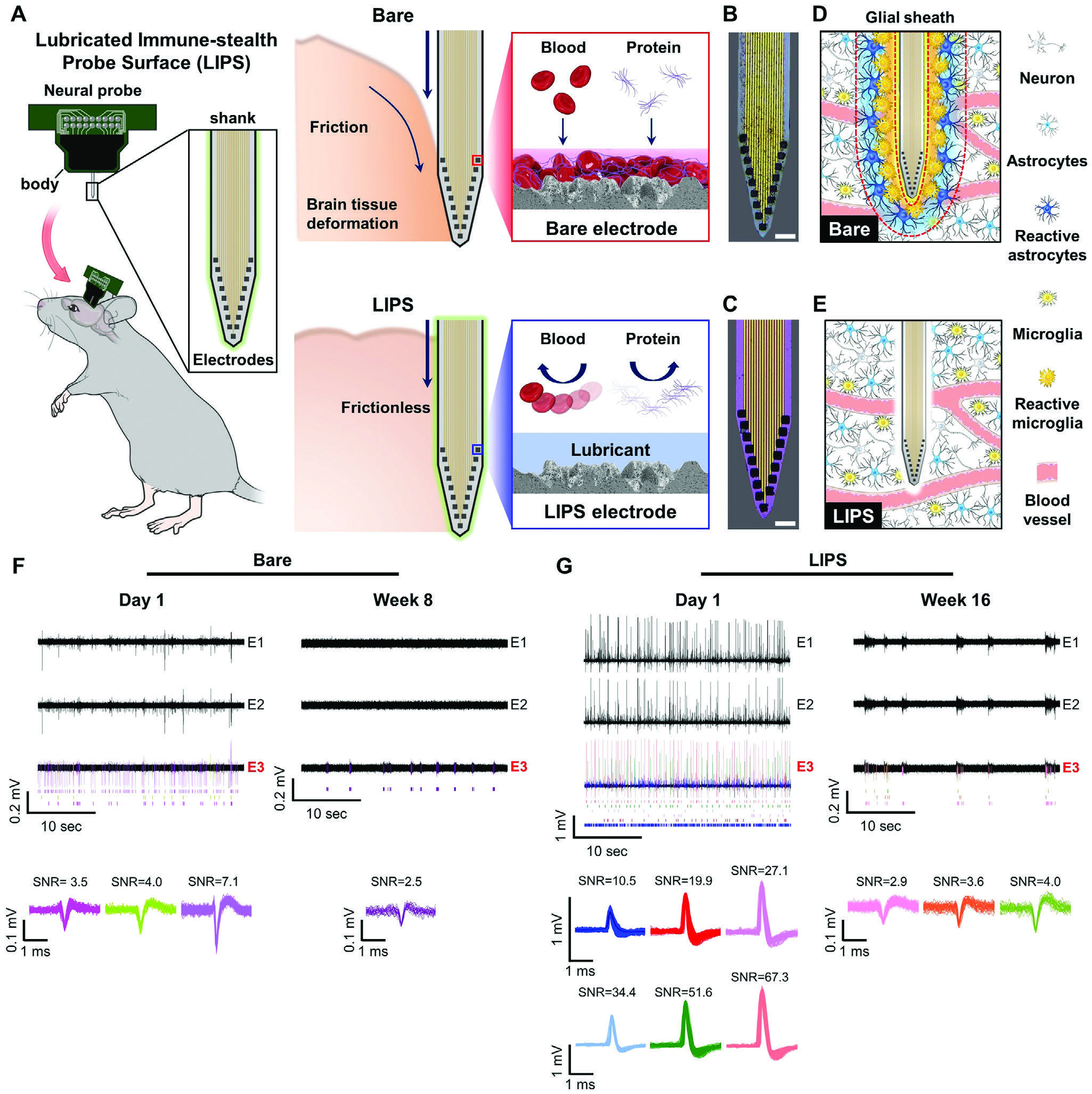
LIPS-coated probe concepts for reducing friction and fouling, alongside representative neural recordings from coated and control probes.
Yeontaek Lee, Hyogeun Shin, Dongwon Lee et al.. “A Lubricated Nonimmunogenic Neural Probe for Acute Insertion Trauma Minimization and Long‐Term Signal Recording”. Figure 1. DOI: 10.1002/advs.202100231. CC BY 4.0. Verified extraction decoded the PDF CMYK image and re-encoded JPEG with pypdf. That extraction was copied without further changes. No resize, panel or label edits; byte/pixel identity to the raw embedded JPEG is not claimed.
Source figure and caption ↗ · DOI: 10.1002/advs.202100231 ↗ · CC BY 4.0 ↗
Evaluation and conditions
Chronic comparisons use weekly anesthetized-mouse recordings and immunostaining. Sorted signal counts must not be confused with animal counts. Recording used anesthesia to reduce movement-related artifacts, with sorting and stopping criteria described in the methods. Immunostaining provides a distinct tissue-response readout; its sampling units must not be pooled with sorted electrical signals.
Key findings
Coated probes retained detectable signals longer and showed lower local immune-marker expression. These observations do not isolate every cause of signal decline. Concordant tissue-marker and recording observations support the surface-design interpretation. Contact impedance and analysis conditions also affect recordings, however, so immune response cannot be declared the sole cause of signal changes.
Limits and open questions
Authors retain impedance and lubricant retention as challenges. Recording duration depends on anesthesia, sorting and stopping criteria. Longer signal detectability does not mean every electrode retained the same quality throughout. The authors’ remaining challenges of selective coating and lubricant retention point to a need to control friction and electrical contact more independently.
Related external research
Foreign body reaction to biomaterials
DOI: 10.1016/j.smim.2007.11.004 ↗
The external abstract outlines adsorption-to-foreign-body responses; LIPS targets surface attachment and insertion injury.
The general mechanism review does not validate recording durability.
Abstract checkedCorresponding-author verification
Jungmok Seo: corresponding authorThis record concerns Jungmok Seo’s correspondence designation. Author order or an asterisk alone is not treated as confirmation; this check is separate from verification of the research content.
- Correspondence evidence source ↗
Corresponding author.
contrib/xref author-notes for Cho and Seo; author-notes correspondence footnote · public_repository_xml_author_and_correspondence_read
- Main-text review scope
- Earlier publisher body: Introduction and §§2.1–2.3, surface/electrode/insertion evaluation. Additional Europe PMC XML read: §§2.6–2.8; Figure 5 full caption; §3 Discussion; Experimental Section / Animal Preparation and Surgery; Electrophysiological Recording and Signal Analysis; Statistical Analysis. §§2.4–2.5 not newly audited in this pass.
- Supplementary review scope
- Supplementary information was not read. No supplementary material is listed as reviewed, and a complete SI audit is not claimed.
- Pending verification
- Supplementary raw data, every electrode panel and animal-level reanalysis were not audited. The reviewed recording conditions do not establish freely moving performance or clinical longevity.
COVERAGE & OUTREACH
Coverage and outreach
Links are checked for their relationship to this paper. Media publication does not establish independent reporting or additional experimental validation.
"인체삽입 의료기기 수명 4배 이상 늘리는 코팅기술 개발" ↗
Cho/Seo, lubricated neural probes, chronic mouse-brain recording and Advanced Science identify #59.
Body read Read the body and the July 11 publication date. It reports a KIST announcement; the headline's fourfold claim is not treated as independent clinical evidence.
A Lubricated Nonimmunogenic Neural Probe for Acute Insertion Trauma Minimization and Long-Term Signal Recording (Adv. Sci. 15/2021) ↗
The Back Cover feature matches #59 by title, authors and original article number 2100231.
Body read Read the separate cover feature, LIPS description and August 4 date, distinguishing it from the research-article landing page.
BLISS 이연택 학생 Advanced Science에 논문 게재 & Back cover 선정 ↗
The announcement's LIPS neural probe and chronic-recording image identify #59, corroborated by Wiley's separate cover feature.
Body read Read the public news JSON title/date and its linked image content (entry: ytgrats-2-3). Lab self-promotion; artwork is not redistributed.
Unverified candidates and access limits (2)
Unverified candidate · 인체 삽입형 의료기기 코팅기술 개발, 의료기기 수명연장과 안정성을 동시에 확보 ↗
The indexed researchers and neural-probe coating appear consistent with #59, but the institutional body was not accessible.
Body access limited Web opening failed and a public HTTP request returned 400. Indexed text was not promoted to body-read evidence.
Unverified candidate · A new coating extends the lifespan of brain implants ↗
The indexed result gives #59's DOI and states that the content was adapted from the original press release.
Body access limited Direct access returned 403. Title, DOI and adaptation notice remain search-result evidence; the page date was not verified.
Sources and verification scope
Earlier publisher body: Introduction and §§2.1–2.3, surface/electrode/insertion evaluation. Additional Europe PMC XML read: §§2.6–2.8; Figure 5 full caption; §3 Discussion; Experimental Section / Animal Preparation and Surgery; Electrophysiological Recording and Signal Analysis; Statistical Analysis. §§2.4–2.5 not newly audited in this pass.
The additional commentary is editorially approved within the stated evidence scope. This does not imply complete verification of all main-text and supplementary material.
- Additional main-text review scope
- Earlier publisher body: Introduction and §§2.1–2.3, surface/electrode/insertion evaluation. Additional Europe PMC XML read: §§2.6–2.8; Figure 5 full caption; §3 Discussion; Experimental Section / Animal Preparation and Surgery; Electrophysiological Recording and Signal Analysis; Statistical Analysis. §§2.4–2.5 not newly audited in this pass.
- Additional supplementary review scope
- Supplementary information was not read. No supplementary material is listed as reviewed, and a complete SI audit is not claimed.
- Public publication baseline ↗ · #59 · 2026-10-03
- Crossref metadata ↗: Only public bibliographic metadata registered with Crossref was checked. This does not mean that the publisher page, abstract, or full text was read; full-text verification in the school Chrome session remains pending. license_urls lists registered links and does not establish permission to redistribute text or figures. It may include TDM or posting-policy links.
- A Lubricated Nonimmunogenic Neural Probe for Acute Insertion Trauma Minimization and Long‐Term Signal Recording ↗
public_web_full_text · Abstract; Introduction; Results §§2.1–2.3; no complete supplement audit. Checked 2026-10-03. - A Lubricated Nonimmunogenic Neural Probe for Acute Insertion Trauma Minimization and Long‐Term Signal Recording ↗
public_repository_full_text · §2.7; Figure 5 caption (sorted neural cells versus analyzed images); Experimental Section: Animal Preparation and Surgery, Electrophysiological Recording and Signal Analysis - A Lubricated Nonimmunogenic Neural Probe for Acute Insertion Trauma Minimization and Long‐Term Signal Recording ↗
public_repository_full_text · §§2.7–2.8; Figure 5; §3 Discussion - A Lubricated Nonimmunogenic Neural Probe for Acute Insertion Trauma Minimization and Long‐Term Signal Recording ↗
public_repository_full_text · §3 Discussion, final limitations concerning impedance and lubricant retention; Experimental Section: recording analysis and stopping criterion - A Lubricated Nonimmunogenic Neural Probe for Acute Insertion Trauma Minimization and Long‐Term Signal Recording ↗
independent_reviewer_selected_main_text · §2.1 design/Pt-black; §§2.7–2.8/Fig.5 recording and immune response; Discussion and recording methods. - Additional commentary source ↗
Research background · Abstract; Introduction; Results §§2.1–2.3; no complete supplement audit. Checked 2026-10-03. · public_web_full_text - Additional commentary source ↗
Approach and advances · Abstract; Introduction; Results §§2.1–2.3; no complete supplement audit. Checked 2026-10-03. · public_web_full_text - Additional commentary source ↗
Evaluation and conditions · §2.7; Figure 5 caption (sorted neural cells versus analyzed images); Experimental Section: Animal Preparation and Surgery, Electrophysiological Recording and Signal Analysis · public_repository_full_text - Additional commentary source ↗
Key findings · §§2.7–2.8; Figure 5; §3 Discussion · public_repository_full_text - Additional commentary source ↗
Limits and open questions · §3 Discussion, final limitations concerning impedance and lubricant retention; Experimental Section: recording analysis and stopping criterion · public_repository_full_text - Additional commentary source ↗
Connections to related work · REST core record abstractText read; PMID 18162407; checked 2026-10-03. External main text not used for the comparison. · public_abstract_via_EuropePMC_API