Research context and placement
A chip-free wireless system combines a capacitive fiber sensor, inductive coil and suture fixation. It extends component integration to sensor-system assembly without demonstrating an interconnect–chip junction. Antifouling and tissue fixation provide host and tissue cross-links.
Boundary case: assigned to the closest interface for navigation. Read the rationale and cross-links together; the primary theme does not delimit the study. Placement of foundational work does not establish direct bioelectronic application.
Research background
Monitoring tissue recovery requires repeated information about deformation during movement. This study reads that information wirelessly from a suture-like electronic structure. Sensing and mechanically supporting a repair are distinct roles.
Approach and advances
A fiber capacitor is coupled to a coil so deformation can be read through resonance changes. A lubricated interface addresses surrounding attachment separately. A compliant sensing fiber should not automatically be assigned the load-bearing role of a conventional surgical suture.
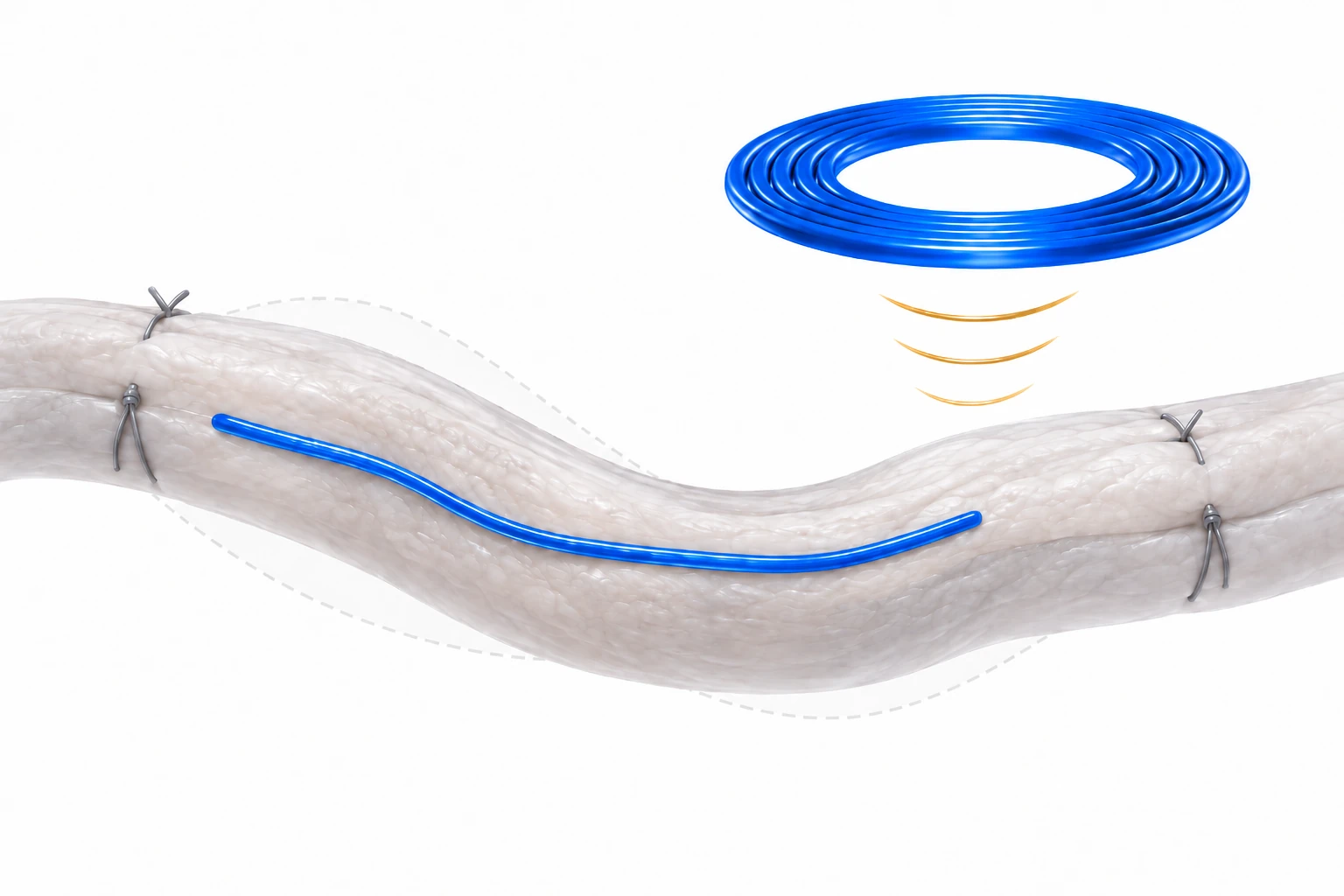
AI-generated, not-to-scale concept showing the functional relationship between a blue sensing region that follows tissue deformation and a separate external readout coil. Gray sutures indicate a separate support function. The actual electrical circuit, implanted resonant/readout assembly and wiring are deliberately omitted. This is not a complete system architecture, does not depict direct wireless communication by the sensing fiber alone, and is not experimental evidence.
Only two functions are illustrated. The faint dashed contour represents deformation conceptually, and the gold arcs are qualitative coupling symbols. Sensor internals, electrical connections, coil turns and layers, implantation location and fixation, tissue strength and healing, wireless performance, and actual dimensions or proportions are neither reconstructed nor validated.
This is not a reproduced paper figure and does not establish permission to reuse the original figure.
Generated in ChatGPT on the web from concepts within the stated public-evidence scope and independently reviewed as a concept. This is not verification of the complete article body or supplementary information. Only display WebP encoding was applied, without cropping, resizing or content editing.
Evaluation and conditions
The porcine in-vivo demonstration used one animal. Motion conditions, fixation and readout-coil alignment matter to interpretation. Inferring tissue state from deformation during movement is not equivalent to directly measuring destructive mechanical strength.
Key findings
In the pig with a reconstructed Achilles tendon, the first two weeks showed little strain response, attributed to support from surgical sutures; a large response appeared around week four. Strain under the same leg movement then declined toward week ten. The multispring-model interpretation of increasing stiffness remains a single-animal inference, not destructive strength testing or validated clinical diagnosis.
Limits and open questions
Reproducible fixation/readout, variation across subjects and the signal–mechanics relationship need further validation. The paper also identifies secondary surgery for sensor removal as a limitation. One animal does not establish average clinical performance, and unread SI model conditions are not inferred.
Related external research
Wirelessly operated bioelectronic sutures for the monitoring of deep surgical wounds
DOI: 10.1038/s41551-021-00802-0 ↗
The PubMed abstract describes RFID-operated capacitive sensing with conductive sutures for deep-wound monitoring. The BLISS study instead targets tendon strain and stiffness estimation.
External full text was not read. Different targets and readout architectures preclude abstract-only rankings of sensitivity, range or durability.
Abstract checkedCorresponding-author verification
Jungmok Seo: corresponding authorThis record concerns Jungmok Seo’s correspondence designation. Author order or an asterisk alone is not treated as confirmation; this check is separate from verification of the research content.
- Correspondence evidence source ↗
Corresponding Authors: Woo Young Jang; Jungmok Seo; Jaehong Lee
Published PDF page 13: correspondence/author information; title and DOI page 1 · local_published_pdf_read
- Main-text review scope
- Public-web verification covers PubMed metadata and abstract. The publisher web text was inaccessible; a matching local publisher PDF supplied Results, Fig. 5, Conclusions and In Vivo Experiment (local_pdf_read). Supplements were not audited; this is distinct from public-web full-text verification.
- Supplementary review scope
- Supporting information was not comprehensively read. A main-text citation to supplementary results does not count as direct inspection of those results.
- Pending verification
- School Chrome verification should check the current publisher version, corrections and supplementary stiffness model, repeated measurements and histology. Institutional access markings do not authorize redistribution of the local PDF.
COVERAGE & OUTREACH
Coverage and outreach
Links are checked for their relationship to this paper. Media publication does not establish independent reporting or additional experimental validation.
DGIST-연세대-고려대 공동연구팀, 무선 봉합사형 전자소자 기술 개발 ↗
The Lee–Seo–Jang collaboration, lubricated wireless strain-sensing sutures, porcine Achilles-tendon monitoring and ACS Nano match #78.
Body read After a web-tool error, a read-only HTTP 200 fetch of the same public URL yielded the body and date. This is DGIST-announcement reporting, distinct from the July inflammation-sensing suture study.
인대 파열 부위, '전자봉합사'로 꿰매고 결과 모니터링까지 한 번에 ↗
DGIST–Yonsei–Korea University, ACS Nano and wireless monitoring of porcine tendon mechanical recovery match #78.
Body read Read the public body and 10:48 timestamp. The article explicitly reports a DGIST announcement and is not treated as independently verified research reporting.
Device–tissue interfaces: prior studies, ELFS biliary stents and FLUID ureteral stents ↗
The post describes prior work on immune-tolerant wireless electronic sutures for monitoring mechanical recovery after tendon repair. DOI 10.1021/acsnano.4c00396, documented as the destination of the in-body shortened link, matches the title and DOI of #78 in the public 101-paper catalogue.
Body read Based on a verification record documenting the post body, “Worldwide” visibility and DOI destinations of six shortened links in a logged-in session. The publication date was determined from the “4 hours” display observed at 22:37 KST on 2026-10-03; the exact publication time remains unverified. DOI destinations were checked on LinkedIn’s external-link notice screens; this does not represent a new review of publisher full text. This is researcher-authored promotion, not independent reporting or additional experimental validation.
Sources and verification scope
Public-web verification covers PubMed metadata and abstract. The publisher web text was inaccessible; a matching local publisher PDF supplied Results, Fig. 5, Conclusions and In Vivo Experiment (local_pdf_read). Supplements were not audited; this is distinct from public-web full-text verification.
The additional commentary is editorially approved within the stated evidence scope. This does not imply complete verification of all main-text and supplementary material.
- Additional main-text review scope
- Public-web verification covers PubMed metadata and abstract. The publisher web text was inaccessible; a matching local publisher PDF supplied Results, Fig. 5, Conclusions and In Vivo Experiment (local_pdf_read). Supplements were not audited; this is distinct from public-web full-text verification.
- Additional supplementary review scope
- Supporting information was not comprehensively read. A main-text citation to supplementary results does not count as direct inspection of those results.
- Public publication baseline ↗ · #78 · 2026-10-03
- Crossref metadata ↗: Only public bibliographic metadata registered with Crossref was checked. This does not mean that the publisher page, abstract, or full text was read; full-text verification in the school Chrome session remains pending. license_urls lists registered links and does not establish permission to redistribute text or figures. It may include TDM or posting-policy links.
- Source for updated publication metadata ↗
Bibliographic and publication-status check; separate from main-text review. - Postoperative Long-Term Monitoring of Mechanical Characteristics in Reconstructed Soft Tissues Using Biocompatible, Immune-Tolerant, and Wireless Electronic Sutures ↗
public_web_abstract · Bibliographic record and Abstract; ACS Nano 18(19), 12210-12224; DOI 10.1021/acsnano.4c00396. Checked 2026-10-03. - Matching local publisher PDF: wireless electronic sutures ↗
local_pdf_read · PDF pp. 9-11 / article pp. 12218-12220: Fig. 5, Results and Conclusions; PDF p. 12 / article p. 12221: In Vivo Experiment states n=1. Title and DOI matched to PubMed; publisher web full text not verified. - Postoperative Long-Term Monitoring of Mechanical Characteristics in Reconstructed Soft Tissues Using Biocompatible, Immune-Tolerant, and Wireless Electronic Sutures ↗
local_published_pdf_selected_full_text_read · PDF pp. 9–11 / article pp. 12218–12220: Results, Fig. 5 and Conclusions - Postoperative Long-Term Monitoring of Mechanical Characteristics in Reconstructed Soft Tissues Using Biocompatible, Immune-Tolerant, and Wireless Electronic Sutures ↗
local_published_pdf_selected_full_text_read · PDF pp. 9–11: fiber-capacitance/resonance sensing and Conclusions - Postoperative Long-Term Monitoring of Mechanical Characteristics in Reconstructed Soft Tissues Using Biocompatible, Immune-Tolerant, and Wireless Electronic Sutures ↗
local_published_pdf_selected_full_text_read · PDF p. 12 / article p. 12221: In Vivo Experiment, n=1; pp. 9–11: motion readout - Postoperative Long-Term Monitoring of Mechanical Characteristics in Reconstructed Soft Tissues Using Biocompatible, Immune-Tolerant, and Wireless Electronic Sutures ↗
local_published_pdf_selected_full_text_read · PDF pp. 9–11 / article pp. 12218–12220: postoperative monitoring, Fig. 5K–Q; p. 12: n=1 In Vivo Experiment; detailed SI model calculations not independently audited - Postoperative Long-Term Monitoring of Mechanical Characteristics in Reconstructed Soft Tissues Using Biocompatible, Immune-Tolerant, and Wireless Electronic Sutures ↗
local_published_pdf_selected_full_text_read · PDF pp. 10–11: early suture support and later strain trajectory; p. 11 Conclusion: secondary removal surgery; p. 12: n=1; editorial reproducibility questions - Postoperative Long-Term Monitoring of Mechanical Characteristics in Reconstructed Soft Tissues Using Biocompatible, Immune-Tolerant, and Wireless Electronic Sutures ↗
independent_reviewer_selected_main_text · Title/DOI-matched locally held published PDF pp.1,10–12; Fig.6 time course; single-pig methods; removal limitation - Additional commentary source ↗
Research background · PDF pp. 9–11 / article pp. 12218–12220: Results, Fig. 5 and Conclusions · local_published_pdf_selected_full_text_read - Additional commentary source ↗
Approach and advances · PDF pp. 9–11: fiber-capacitance/resonance sensing and Conclusions · local_published_pdf_selected_full_text_read - Additional commentary source ↗
Evaluation and conditions · PDF p. 12 / article p. 12221: In Vivo Experiment, n=1; pp. 9–11: motion readout · local_published_pdf_selected_full_text_read - Additional commentary source ↗
Key findings · PDF pp. 9–11 / article pp. 12218–12220: postoperative monitoring, Fig. 5K–Q; p. 12: n=1 In Vivo Experiment; detailed SI model calculations not independently audited · local_published_pdf_selected_full_text_read - Additional commentary source ↗
Limits and open questions · PDF pp. 10–11: early suture support and later strain trajectory; p. 11 Conclusion: secondary removal surgery; p. 12: n=1; editorial reproducibility questions · local_published_pdf_selected_full_text_read - Additional commentary source ↗
Connections to related work · PDF pp. 9–11; external abstract · local_published_pdf_selected_full_text_read - Additional commentary source ↗
Connections to related work · Wirelessly operated bioelectronic sutures for the monitoring of deep surgical wounds; DOI 10.1038/s41551-021-00802-0; previously verified Abstract · public_external_abstract_read