Research context and placement
The publisher abstract spans electrical contacts, heat transfer and skin conformity. As no single joining method dominates, retain integration foundations with tissue/routing cross-links and explicit cross-theme ambiguity.
Boundary case: assigned to the closest interface for navigation. Read the rationale and cross-links together; the primary theme does not delimit the study. Placement of foundational work does not establish direct bioelectronic application.
Research background
Wearable thermoelectrics must accommodate movement while harvesting or moving heat. Skin contact, electrical connections and heat rejection can limit a device even when its thermoelectric material performs well. The review connects material properties to the behavior of the assembled wearable.
Approach and advances
Compliance can improve skin conformity, but greater flexibility does not automatically improve thermoelectric performance. Electrical and thermal pathways change with the architecture. Material selection, component arrangement and contact stability therefore have to be considered together.
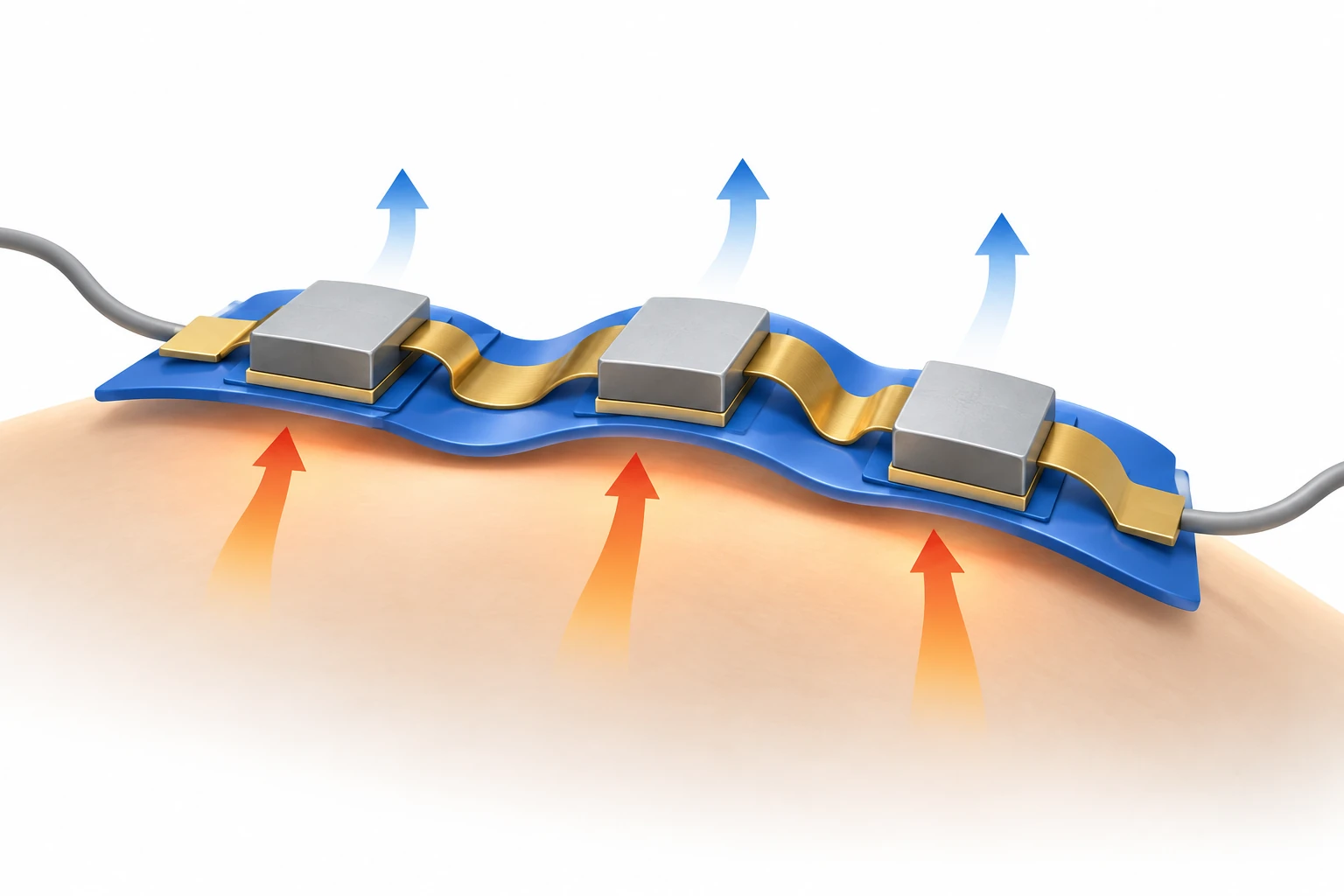
AI-generated concept of a review perspective linking curved-surface contact, deformable electrical connections and heat transport in wearable thermoelectrics. Arrows indicate conceptual heat flow, not a device’s body-heat power output or cooling performance.
Blocks and gold links denote functional units and connections. Internal thermoelectric junctions, circuit routing, composition, temperature, output and dimensions are not reproduced. This is not the review’s cited kirigami experiment.
This is not a reproduced paper figure and does not establish permission to reuse the original figure.
Generated in ChatGPT on the web from concepts in a public paper and checked for conceptual consistency within the selected main-text reading and stated independent-review scope. This does not claim a complete main-text or supplement audit. Display processing is limited to WebP encoding, without cropping or content editing.
Evaluation and conditions
Generation depends on the temperature difference across the device and its electrical load. Cooling depends on input power, hot-side heat rejection and skin contact. These different boundary conditions prevent a single ranking based on electrical output and cooling temperature.
Key findings
The review describes a pop-up kirigami device that retained contact with a cylindrical heat source and similar output during stretching. Geometry accommodated deformation without requiring the thermoelectric material itself to stretch. The cited demonstration used a 100 °C source, not body-temperature harvesting, and its original raw data were not independently audited.
Limits and open questions
Follow-up questions concern contact and connection stability during repeated wear, with matched area and ambient conditions. Answering them requires the original device-level protocols. The selected review sections do not establish long-term safety or a universally optimal architecture.
Related external research
Modular assembly of self-healing flexible thermoelectric devices with integrated cooling and heating capabilities
DOI: 10.1038/s41467-025-59602-8 ↗
Its abstract describes selective encapsulation of liquid-metal electrodes and self-healing module assembly, concretizing #99's contact and thermal-transport concerns.
A review and an experimental study cannot be directly ranked; output under imposed temperature differences is not equivalent to everyday wearable output.
Abstract checkedCorresponding-author verification
Jungmok Seo: corresponding authorThis record concerns Jungmok Seo’s correspondence designation. Author order or an asterisk alone is not treated as confirmation; this check is separate from verification of the research content.
- Correspondence evidence source ↗
Jungmok Seo; contrib corresp="yes"; correspondenceTo
front/article-meta/contrib-group and author-notes; name-to-corresp reference and email · public_repository_xml_read
- Main-text review scope
- Verified publisher metadata, Abstract, §1, §3.1–3.2 and §7. During expansion, read the same article’s public XML §2.1–2.2, §4.1 and §7 to check generation/cooling boundaries and heat-transfer limitations. Cited experiments and raw numerical data were not individually audited. Also rechecked the kirigami example in public XML §3.1, without independently auditing the cited original.
- Supplementary review scope
- Supporting information was not comprehensively read. A main-text citation to supplementary results does not count as direct inspection of those results.
- Pending verification
- Check cited original studies, test conditions and figure-specific reuse rights in school Chrome. Results from different devices are not matched direct comparisons.
COVERAGE & OUTREACH
Coverage and outreach
Links are checked for their relationship to this paper. Media publication does not establish independent reporting or additional experimental validation.
No related outreach link was verified against its body within these searches. This does not establish that none exists.
Channel coverage and search log for all 101 records →Sources and verification scope
Verified publisher metadata, Abstract, §1, §3.1–3.2 and §7. During expansion, read the same article’s public XML §2.1–2.2, §4.1 and §7 to check generation/cooling boundaries and heat-transfer limitations. Cited experiments and raw numerical data were not individually audited. Also rechecked the kirigami example in public XML §3.1, without independently auditing the cited original.
The additional commentary is editorially approved within the stated evidence scope. This does not imply complete verification of all main-text and supplementary material.
- Additional main-text review scope
- Verified publisher metadata, Abstract, §1, §3.1–3.2 and §7. During expansion, read the same article’s public XML §2.1–2.2, §4.1 and §7 to check generation/cooling boundaries and heat-transfer limitations. Cited experiments and raw numerical data were not individually audited. Also rechecked the kirigami example in public XML §3.1, without independently auditing the cited original.
- Additional supplementary review scope
- Supporting information was not comprehensively read. A main-text citation to supplementary results does not count as direct inspection of those results.
- Public publication baseline ↗ · #99 · 2026-10-03
- Crossref metadata ↗: The DOI missing from the baseline was verified at the publisher and Crossref. Published online 21 September 2026, Small Science 6(9), e70402. The original Accepted record is preserved in the baseline.
- Source for updated publication metadata ↗
Bibliographic and publication-status check; separate from main-text review. - Small Science — publisher article and metadata ↗
public_publisher_selected_full_text · First published 21 September 2026; Volume 6, Issue 9, e70402; DOI; Abstract; §1; §3.1–3.2; §7 Conclusion. Cited quantitative results were not individually audited. - External comparator — Nature Communications ↗
Public publisher abstract; checked 2026-10-03 · Abstract; publication date 2025-05-07; About this article > DOI - Advances in Wearable Thermoelectric Devices: Strategies for Enhancing Wearability and Performance ↗
public_repository_selected_full_text_read · §1 Introduction; §7 Conclusion - Advances in Wearable Thermoelectric Devices: Strategies for Enhancing Wearability and Performance ↗
public_repository_selected_full_text_read · §3.1 Geometry Modification; §3.2 Stretchable Interconnect; §7 Conclusion - Advances in Wearable Thermoelectric Devices: Strategies for Enhancing Wearability and Performance ↗
public_repository_selected_full_text_read · §2.1 Seebeck Effect; §2.2 Peltier Effect - Advances in Wearable Thermoelectric Devices: Strategies for Enhancing Wearability and Performance ↗
public_repository_selected_full_text_read · §3.1 Geometry Modification, pop-up kirigami example and Fig. 3g–i; original cited study not independently audited - Advances in Wearable Thermoelectric Devices: Strategies for Enhancing Wearability and Performance ↗
public_repository_selected_full_text_read · §7 Conclusion; editorial comparison conditions, not independently audited cited experiments - Advances in Wearable Thermoelectric Devices: Strategies for Enhancing Wearability and Performance ↗
independent_reviewer_selected_main_text · DOI/title, Abstract, §1, §2.1 Seebeck Effect, §2.2 Peltier Effect, §3.1 Geometry Modification, §3.2 Stretchable Interconnect, §7 Conclusion - Additional commentary source ↗
Research background · §1 Introduction; §7 Conclusion · public_repository_selected_full_text_read - Additional commentary source ↗
Approach and advances · §3.1 Geometry Modification; §3.2 Stretchable Interconnect; §7 Conclusion · public_repository_selected_full_text_read - Additional commentary source ↗
Evaluation and conditions · §2.1 Seebeck Effect; §2.2 Peltier Effect · public_repository_selected_full_text_read - Additional commentary source ↗
Key findings · §3.1 Geometry Modification, pop-up kirigami example and Fig. 3g–i; original cited study not independently audited · public_repository_selected_full_text_read - Additional commentary source ↗
Limits and open questions · §7 Conclusion; editorial comparison conditions, not independently audited cited experiments · public_repository_selected_full_text_read - Additional commentary source ↗
Connections to related work · §7 Conclusion; external abstract · public_repository_selected_full_text_read - Additional commentary source ↗
Connections to related work · Modular assembly of self-healing flexible thermoelectric devices with integrated cooling and heating capabilities; DOI 10.1038/s41467-025-59602-8; previously verified Abstract · public_external_abstract_read