Overview
This study, by researchers at the BLISS Lab (Jungmok Seo) at Yonsei University and the Daegu Gyeongbuk Institute of Science and Technology (DGIST), presents a drug-releasing electronic suture system (DRESS) in which a single fiber both monitors suture strain and releases drug on demand. The conductive core reached a gauge factor of about 686 and withstood more than 3000 stretching cycles, and in a fibroblast scratch assay, medium from heat-activated DRESS loaded with epidermal growth factor left a 66% smaller wound area after 48 h than medium from non-activated DRESS.
Background
Excessive tension on a sutured skin wound early in healing can delay healing and lead to wound failure and tissue necrosis, yet the suture site is usually covered by a dressing, and frequent dressing changes for inspection can themselves delay regeneration. A reported drug-eluting suture, braided silk with a levofloxacin-loaded polycaprolactone coating, was designed for sustained release, so additional doses were required when higher doses were needed, and its coating could delaminate under suturing stress. Patch-type or implanted wound sensors need bulky circuits near the wound or risk inflammation, and earlier multifunctional fiber sensors were not suitable for measuring the strain that indicates suture integrity.
Design and approach
DRESS has a core-shell structure. The core is a commercial polyurethane multifilament fiber into which Ag nanoparticles are formed by repeated absorption and reduction of an Ag precursor; stretching separates the nanoparticles and cracks the Ag-rich surface layer, so resistance rises with strain, and the same core acts as a Joule heater. The core is encapsulated with poly(dimethylsiloxane) (PDMS), treated with O2 plasma and dip-coated with poly(vinyl alcohol) (PVA) grafted with poly(N-isopropylacrylamide) (PNIPAm), which is stabilized by freezing and thawing and loaded with drug by swelling. Above the lower critical solution temperature (LCST), PNIPAm dehydrates and shrinks, expelling the drug. Because strain raises the core resistance and lowers heating at a fixed voltage, a closed-loop voltage controller adjusts the input to hold the target temperature.
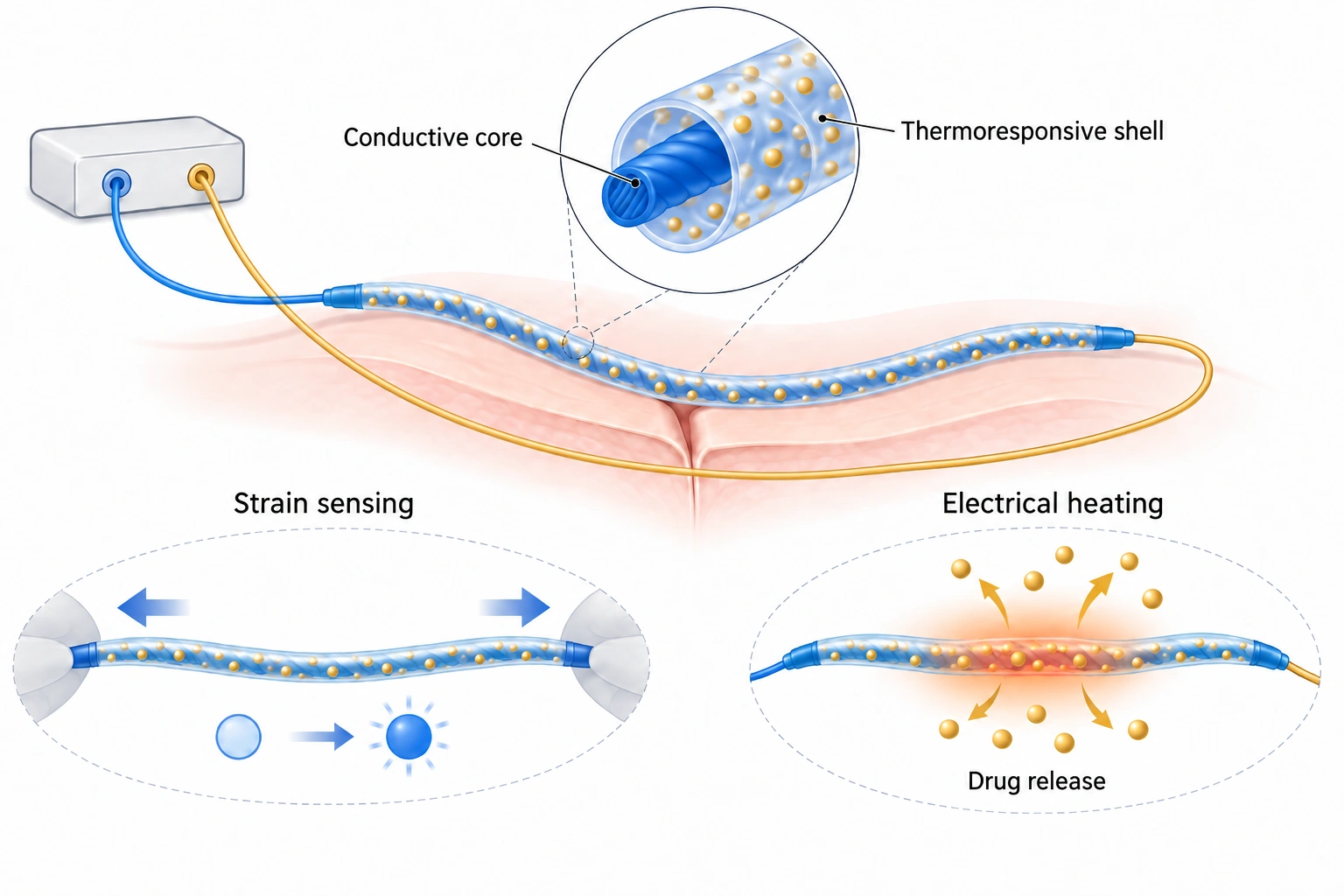
AI-generated, not-to-scale concept of strain sensing in a conductive core and drug release from a heat-responsive outer layer through externally powered Joule heating. It omits the PDMS protective/insulating layer between the actual AgNP/PU core and PVA–PNIPAm shell.
Generated for this library to illustrate the design; it is not a figure from the paper and does not show measured data.
How it was evaluated
The strain sensor was characterized by its gauge factor (GF), hysteresis up to 50% strain and 3000 cycles at 10% strain. Heating was measured with an infrared camera at a fixed 130 mV under strain and at 30% strain with varying voltage, and compared with an analytical model and finite element simulation. PVA:PNIPAm ratios of 5:1, 10:1 and 20:1 were compared for swelling and for release of rhodamine B (model drug) at room temperature and 42 °C, with 45 °C noted as the skin-burn threshold; release was also imaged in an agarose skin phantom. Biocompatibility was tested with NIH-3T3 fibroblasts next to bare Ag fiber, PDMS-coated Ag fiber, DRESS and a commercial suture for 72 h. Wound healing was assessed in a fibroblast scratch assay using media eluted from EGF-loaded DRESS with or without 130 mV heating (n = 3). Finally, DRESS was sutured into a 30 mm long, 5 mm deep wound in fresh porcine skin ex vivo.
Key results
The DRESS core measured about 300 µm and the coated suture about 600 µm in diameter, it could be produced one meter long, and its fracture strain remained above 450%. The GF increased from about 155 after two Ag formation cycles to about 686 after five cycles in the 40–50% strain range. Hysteresis was negligible up to 50% strain, and the response remained stable after 3000 cycles at 10% strain.
At a fixed 130 mV, the fiber temperature fell as strain increased, because higher resistance reduced Joule heating. The analytical prediction of the PVA–PNIPAm layer temperature agreed with finite element simulation and measurement, and the closed-loop voltage control kept the target temperature constant during repeated 10% stretch-release cycles.
The 10:1 PVA–PNIPAm shell showed the highest swelling and a 98.2 ± 19.5% increase in drug-release efficiency upon heating to 42 °C, whereas the 5:1 composition had a lower release efficiency, which the authors attribute to its low LCST, which increased release at room temperature, and poor swelling. In the skin phantom, the drug-diffused area around voltage-activated DRESS was twice that around non-activated DRESS, and release increased linearly with the number of threads. Most NIH-3T3 cells next to bare Ag fiber were dead; viability increased from 68% to 85% after the Ag fiber was coated with PDMS and PVA–PNIPAm, and DRESS showed viability similar to a commercial suture.
In the scratch assay, the results section reports that the wound gap had shrunk by up to 11% with heat-activated DRESS medium while 31% of the wound area remained with non-activated DRESS medium at 48 h; the abstract summarizes this as a 66% decrease in wound area. On porcine skin ex vivo, the sutured DRESS showed a stable resistive response during repeated stretching, its 40 °C target temperature dropped under strain at a fixed voltage, and closed-loop control maintained the target temperature during repeated strain cycles.
Open questions
The authors state that DRESS can load only hydrophilic drugs, so a thermoresponsive polymer able to carry both hydrophilic and hydrophobic drugs is needed, and that in vivo feasibility must be investigated before clinical application.
Related research
Wirelessly operated bioelectronic sutures for the monitoring of deep surgical wounds
DOI: 10.1038/s41551-021-00802-0 ↗
The related study uses multifilament sutures coated with a conductive polymer and capacitive sensors operated by radiofrequency identification to monitor wound integrity, gastric leakage and tissue micromotion in live pigs without a battery. DRESS reads strain through the resistance of its conductive core and adds heat-triggered drug release, and it was tested in cells and excised porcine skin.
Abstract-based introductionRESEARCH NEWS
Research in the news
Unverified candidates and access limits (1)
Unverified candidate · Nanoscale 2022 Lunar New Year Collection ↗
Sources used in this summary
This summary is based on the published PDF of the article (abstract, Sections 1-4, Figures 1-6 legends and author contributions); the electronic supplementary information and movies were not reviewed.