Overview
This review, written by the BLISS Lab (Jungmok Seo) at Yonsei University, surveys liquid-based electronic materials for bioelectronics, in which a liquid is infiltrated into a structuring material to give conformability, self-healing and stable interfaces. It covers ionic liquid hydrogels, nanomaterial-incorporated hydrogels and liquid metals as conductors, liquid-infused surfaces as encapsulation and liquid-based adhesives, and it closes each class with its current limitations, such as evaporation of ionic liquids and depletion of infused lubricants.
Background
The authors note that solid electronic materials are mechanically mismatched with tissue and are vulnerable to moisture and mechanical damage, which causes malfunction and shortens device lifetime. Wrinkled and serpentine designs add flexibility, but devices still degrade and fail under repeated deformation beyond a threshold, which motivates materials with conductivity, conformability and self-healing. Liquid-based materials are presented as candidates because liquid-like interfaces can form conformal contact with tissue and tolerate dynamic deformation.
How the review is organized
The review is organized by function within a device. Section 2 treats liquid-based conductors in three groups: ionic liquid-based materials, conductive hydrogels incorporating metal or carbon nanomaterials, and liquid metals and their composites. Section 3 covers liquid-infused surfaces used to encapsulate electronics against water, and Section 4 covers hydrogel-based adhesives that bond electronic components to each other or to tissue. Each subsection describes representative studies and ends with the drawbacks of the material class, and the conclusions discuss the path toward all-soft devices.
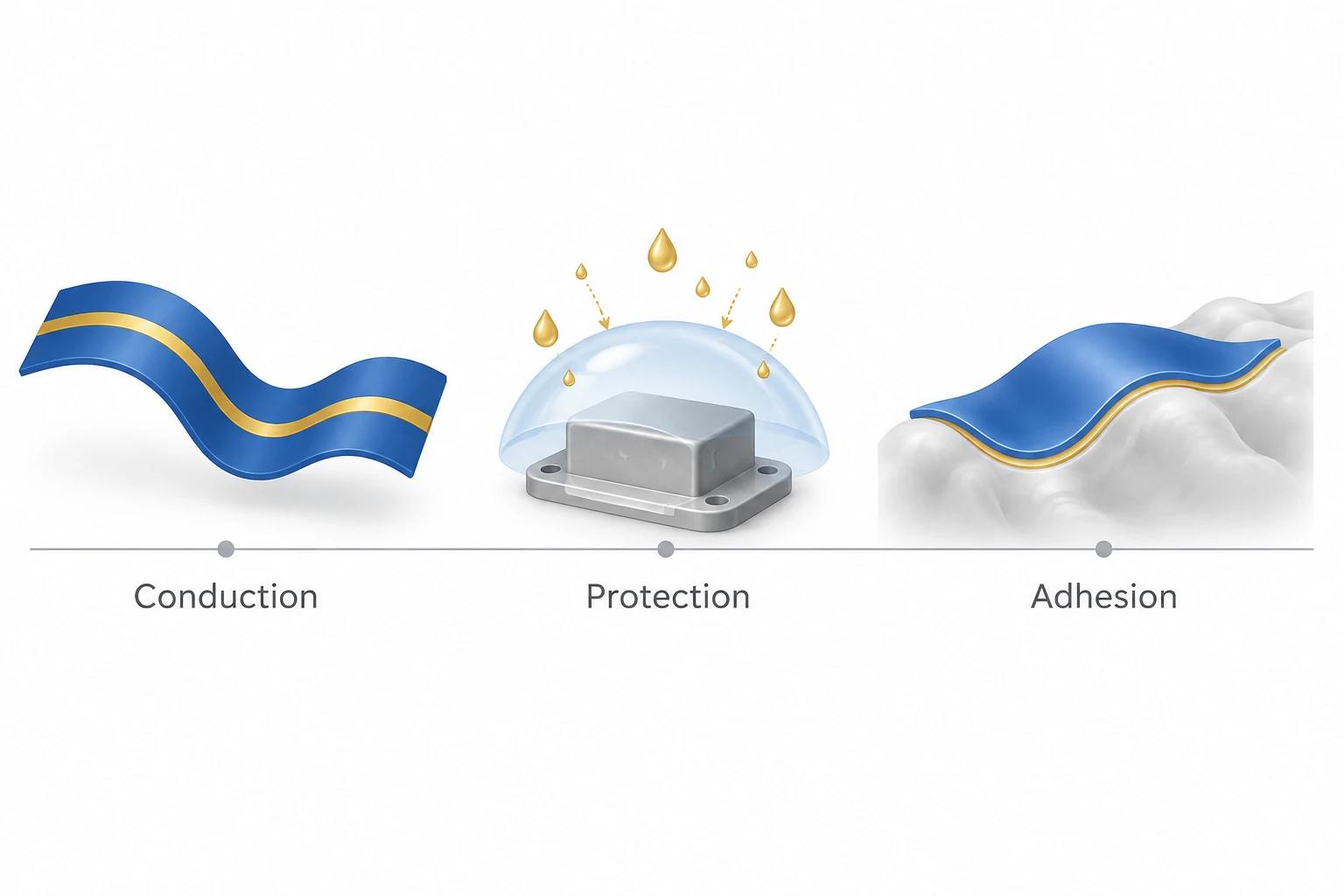
AI-generated concept: conduction, protection and adhesion are shown as separate roles in liquid-based bioelectronics. Shapes and colors represent functions rather than a single fabricated device or a specified material.
Generated for this library to illustrate the design; it is not a figure from the paper and does not show measured data.
Scope of the review
For conductors, the review compares cited studies by conductivity, stretchability, gauge factor, sensitivity, cycling durability and patterning resolution, across applications including strain and pressure sensors, grid-less touch sensing, triboelectric energy harvesting and implanted nerve stimulation and recording. For encapsulation, it compares mechanical sealing, polymer film coatings and lubricant-infused layers by water barrier behavior and lifetime. For adhesives, it discusses catechol-, chitosan- and gelatin-based hydrogels with respect to adhesion mechanism, reversibility and tissue sealing. Table 1 lists elongation, conductivity and durability for selected ionic hydrogels, conductive hydrogels and liquid metals.
Main points of the review
Among ionic conductors, the review cites a pyramidal ionic gel pressure sensor with a sensitivity of more than 2 kPa-1 up to 50 kPa, an ionic skin-based triboelectric nanogenerator stretched to 700% without performance loss, and an ionic polydimethylsiloxane (PDMS) touch sensor with 96.5% transparency, 539.1% stretchability and 99.0% resilience. It identifies durability, scalability, limited conductivity and evaporation of the ionic liquid as the main constraints.
For nanomaterial-incorporated hydrogels, cited examples include a silver nanofiber hydrogel strain sensor with a gauge factor of 165, compared with less than 10 for conventional ionic conductive hydrogels, and a polyacrylamide-alginate hydrogel with silver flakes reaching 374 S cm-1 with a Young's modulus below 10 kPa and stability up to 250% strain. The review states that conductivity still falls short of conventional electronic components.
For liquid metals, the review describes injection into channels and printing methods, with a meniscus-guided printing resolution of up to 50 μm and a photolithography-assisted pattern width of 1.3 μm. Composites address stability, for example an MXene-doped liquid metal interconnect reaching 2.2 × 10^6 S m-1 and a carbon nanotube-containing bi-layer liquid metal particle fiber with 2.24 × 10^6 S m-1 and negligible resistance change over 10 000 cycles of 150% strain, which was implanted on the sciatic nerve for stimulation and electromyography. Remaining issues are irreversible loss of conduction once an electrode separates and an oxide forms, line merging due to high surface tension, and the robustness of the oxide layer.
For encapsulation, the review contrasts mechanical sealing, which increases size and stiffness, and polymer films, whose voids and cracks let water permeate, with lubricant-infused layers that keep the polymer matrix free of defects; a cited oil-infused rough silicone maintained its water barrier for 226 days at body temperature, but depletion of the infused liquid can degrade performance. For adhesives, it describes catechol-, chitosan- and gelatin-based hydrogels, including a hemostatic powder that forms an adhesive hydrogel within four seconds on contact with blood, and notes that selective adhesion and mechanical stability need further work. The authors conclude that current soft devices still depend on solid-based electronics and that combining liquid-based conductors, encapsulation and adhesives could lead to all-soft devices.
Related research
3D printing of conducting polymers
DOI: 10.1038/s41467-020-15316-7 ↗
Yuk and colleagues provide a concrete example of printing conductive structures together with insulation. The device helps explain the review's broader material categories.
Description drawing on the main textRESEARCH NEWS
Research in the news
Unverified candidates and access limits (1)
Sources used in this summary
This summary is based on the full text, figure legends and Table 1 of the open-access review; the primary studies it cites were not reviewed, and the values reported here are those stated in the review text.