Research context and placement
Conductor sections motivate the primary liquid-routing placement, but this review also covers adhesion, encapsulation and antifouling. Its breadth requires multiple themes and an ambiguity flag.
Boundary case: assigned to the closest interface for navigation. Read the rationale and cross-links together; the primary theme does not delimit the study. Placement of foundational work does not establish direct bioelectronic application.
Research background
Bioelectronics needs more than deformable conductors. This review connects conduction, encapsulation and adhesion. A compliant conductor still needs protection from water and reliable contact with tissue. The useful unit of analysis is therefore a device assembled from layers with different functions, rather than an isolated material with high conductivity.
Approach and advances
Encapsulation trades moisture protection against compliance. The review contrasts bulky, stiff mechanical seals with voids and cracks in polymer films, then discusses lubricant-infused interfaces as a compliant, defect-mitigating approach. In this design discussion, the liquid manages the interface through which water could enter; it is not simply an additive that softens a conductor. This is a reviewed design strategy, not proof that every liquid-containing material forms an equally effective barrier.
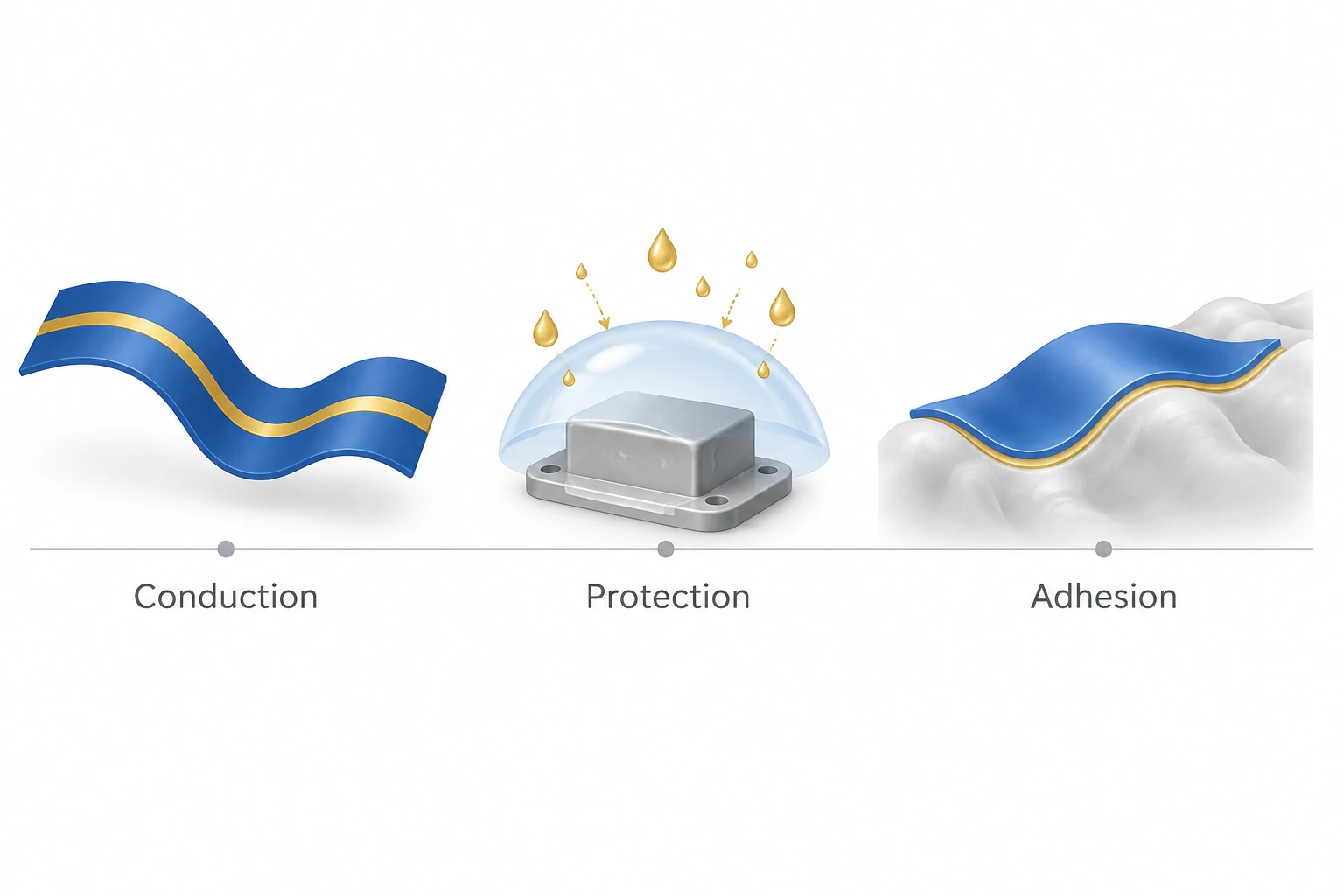
AI-generated concept showing conduction, protection and adhesion as separate roles in a liquid-based bioelectronics review. Shapes and colors denote functions, not one fabricated device, specified materials, complete waterproofing or measured performance.
Approved as a nonquantitative map of review functions; actual layer/housing designs and liquid-barrier performance are excluded.
This is not a reproduced paper figure and does not establish permission to reuse the original figure.
Generated in ChatGPT on the web from concepts in a public paper and checked for conceptual consistency within the selected main-text reading and stated independent-review scope. This does not claim a complete main-text or supplement audit. Display processing is limited to WebP encoding, without cropping or content editing.
Evaluation and conditions
Tissue-like modulus alone is insufficient for adhesion. High water content and low modulus can hinder integrity, motivating designs that combine crosslinking with interfacial bonding sites. Matching tissue mechanics and establishing interfacial bonds answer different questions. Keeping them separate prevents a stretchable conductor, a moisture barrier and a wet adhesive from being treated as interchangeable solutions.
Key findings
Solid components remain necessary for stability/function. Fully soft systems remain an outlook. The synthesis is not simply a proposal to eliminate solid components. It identifies the integration problem of connecting necessary components through compliant materials while managing mechanical mismatch and water exposure.
Limits and open questions
This design review cannot rank materials or lifetimes without checking the cited studies. A maximum conductivity or strain value in the table may come from a different specimen and loading history. This account therefore explains which layer and failure problem a strategy addresses; it does not turn the review table into a cross-material leaderboard.
Related external research
3D printing of conducting polymers
DOI: 10.1038/s41467-020-15316-7 ↗
Yuk offers a concrete case of printing conducting structures with insulation, grounding the review’s broad material categories in a device architecture.
A PEDOT:PSS device does not validate liquid metals, ionic liquids or encapsulation materials as a class.
Full text checkedCorresponding-author verification
Jungmok Seo: corresponding authorThis record concerns Jungmok Seo’s correspondence designation. Author order or an asterisk alone is not treated as confirmation; this check is separate from verification of the research content.
- Correspondence evidence source ↗
Jungmok Seo; Corresponding authors
author list and Author affiliations; starred author linked to corresponding-author legend · publisher_author_correspondence_read
- Correspondence evidence source ↗
E-mail: [redacted]
BLS20_IndChemMater_2024_Liquid_Bioelectronics_Review_MAIN.pdf; PDF page 2 · local_public_pdf_read
- Main-text review scope
- Local published PDF pp. 2–14: conductor, encapsulation and adhesive sections; Table 1; Conclusions; title/DOI matched. Additional targeted main-text reading in this pass: Local PDF §3 Liquid-infused surfaces for encapsulation, opening comparison of seals/films; §4 adhesive discussion, high-water-content/low-modulus hydrogel limitations; §5 Conclusions This additional reading refers to main text, not supplementary information.
- Supplementary review scope
- Supplementary information was not read. No supplementary material is listed as reviewed, and a complete SI audit is not claimed.
- Pending verification
- SI was not read. Numerical rankings and material lifetimes require verification of the cited primary studies; this account remains within the review’s design scope.
COVERAGE & OUTREACH
Coverage and outreach
Links are checked for their relationship to this paper. Media publication does not establish independent reporting or additional experimental validation.
Recent progress and material characteristics of liquid-based electronic materials (IMAGE) ↗
The journal-supplied media page explicitly states DOI 10.1039/D3IM00122A and credits Jungmok Seo.
Body read Read the public caption, provider, linked release title and DOI. No image was copied; reading this companion page does not establish access to the blocked release body.
Unverified candidates and access limits (1)
Unverified candidate · Emerging electronic materials for next generation soft bioelectronic applications: From material designs to devices performances ↗
The index gives the exact paper title and DOI 10.1039/D3IM00122A, also present on the linked media page; the release itself could not be directly opened.
Body access limited Only indexed excerpts and the displayed 10-Oct-2024 date were available. Both web opening and an ordinary public HTTP request returned 403; direct body verification remains pending.
Sources and verification scope
Local published PDF pp. 2–14: conductor, encapsulation and adhesive sections; Table 1; Conclusions; title/DOI matched. Additional targeted main-text reading in this pass: Local PDF §3 Liquid-infused surfaces for encapsulation, opening comparison of seals/films; §4 adhesive discussion, high-water-content/low-modulus hydrogel limitations; §5 Conclusions This additional reading refers to main text, not supplementary information.
The additional commentary is editorially approved within the stated evidence scope. This does not imply complete verification of all main-text and supplementary material.
- Additional main-text review scope
- Local published PDF pp. 2–14: conductor, encapsulation and adhesive sections; Table 1; Conclusions; title/DOI matched. Additional targeted main-text reading in this pass: Local PDF §3 Liquid-infused surfaces for encapsulation, opening comparison of seals/films; §4 adhesive discussion, high-water-content/low-modulus hydrogel limitations; §5 Conclusions This additional reading refers to main text, not supplementary information.
- Additional supplementary review scope
- Supplementary information was not read. No supplementary material is listed as reviewed, and a complete SI audit is not claimed.
- Public publication baseline ↗ · #74 · 2026-10-03
- Crossref metadata ↗: Only public bibliographic metadata registered with Crossref was checked. This does not mean that the publisher page, abstract, or full text was read; full-text verification in the school Chrome session remains pending. license_urls lists registered links and does not establish permission to redistribute text or figures. It may include TDM or posting-policy links.
- [Invited Review] Liquid-based electronic materials for bioelectronics: current trends and challenges ↗
local_pdf_read · BLS20_IndChemMater_2024_Liquid_Bioelectronics_Review_MAIN.pdf; PDF pp. 2–14; conductor, encapsulation, adhesive sections; Table 1; Conclusions; title and DOI matched; PDF not redistributed - Liquid-based electronic materials for bioelectronics: current trends and challenges ↗
local_pdf_read · PDF pp. 2–14; conductor, encapsulation, adhesive sections; Table 1; Conclusions; title and DOI matched; PDF not redistributed - Liquid-based electronic materials for bioelectronics: current trends and challenges ↗
local_pdf_read · Local PDF §3 Liquid-infused surfaces for encapsulation, opening comparison of seals/films; §4 adhesive discussion, high-water-content/low-modulus hydrogel limitations; §5 Conclusions - Liquid-based electronic materials for bioelectronics: current trends and challenges ↗
independent_reviewer_selected_main_text · Local published PDF: encapsulation opening; adhesive constraints; §5 Conclusions. - Additional commentary source ↗
Research background · BLS20_IndChemMater_2024_Liquid_Bioelectronics_Review_MAIN.pdf; PDF pp. 2–14; conductor, encapsulation, adhesive sections; Table 1; Conclusions; title and DOI matched; PDF not redistributed · local_pdf_read - Additional commentary source ↗
Key findings · BLS20_IndChemMater_2024_Liquid_Bioelectronics_Review_MAIN.pdf; PDF pp. 2–14; conductor, encapsulation, adhesive sections; Table 1; Conclusions; title and DOI matched; PDF not redistributed · local_pdf_read - Additional commentary source ↗
Limits and open questions · BLS20_IndChemMater_2024_Liquid_Bioelectronics_Review_MAIN.pdf; PDF pp. 2–14; conductor, encapsulation, adhesive sections; Table 1; Conclusions; title and DOI matched; PDF not redistributed · local_pdf_read - Additional commentary source ↗
Connections to related work · DOI 10.1038/s41467-020-15316-7; Results: multi-material printing of PEDOT:PSS and insulating PDMS; electrical performance and Fig. 3b–c bending; device demonstration and Fig. 4. Selected main-text paragraphs rechecked; SI not audited. · public_repository_selected_full_text - Additional commentary source ↗
Approach and advances · Local PDF §3 Liquid-infused surfaces for encapsulation, opening comparison of seals/films; §4 adhesive discussion, high-water-content/low-modulus hydrogel limitations; §5 Conclusions · local_pdf_read - Additional commentary source ↗
Evaluation and conditions · Local PDF §3 Liquid-infused surfaces for encapsulation, opening comparison of seals/films; §4 adhesive discussion, high-water-content/low-modulus hydrogel limitations; §5 Conclusions · local_pdf_read